
Table of Contents
- Why Benefits of Australian Made Panels Matter for Your Home
- Durability and Build Quality: Engineering Built for Australian Conditions
- Australian Solar Panel Manufacturers: Local Innovation and Expertise
- Australian Solar Panel Warranty and Performance Guarantees
- Australian Solar Panel Efficiency: Superior Performance Standards
- Cost of Australian Made Solar Panels vs. Imported Alternatives
- Supply Chain Transparency and Local Support Accessibility
- Economic Growth and Supporting Australian Jobs
Last Updated: July 18, 2026
Why Benefits of Australian Made Panels Matter for Your Home
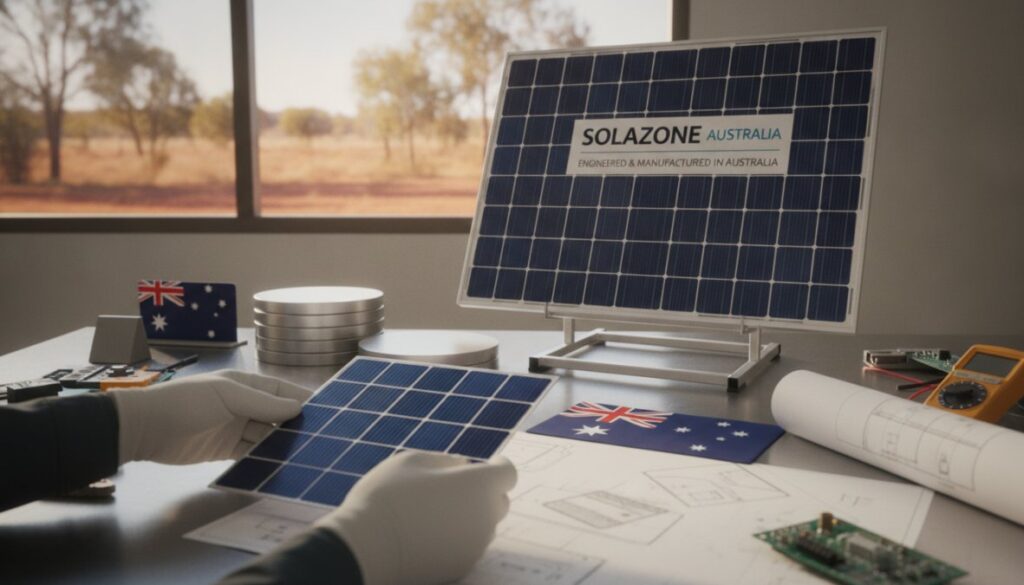
Understanding the benefits of Australian made panels has become increasingly important for homeowners considering solar investments. Australian made panels aren’t simply rebranded imports, they’re engineered specifically for local climate conditions, tested under Australian environmental standards, and backed by service networks designed around Australian geography.
A solar panel installed in Melbourne faces different challenges than one installed in Darwin. Temperature fluctuations, humidity patterns, salt spray exposure, and UV intensity vary dramatically across Australia. Panels designed and tested for these specific conditions perform differently than generic systems optimized for international markets.
Australian made panels are engineered for local climate conditions and backed by accessible local support networks, factors that matter significantly more than many buyers realize.
Durability and Build Quality: Engineering Built for Australian Conditions
Durability represents the foundation of panel performance, and this is where Australian manufacturing shows its strongest differentiation. Panels manufactured locally undergo testing protocols that simulate Australian weather patterns, extreme heat, rapid temperature swings, salt-laden coastal air, and intense UV exposure.
Rigid Frame Construction and Micro-Crack Resistance
Australian made panels typically feature rigid aluminium frames designed to handle the thermal stresses unique to the Australian climate. When temperatures swing from 5°C to 45°C within hours, the panel’s frame must expand and contract without developing micro-cracks that compromise electrical performance.
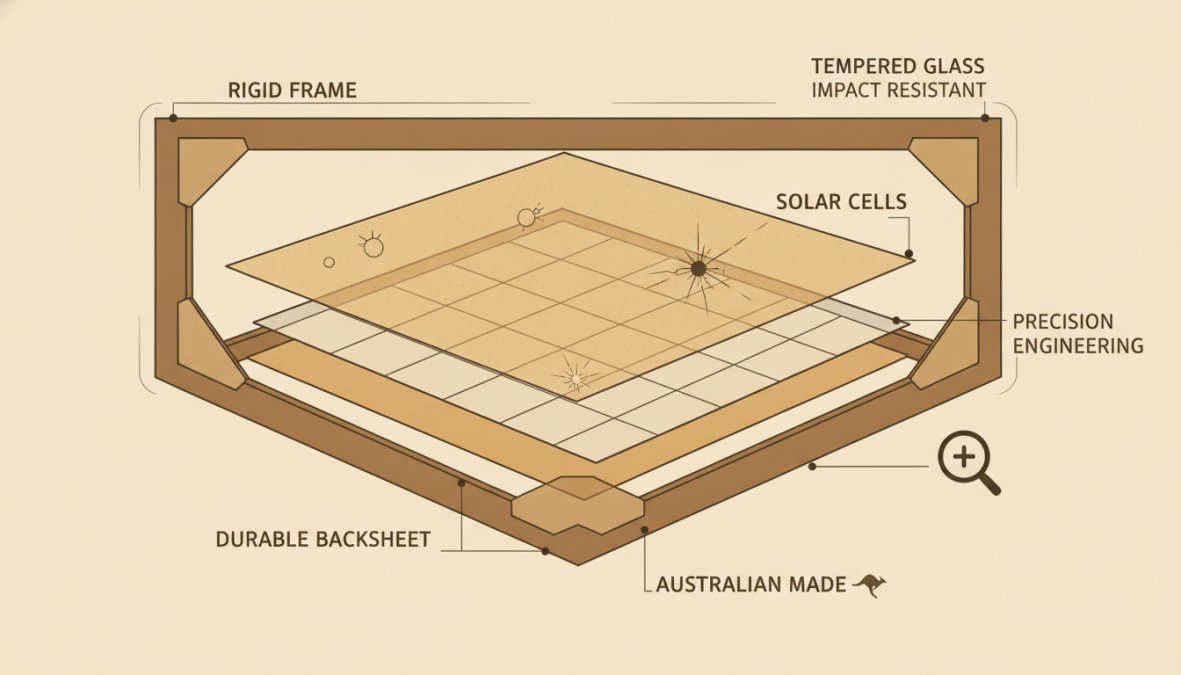
Micro-cracks represent one of the most insidious failure modes in solar panels. They’re invisible to the naked eye but create electrical pathways that reduce power output and accelerate degradation. Panels manufactured to Australian standards undergo accelerated thermal cycling tests that intentionally push frames to failure points, ensuring production units remain well below those thresholds.
The rigid frame also matters for coastal installations. Salt spray corrodes softer metals rapidly. Australian manufacturers use anodized aluminium and stainless steel fasteners specifically chosen to resist corrosion in high-salt environments.
Precision Engineering and Quality Assurance
Manufacturing precision directly impacts long-term reliability. Australian solar manufacturers operate under strict quality assurance protocols that include cell-level testing, module-level electrical verification, and thermal imaging to detect manufacturing defects before panels leave the factory.
Locally-manufactured panels typically show lower defect rates than imported alternatives, particularly in categories like delamination and solder joint failures. This closed-loop quality system, where field teams identify emerging durability issues and feedback loops back into production specifications, doesn’t exist with imported panels.
Ask manufacturers about their quality assurance protocols specifically. Australian made panels should have documented thermal cycling tests, salt spray exposure tests, and electrical performance verification at the module level.
Australian Solar Panel Manufacturers: Local Innovation and Expertise
Australia’s solar manufacturing sector produces panels through companies that understand the local market intimately. Tindo Solar represents one of Australia’s most recognized manufacturers, producing panels with specific design features for domestic installation. Their engineering teams conduct testing in Australian test facilities, enabling rapid iteration based on local performance data.
Australian manufacturers invest in technologies specifically relevant to local needs: enhanced salt-spray resistance coatings, frame designs optimized for rapid thermal cycling, and electrical specifications that work seamlessly with Australian grid standards and solar rebate programs. Supporting Australian solar panel manufacturers creates economic activity that extends beyond the manufacturing facility itself.
Australian Solar Panel Warranty and Performance Guarantees
25-Year Warranties and Long-Term Reliability
Many Australian manufactured panels come with 25-year warranties covering both product defects and performance degradation, guaranteeing that panels will retain at least 80% of their rated output after 25 years. A 25-year warranty is only credible if the manufacturer expects to remain in business for that period and has financial reserves to honor claims.
Australian manufacturers can typically arrange local repair or replacement without customers navigating international logistics. If a panel fails in year 15, pursuing a claim against an overseas manufacturer involves shipping costs, currency conversion, and potential language barriers.
Power Output Degradation and Performance Standards
Power output degradation follows a predictable pattern in quality panels. First-year degradation typically ranges from 2-3%. Subsequent annual degradation should remain under 0.7% per year. After 25 years, a quality panel retains approximately 82-85% of its original output.
Australian made panels typically perform at the upper end of this range because manufacturing processes account for the specific stressors Australian panels encounter. Performance guarantees should specify degradation rates explicitly.
Be cautious of warranties that don’t specify degradation rates or that reference “industry standards” without explicit numbers. Vague warranty language often masks higher actual degradation rates.
Australian Solar Panel Efficiency: Superior Performance Standards
Efficiency measures how effectively a panel converts sunlight into electricity. Modern solar panels typically range from 18-22% efficiency. The difference between 18% and 22% efficiency matters significantly over 25 years, with a 22% efficient panel generating approximately 22% more electricity than an 18% efficient panel of the same size.
Australian manufactured panels often achieve efficiency levels at or above market averages, particularly in monocrystalline technology. This efficiency advantage reflects manufacturing precision and design choices made specifically for Australian conditions.
Temperature coefficient measures how much a panel’s output decreases as temperature increases. A panel with a -0.4% per degree Celsius coefficient loses 0.4% of its output for every degree the panel heats above standard test temperature. On a hot Australian day, panels regularly reach 60-70°C, making temperature coefficient significantly impact real-world performance.
Australian manufactured panels typically feature lower (better) temperature coefficients than imported alternatives because manufacturers optimize for the high-temperature conditions panels actually experience in Australia.
Cost of Australian Made Solar Panels vs. Imported Alternatives
Understanding the Price Premium
Australian made panels typically cost 15-25% more than equivalent imported panels. This premium reflects local manufacturing labor costs, smaller production volumes, domestic quality assurance testing, and warranty obligations backed by local operations.
The relevant comparison isn’t simply "Australian made panel price vs. imported panel price." The relevant comparison is "total cost of ownership over 25 years including energy generation, degradation rates, warranty service accessibility, and replacement costs if failure occurs."
Long-Term Value and Return on Investment
Many households find that the 15-25% price premium for Australian made panels is recovered through superior performance within 5-7 years of operation. Over a 25-year panel lifespan, this compounds into significant value.
The calculation becomes more favorable when considering warranty service accessibility. If an imported panel fails in year 12, the cost of pursuing an international warranty claim might exceed simply replacing the panel with a new one. An Australian made panel with local warranty support avoids these complications entirely.
Australian made panels deliver the strongest ROI for homeowners planning to remain in their property for 12+ years and those in harsh climates (coastal areas, extreme heat zones, high-UV regions) where durability advantages compound most significantly.
Supply Chain Transparency and Local Support Accessibility
Supply chain transparency reveals how materials flow from raw materials to finished products. Australian manufacturers maintain visibility over their entire supply chain, from silicon wafer production through final assembly.
Imported panels often pass through multiple intermediaries, potentially obscuring the manufacturing origin and quality history. When you purchase a panel from an Australian manufacturer, you’re buying directly from the source rather than through a distribution chain.
Maintenance and Local Service Networks
Solar panels require minimal maintenance, but when issues arise, accessibility matters enormously. An Australian made panel backed by a local manufacturer means service calls can be arranged quickly, replacement panels can be sourced without international shipping delays, and technicians familiar with the specific product are available locally.
This accessibility advantage becomes particularly valuable if your system experiences failure during extreme weather events. If a hailstorm damages panels, local manufacturers can typically arrange rapid replacement.
Climate Testing and Real-World Performance Data
Australian manufacturers accumulate real-world performance data from thousands of installed systems across diverse Australian climates. This data informs design improvements and helps manufacturers understand how panels actually perform in Tasmanian winters, tropical humidity, desert heat, and coastal salt spray.
This continuous improvement process, driven by real-world Australian data, is unavailable to manufacturers serving global markets without Australian-specific focus.
Economic Growth and Supporting Australian Jobs
Supporting Australian manufactured panels contributes directly to local economic activity. Manufacturing facilities employ engineers, technicians, and production staff. Installation networks require training, certification, and ongoing employment.
The renewable energy sector represents one of Australia’s fastest-growing employment categories. Supporting local manufacturing strengthens this sector’s foundation and ensures that Australia maintains expertise and capacity in solar technology rather than becoming entirely dependent on imported solutions.
A renewable energy infrastructure built on locally-manufactured components is more resilient than one dependent on international supply chains. Supply disruptions, geopolitical tensions, or manufacturing capacity constraints in other countries don’t affect Australian solar deployment when panels are manufactured domestically.
Choosing between Australian made and imported solar panels ultimately depends on your specific situation, timeline, and climate zone. However, the evidence increasingly favors Australian manufactured panels for homeowners prioritizing durability, local support accessibility, and long-term value.
Solazone Australia specializes in connecting customers with high-quality Australian made systems engineered for local conditions. With over 40 years of technical expertise and thousands of satisfied customers nationwide, our team can evaluate your specific roof, climate zone, and energy needs to recommend systems optimized for your situation. Contact Solazone Australia today to discuss how Australian made panels can reduce your energy costs while supporting local manufacturing and innovation.
| Factor | Australian Made Panels | Imported Panels |
|---|---|---|
| Climate Optimization | Engineered for Australian conditions | Generic international design |
| Warranty Support | Local, accessible service networks | International claims process |
| Performance Data | 25+ years of Australian real-world data | Limited Australian-specific history |
| Quality Assurance | Direct manufacturer oversight | Multiple intermediaries |
| Efficiency | 20-22% typical range | 18-21% typical range |
| Temperature Coefficient | -0.35% to -0.40% per °C | -0.40% to -0.45% per °C |
| 25-Year Degradation | 15-18% total | 18-22% total |
| Price Premium | Baseline | 15-25% lower initial cost |
| Long-Term ROI | 12+ year payback period | Longer payback period |
| Local Economic Impact | Supports Australian jobs and innovation | Overseas benefit |
Frequently Asked Questions
Are Australian made solar panels actually better quality than imported alternatives?
Australian made panels undergo rigorous quality assurance and precision engineering tailored to local climate conditions. They feature rigid frame construction designed to resist micro-cracks and are tested extensively for Australian weather extremes. While imported panels can be reliable, Australian manufacturers focus on long-term durability in specific climate zones, with 25-year warranties backing performance guarantees. The key difference lies in local expertise and accountability, you can access direct support and warranty service locally, ensuring faster resolution if issues arise.
What warranty coverage do Australian solar panel manufacturers typically offer?
Most Australian solar panel manufacturers offer 25-year performance warranties guaranteeing minimal power output degradation, typically limiting losses to 0.8% annually. These warranties cover manufacturing defects, material failures, and workmanship. Australian-made panels often include extended coverage for frame integrity and glass durability. Unlike imported panels, warranty claims can be processed locally without international shipping delays. Always verify specific warranty terms with your installer, as coverage varies by manufacturer and may include options for accelerated replacement or repair.
How do Australian solar panel efficiency ratings compare to imported panels?
Australian solar panel efficiency has reached competitive levels with leading international standards, with modern Australian-made panels achieving 18-22% efficiency ratings. What sets them apart is consistency in performance across Australia's diverse climates, from tropical heat to temperate zones. Australian manufacturers invest in climate-specific testing, ensuring panels maintain efficiency in high-temperature environments where imported panels sometimes underperform. Efficiency alone doesn't tell the full story; Australian panels are engineered for long-term reliability and minimal degradation in local conditions.
Why does Australian made solar cost more, and is the extra investment worth it?
Australian made panels typically cost more due to higher labor standards, rigorous quality control, local manufacturing overhead, and extended warranty commitments. The premium reflects precision engineering and durability testing specific to Australian climates. Over a 25-year lifespan, the investment often proves worthwhile through lower maintenance costs, faster local support access, and superior long-term performance in harsh conditions. Combined with Australian solar rebates and STCs (Small-scale Technology Certificates), the payback period can be competitive. Request a personalized quote to compare long-term value for your specific situation.
What maintenance and local support can I expect with Australian made solar panels?
Australian manufacturers typically maintain local service networks with trained technicians familiar with regional climate challenges and panel-specific requirements. Maintenance needs are minimal, mainly periodic cleaning and electrical inspections. Local support means faster response times for warranty claims, easier access to replacement parts, and technicians who understand how your system performs in your specific climate zone. Supply chain transparency ensures spare parts availability without international delays. This accessibility advantage is significant for remote areas or regions experiencing frequent power disruptions, where quick local support is critical.
This article was written using GrandRanker