
AP Systems microinverters
Why Microinverters?
- Panel-Level Optimization: Microinverters are installed on each individual solar panel, allowing each panel to operate independently. This ensures that shading or underperformance of one panel does not affect the entire system’s output.
- Enhanced Performance: Microinverters can maximize energy production by optimizing each panel’s output, especially in installations with shading issues, varying roof orientations, or complex layouts.
- Reliability: The decentralized nature of microinverters means there is no single point of failure affecting the entire system. If one microinverter malfunctions, the others continue to operate normally.
- Monitoring: Microinverters typically offer advanced monitoring capabilities at the panel level, providing detailed insights into each panel’s performance and the overall system’s efficiency.
- Cost Considerations: Microinverters are generally more expensive per panel compared to string inverters. However, the total system cost may vary based on the number of panels and specific installation requirements.
- Installation Flexibility: They offer more flexibility in system design and installation, accommodating challenging roof layouts, and maximizing energy production in diverse conditions.
Choosing Between String Inverters and Microinverters:
- System Size and Layout: Microinverters are advantageous for systems with shading issues or panels facing different directions. String inverters may be more cost-effective for straightforward installations with uniform sunlight exposure.
- Budget: Consider upfront costs and long-term savings. While microinverters may have higher initial costs, they can potentially yield higher energy production and savings over time, especially in challenging environments.
- Monitoring Needs: If detailed monitoring and performance optimization at the panel level are priorities, microinverters offer superior capabilities.
- Reliability: Microinverters provide enhanced reliability due to their decentralized design, minimizing the impact of individual panel issues on the overall system’s performance.
In conclusion, the choice between string inverters and microinverters depends on factors such as system complexity, shading conditions, budget, and monitoring requirements.
To make sense, view the benefits:
- When installing solar panels on multiple roofs facing in different directions.
- When shading occurs on parts of the roof at different times of the day.
- If you want a solution to maximise your solar output on every solar panel.
- If you wish to track and record the performance of every individual solar panel.
- To enable you to view your solar performanc at any particular time on your computer or phone, anywhere in the world.
- Eliminate dangerous high voltage DC wiring anywhere on your roof, or in your ceiling, that may cause a fire.

See the latest technology microinverter from AP systems, designed to connect to two solar modules. By installing one inverter per 2 modules the number of devices and connections required per installation are halved and the overall cost of the system is reduced. AP Systems microinverters are compatible with most 60 and 72 cell solar modules. Up to 9 microinverters (18 solar modules) can be installed on a single circuit.
Microinverters provide individual module maximum power point tracking and are easy and quick to install.
Featuring a standard 10-year and optional 25-year manufacturer’s warranty.
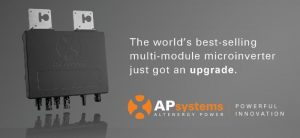
New AP Systems YC600 micro inverter
Product Description
Our flagship microinverter, the bestselling microinverter handles two PV modules simultaneously with dual MPPT.
- Maximum Power Output: 600W (from two solar modules)
- Individual MPPT for each panel
- Peak Efficiency: 95.5%
- Dimensions: 8.6″ (220mm) x 5.4″ (160mm) x 1.37″ (29mm)
- Weight: 5.5 lbs. (2.5kg)
- Up to 14 solar modules (7 x YC600s) in a string with a 20A breaker
- 10 and 25-year warranties available
- Designed to operate in challenging real-world conditions from -40 F to 149 F.
AP systems Energy Control Units (ECU)
The AP systems ECU Energy Control Unit is the internet gateway device that communicates with each AP systems microinverter and downloads system data to the internet. The installation of an ECU is not essential for an AP systems installation, however, you do need to install one if you want access to real-time and historical system data via the internet. The standard ECU provides access to aggregated system-level data. Access to module level data is available at additional cost.
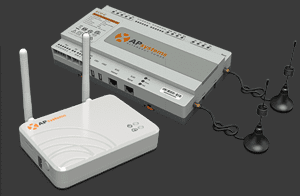
AP systems-Product-Datasheet-ECU-C
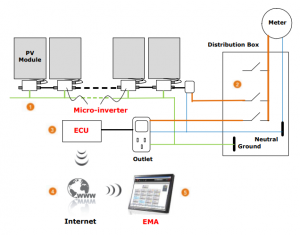
APsystems-Microinverter-YC600 User-manual
AP systems Battery Backup
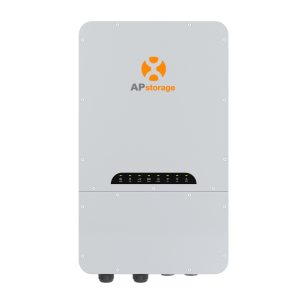
Apstorage ELS-5K 5000Va 48V hybrid inverter.
Enquire now for a fast quote to suit your property :