
Table of Contents
- Understanding How Shading Affects Solar Panel Performance
- Step 1: Assess Your Shading with Sun Path Analysis
- Step 2: Manage Trees and Physical Obstructions, Tree Trimming for Solar Panels Australia
- Step 3: Optimise Panel Orientation and Roof Tilt
- Step 4: Choose the Right Hardware, Microinverters vs String Inverters Shading
- Step 5: Reconfigure Your Solar Array Layout
- Solar Panel Shading Solutions Australia: Legal Framework and Solar Access Laws
- Shading Impact on Battery Storage Systems
Last Updated: July 27, 2026
Understanding How Shading Affects Solar Panel Performance
Roof shading is one of the most common barriers to solar system performance. When sunlight is blocked from even a portion of a solar panel, the entire string of panels connected to that module experiences a voltage drop. This isn’t a minor efficiency loss, it’s a cascading failure that can reduce system output by 25% or more. Solar panels are typically wired in series strings, meaning the weakest panel determines the output of the entire string.
Partial Shading and Voltage Drop Explained
Partial shading creates a voltage drop across the string. When one panel is shaded, it acts like a resistor in an electrical circuit, forcing the inverter to work harder to convert DC power to AC power. A 6kW solar system with one panel receiving 50% shading might deliver only 4.5kW of output instead of the expected 5.8kW, a system-wide reduction affecting your entire day’s energy yield.
The impact compounds over time. A tree growing larger, a neighboring building’s shadow creeping across your roof, or seasonal changes in the sun’s path can transform a well-performing system into an underperforming installation within years.
Partial shading losses are cumulative. A panel receiving 25% shading during morning hours and another receiving 25% shading during afternoon hours doesn’t just lose 50% combined, the system losses compound because [string inverter](/solar-power/inverters/latronics-pv-edge-inverters/)s cannot optimize each panel independently.
Why Bypass Diodes Matter in Shaded Arrays
Bypass diodes are small electrical components installed within solar panels that allow current to bypass a shaded cell when it would otherwise block the entire string’s output. Modern panels typically include bypass diodes (usually one for every 18-24 cells), which provide protection against shading losses by essentially short-circuiting the shaded portion of the panel and allowing current to flow around the problem area.
However, bypass diodes are a safety feature first and an efficiency feature second, they prevent heat damage to shaded cells rather than maximize energy output. Without bypass diodes, the shaded panel would cause the entire string to operate at the voltage of that single shaded cell, resulting in catastrophic efficiency loss.
Bypass diodes activate automatically when shading occurs, but they generate heat as a byproduct. In systems with chronic partial shading, this heat generation can degrade panel lifespan over time, making shading mitigation even more critical than the immediate efficiency loss suggests.
Step 1: Assess Your Shading with Sun Path Analysis
Before investing in hardware solutions or physical modifications, you need to understand exactly when and how shading affects your roof. Sun path analysis maps the sun’s position throughout the day and across all seasons, then overlays it against your roof’s orientation and obstructions. This reveals your actual shading pattern, the precise hours and seasons when shadows fall across your panels.
DIY vs Professional Assessment: What You Need to Know
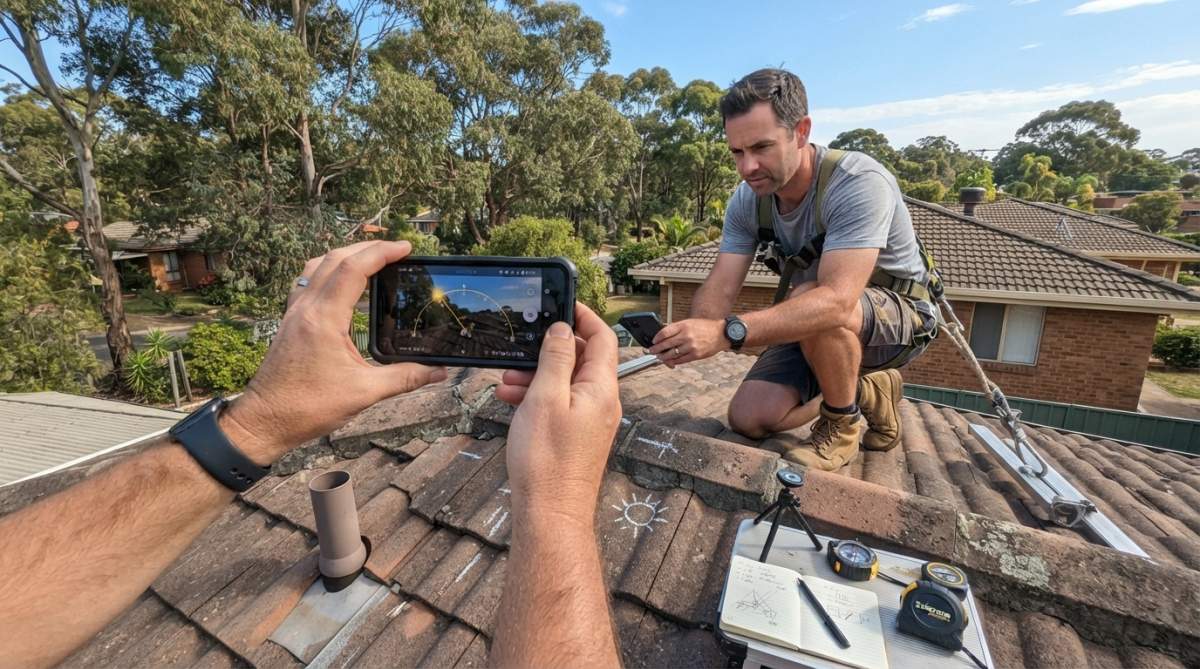
A DIY sun path assessment requires only a smartphone and basic tools. Apps like Sun Surveyor allow you to photograph your roof and see exactly when shadows appear. This costs nothing and takes about 30 minutes.
However, DIY assessments don’t account for future tree growth, neighboring buildings under construction, or seasonal variations that only become apparent over years. A professional solar assessment uses specialized equipment like fisheye cameras and shading analysis software to model your site with precision.
For most residential installations, a hybrid approach works best: start with a DIY assessment to identify obvious obstructions, then request a professional shading analysis from your installer before committing to a system design. The critical question is whether your shading occurs during peak solar hours (9 AM to 3 PM), or during shoulder hours when the sun is lower and shading is less damaging.
A professional shading assessment typically reveals that 40-60% of assumed shading problems occur during non-peak hours, meaning the actual performance impact is smaller than homeowners expect. This often changes the cost-benefit analysis of mitigation strategies.
Step 2: Manage Trees and Physical Obstructions
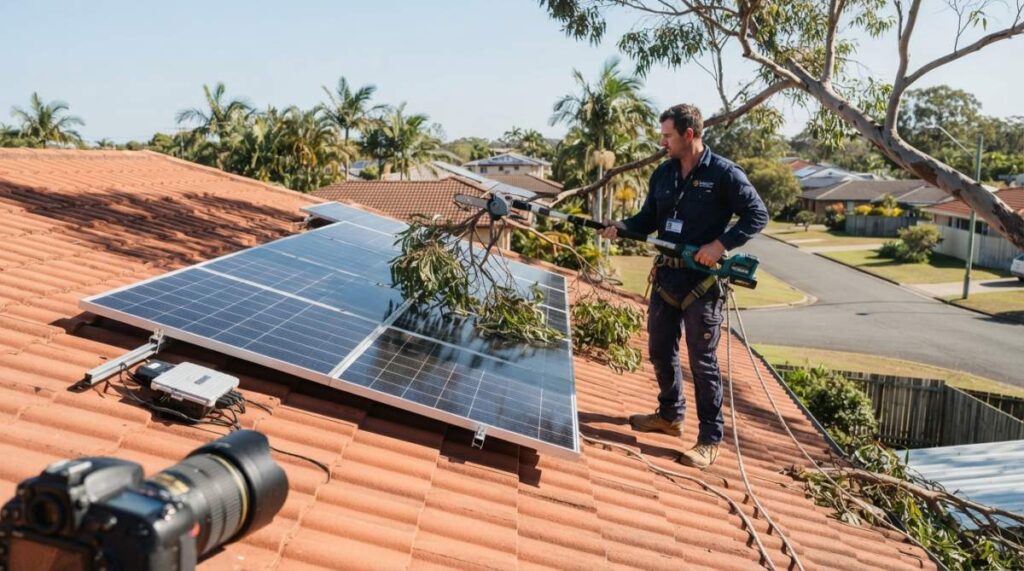
Tree trimming is the most cost-effective shading mitigation for many Australian properties. A single afternoon of professional tree work can eliminate years of efficiency losses. The goal isn’t to remove trees entirely, but to selectively prune branches that block the sun’s path during peak solar hours (typically 9 AM to 3 PM).
Start by identifying which branches create shadows on your panels during critical hours, then consult with a certified arborist about removal. Many trees can tolerate significant pruning without damage, eucalypts, acacias, and many native Australian species actually benefit from selective pruning.
Legal and HOA Constraints on Tree Removal in Australia
Tree removal and significant pruning are regulated differently across Australian states. In most jurisdictions, you can prune branches that overhang your property without permission, but removing a tree entirely often requires council approval, particularly if the tree is heritage-listed or protected.
Before pruning, check your local council’s tree protection orders and any covenants on your property title. For properties in strata schemes or with HOA-style restrictions, you may need written approval from the body corporate before pruning.
Contact your local council’s planning department and describe the tree and your intended work. In most cases, selective pruning for solar access is approved quickly because it doesn’t involve tree removal.
Removing a protected tree without permission can result in fines exceeding $10,000 in some Australian councils. Always verify your tree’s status before hiring an arborist.
Step 3: Optimise Panel Orientation and Roof Tilt
Your panel orientation and roof tilt determine how much sunlight your array captures throughout the day and across seasons. For most Australian locations, a north-facing orientation with a tilt angle equal to your latitude delivers maximum annual energy production.
If shading is unavoidable during certain hours, adjusting your panel layout can shift production away from shaded periods. East-facing panels produce more energy in the morning, while west-facing panels peak in the afternoon. By strategically placing panels on different roof faces, you can avoid shading patterns that would affect a single orientation.
Roof tilt also influences shading impact. A steeper tilt reduces the footprint of shadows during winter months when the sun is lower. The optimal tilt depends on your location and shading pattern. Reconfiguring your array layout requires careful design work, but it’s often the most elegant solution because it addresses shading through system design rather than hardware complexity.
Step 4: Choose the Right Hardware
The inverter you choose determines how effectively your system handles partial shading. A string inverter connects multiple panels in series, meaning shading on one panel affects the entire string’s voltage and output. String inverters are cheaper to install but vulnerable to shading losses.
Microinverters attach directly to each panel, allowing each to operate independently. Shading on one panel doesn’t affect others. A 6kW system with microinverters and one shaded panel loses output only from that single panel. Systems with chronic partial shading often see 15-25% higher output with microinverters compared to string inverters.
The trade-off is cost. Microinverters add $3,000-$5,000 to a typical residential installation, but for properties with unavoidable shading, this cost is often justified by the performance gains.
Power Optimizers as a Middle-Ground Solution
Power optimizers sit between string inverters and microinverters in terms of complexity and cost. Each optimizer attaches to a panel and communicates with a central string inverter, allowing individual panel optimization while maintaining the simplicity of a single conversion point.
Power optimizers cost $1,500-$3,000 for a 6kW system and provide most of the shading benefits. They’re an excellent choice for systems with moderate shading where full microinverter conversion isn’t justified.
Light shading (less than 10% of panels affected) may not justify extra hardware costs. Moderate shading (25-50% of panels affected) often makes power optimizers the best choice. Severe shading (more than 50% of panels shaded during peak hours) usually justifies microinverters despite their higher cost.
A system losing $200 per year to shading justifies a $1,500 power optimizer upgrade because it recovers its cost in 7-8 years, then delivers pure savings. The same system with only $100 annual shading loss wouldn’t justify the upgrade, tree trimming would be better.
Step 5: Reconfigure Your Solar Array Layout
Your array layout directly influences shading impact. A poorly designed layout places all panels where they’re vulnerable to the same shadows. A well-designed layout distributes panels across multiple roof faces so that shading on one section doesn’t compromise the entire system.
By placing panels on north, east, and west-facing roof sections, you ensure that shadows affecting one orientation don’t cascade across your entire array. Array reconfiguration also considers roof structural capacity, electrical wiring efficiency, and aesthetic preferences.
For properties with complex roof layouts or multiple shading obstacles, array reconfiguration combined with microinverters or power optimizers delivers the best overall performance. This approach is more expensive upfront but often recovers its cost through superior energy production over the system’s 25+ year lifespan.
Solar Panel Shading Solutions Australia: Legal Framework and Solar Access Laws
Australia’s approach to solar access rights has evolved significantly. Several states now recognize solar access as a property right, meaning neighbors cannot deliberately obstruct your panels.
The Solar Access Rights Act varies by state. In New South Wales, the Solar Shade Control Act (2010) limits the shade that buildings can cast on neighboring solar systems. Similar protections exist in Victoria and Queensland. These laws typically allow you to require a neighbor to trim trees or modify structures that shade your panels, though the specific process varies by jurisdiction.
However, these laws don’t protect you from natural growth of existing trees, only from new construction or deliberate obstruction. A tree that existed before your solar installation is generally not subject to legal action, even if it grows to shade your panels. Understanding your state’s solar access laws helps you plan mitigation strategies with confidence.
Shading Impact on Battery Storage Systems
Battery storage systems amplify the cost of lost energy. When shading reduces your panel output, your batteries charge more slowly. During peak demand hours (typically evening), you’re drawing from partially charged batteries, meaning you’re more reliant on grid power and less able to achieve energy independence.
For battery systems, shading mitigation becomes even more critical. A 20% shading loss on a grid-tied system might cost $300 annually in forgone electricity. The same loss on a battery-backed system might cost $500 annually because you’re not only losing solar production but also reducing your ability to store and use that energy when you need it most.
This reality often justifies more aggressive mitigation strategies for battery systems. Microinverters or power optimizers become more attractive when paired with batteries because the performance gains directly improve your system’s ability to store and deliver energy when demand peaks.
| Shading Loss | Grid-Tied System Cost | Battery System Cost | Mitigation ROI |
|---|---|---|---|
| 10% | $150/year | $250/year | 3-4 years |
| 20% | $300/year | $500/year | 2-3 years |
| 30% | $450/year | $750/year | 2 years |
| 40% | $600/year | $1,000/year | 1.5 years |
Summary: Your Shading Mitigation Strategy
Mitigating roof shading issues requires a systematic approach that starts with accurate assessment and progresses through physical, electrical, and design-based solutions.
Begin with sun path analysis to understand your actual shading pattern. For light shading, tree trimming and panel repositioning often deliver sufficient improvement without additional hardware cost. For moderate to severe shading, microinverters or power optimizers justify their cost through improved energy production. For complex shading scenarios, combine hardware solutions with thoughtful array layout design.
The most important principle is solving shading problems during the design phase, not after installation. A system designed around your property’s shading realities will outperform an oversized system that attempts to compensate for poor placement.
At Solazone Australia, our 40+ years of experience means we’ve encountered nearly every shading scenario across Australian properties. We combine detailed sun path analysis with hardware expertise and creative array design to maximize your system’s performance despite shading challenges. From microinverters that handle partial shading elegantly to strategic panel placement that avoids shadows entirely, we tailor solutions to your specific property and budget.
Ready to design a solar system that performs at its best regardless of shading? Contact Solazone Australia for a comprehensive shading assessment and system design consultation that accounts for your roof’s unique characteristics and delivers the energy independence you deserve.
Frequently Asked Questions
How does roof shading affect solar panel efficiency in Australia?
Roof shading reduces solar panel efficiency by blocking solar irradiance and causing voltage drop across the array. Even partial shading on one panel can significantly reduce energy yield if the system uses string inverters without bypass diodes. Microinverters and power optimizers help mitigate this by allowing shaded panels to operate independently, maintaining overall system performance. The exact impact depends on shading duration, intensity, and your system design.
What's the best way to mitigate roof shading issues, hardware or physical solutions?
The best approach combines both. Start with physical management (tree trimming, repositioning panels) as it's often the most cost-effective. Then add hardware solutions like microinverters or power optimizers if shading persists. For Australian homes with significant tree cover, tree trimming or pruning is typically the first step. Hardware solutions offer better ROI when physical options are limited by legal constraints or HOA restrictions.
Are there Australian laws that protect my solar access or restrict tree removal?
Yes. Australia's solar access rights vary by state and local council. Some councils have solar access protection policies, while others require council approval before removing trees. Check with your local council about tree removal permits and any solar access laws in your area. HOA or body corporate restrictions may also apply. Professional installers like Solazone Australia can advise on local regulations during your site assessment.
Should I invest in microinverters or power optimizers to handle roof shading?
Microinverters suit homes with significant, uneven shading across multiple panels. Power optimizers offer a middle ground, cheaper than microinverters but more effective than string inverters alone. For most Australian homes, the financial ROI depends on your current shading loss (typically 5-25% of energy production). Get a professional assessment to quantify shading impact and compare hardware costs against energy gains over 10+ years.
This article was written using GrandRanker