
Table of Contents
- Understanding Solar Panel Shading Output Loss
- The Physics Behind Shading: Bypass Diodes and Hotspots
- Solar Panel Efficiency in Shade Australia: What You Need to Know
- Microinverters for Shaded Panels Australia: A Superior Solution
- Half-Cut Solar Cells Shading Australia: Advanced Panel Technology
- Solar Panel Placement for Shade Australia: Strategic Design
- Shading vs. Soiling and Debris: Different Problems, Different Solutions
- Practical Steps to Reduce Shading Impact on Your Solar Array
Last Updated: July 28, 2026
Understanding Solar Panel Shading Output Loss
Solar panel shading output loss is one of the most significant challenges facing homeowners and installers across Australia. When shade falls across a photovoltaic (PV) system, even partial coverage can dramatically reduce energy generation. In a traditional string inverter setup, solar panels are wired in series. When one panel is shaded, it becomes a bottleneck that restricts current flow through the entire string, dragging down the performance of every connected panel, not just the shaded one.
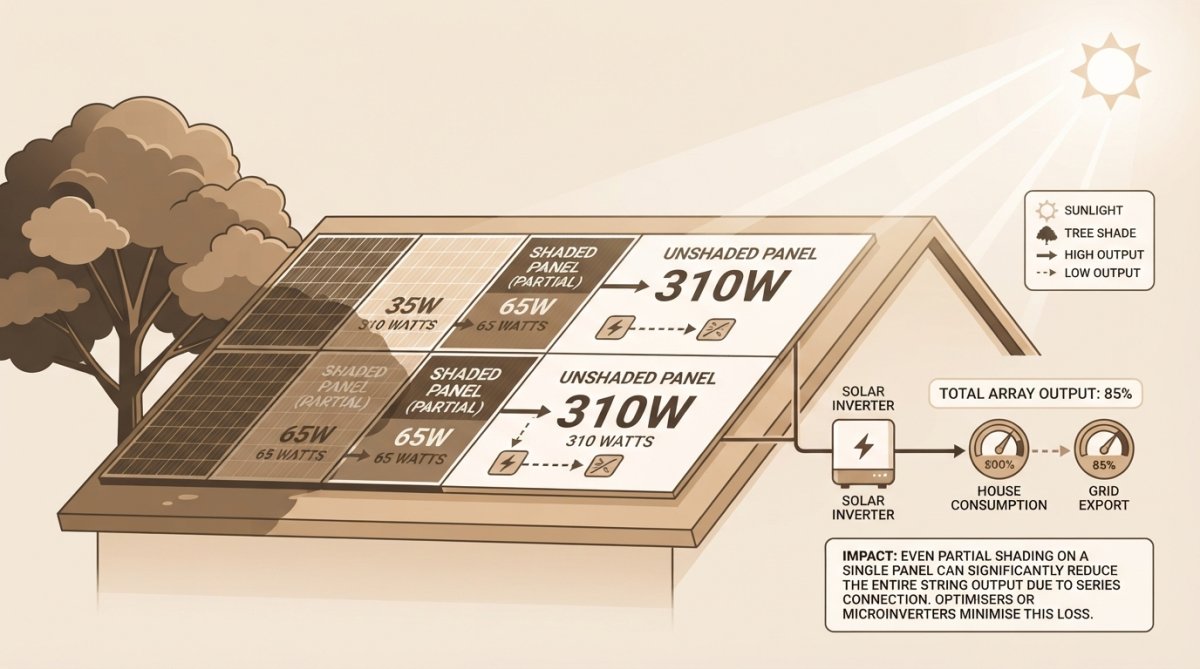
This is the single biggest mistake homeowners make: assuming shading affects only the covered panels. In reality, the impact cascades through your entire system.
How shading affects PV system performance
When shade covers part of a solar panel, the affected cells attempt to block current flow rather than generate it. In a string configuration, this creates severe mismatch losses. The unshaded cells want to push current through, but the shaded cells resist. The result is that the entire string operates at reduced power, often by 50-75% or more depending on the extent of shading.
The severity depends on several factors. A small shadow moving across a panel for an hour creates temporary losses. But a permanent obstruction, like a neighbouring building, large tree, or chimney, creates consistent daily losses. In Australian conditions, permanent shading affects about 30-40% of residential installations.
Partial shading is particularly damaging because it’s often unpredictable. Morning shade from a tree might clear by midday. Afternoon shade from a building might only affect certain seasons. This variability makes it harder to design around and harder to predict actual system performance.
The bottleneck effect and mismatch losses
The bottleneck effect occurs because solar cells in series must pass the same current. When one cell is shaded and produces less current, it forces all cells in that string to operate at that lower current level. The unshaded cells are essentially forced to underperform.
This creates mismatch losses. The shaded cell acts like a resistor in the circuit, dissipating energy as heat rather than converting it to electricity. String inverters amplify this problem because they treat all panels as a single unit. A 10-panel string with one panel 50% shaded will lose far more than 5% of output, losses often reach 40-60% for the entire string.
The Physics Behind Shading: Bypass Diodes and Hotspots
How bypass diodes prevent hotspot formation
Bypass diodes are small semiconductor devices embedded in solar panels specifically to handle shading scenarios. Each panel typically contains three bypass diodes, one for every 20-24 cells. When a section of cells becomes shaded and starts acting as a resistor, the bypass diode detects this and conducts current around those cells, protecting them from excessive heat.
Without bypass diodes, shaded cells would dissipate enormous amounts of heat, potentially causing permanent damage. Modern solar panels all include bypass diodes as standard. However, their effectiveness depends on system design. If panels are connected in long strings with no intermediate protection, a single shaded panel still drags down the entire string. Microinverters and power optimizers add additional control points that can isolate problems and optimize each panel independently.
Panel degradation from partial shading
Repeated hotspot formation accelerates panel degradation. Each time a panel overheats, materials inside, solder joints, cell interconnects, encapsulation material, experience thermal stress. Over years, this stress accumulates and reduces panel lifespan.
Panels exposed to chronic partial shading can degrade 20-30% faster than panels in full sun. A panel that’s supposed to retain 80% of its rated capacity at 25 years might retain only 60% if it’s been in partial shade the entire time. This is why shading assessment during the design phase is critical.
Solar Panel Efficiency in Shade Australia: What You Need to Know
Solar panel efficiency in shade is almost always worse than stated ratings would suggest. Panel ratings are measured under standard test conditions: 1000W/m² irradiance, 25°C cell temperature, and specific spectral conditions. Real-world shading conditions rarely match these parameters.
When irradiance drops to 500W/m² (half sun), panel efficiency doesn’t drop to 50%. It often drops to 30-40% or lower, depending on the panel technology and the type of shade. Different panel technologies respond differently to shading. Monocrystalline panels handle partial shading somewhat better than older polycrystalline panels. Bifacial modules, panels that capture light from both sides, can actually perform better in certain shading scenarios because they capture reflected light from the ground or nearby surfaces.
Microinverters for Shaded Panels Australia: A Superior Solution
Microinverters represent a fundamental shift in how you approach shading. Instead of one central inverter managing all panels in series, each panel gets its own small inverter. This isolation means that shading on one panel doesn’t degrade the performance of adjacent panels.
The performance difference is dramatic. A system with 10 panels where one is 50% shaded will lose approximately 5-10% of total output with microinverters, compared to 40-60% loss with a string inverter. Microinverters also enable panel-level monitoring, so you can see exactly which panels are underperforming and why.
The trade-off is cost. Microinverters add approximately 20-30% to the upfront system cost compared to a string inverter setup. However, for properties with shading, this cost is often justified by the performance gains over the system’s 25-year lifespan.
Comparing microinverters, string inverters, and power optimizers
| Component Type | Shading Tolerance | Upfront Cost | Monitoring | Best For |
|---|---|---|---|---|
| String Inverter | Poor | Low | System-level only | Unshaded roofs, simple layouts |
| Microinverters | Excellent | High | Panel-level | Shaded roofs, complex layouts |
| Power Optimizers | Good | Medium | Panel-level | Moderate shading, cost-conscious |
Power optimizers occupy the middle ground. They’re installed on each panel like microinverters but feed into a central inverter. They cost less than full microinverters but provide better shading tolerance than string inverters alone. For Australian properties with moderate shading, power optimizers often represent the best balance.
String inverters remain the standard choice for unshaded systems because they’re simple, reliable, and cost-effective. But if your property has any shading concerns, the upgrade to microinverters or power optimizers typically pays for itself within 5-8 years through improved energy generation.
Half-Cut Solar Cells Shading Australia: Advanced Panel Technology
Half-cut solar cells divide each string into two parallel paths, effectively creating two smaller strings within one panel. If one half of a half-cut panel is shaded, the other half can still operate at full capacity. This reduces mismatch losses within the panel itself.
Half-cut panels aren’t a complete solution to shading problems, but they do improve overall system resilience. Combined with microinverters or power optimizers, half-cut panels provide an additional layer of shading tolerance. Most modern premium panels now use this technology.
Bifacial modules and improved shading tolerance
Bifacial modules capture light from both the front and back surfaces. When direct sunlight is blocked by an obstacle, the panel can still capture reflected light from the ground, nearby surfaces, or diffuse sky light. This reflected light is captured by the back surface, providing additional generation even during partial shading.
In Australian conditions, bifacial modules perform best on reflective surfaces like light-coloured gravel, concrete, or sand. The additional cost is typically 10-15% above standard panels. For properties with moderate shading and suitable mounting surfaces, bifacial modules can improve overall system performance by 15-20%.
Solar Panel Placement for Shade Australia: Strategic Design
Shading analysis and array configuration
Before installation, a proper shading analysis should map shadows across your roof at different times of day and seasons. This analysis reveals which areas experience chronic shading and which areas are suitable for panels.
Many installers use software tools to model shadows, accounting for the sun’s position throughout the year, nearby structures, trees, and topography. A good analysis should answer specific questions: Which roof areas are shade-free? Which areas experience morning shade only? Which areas have afternoon shade? Which areas have permanent shade from nearby buildings?
Array configuration refers to how panels are grouped and wired together. With this information, an experienced installer can design the array to minimize shading impact. Panels in shade-free areas might be wired together in one string. Panels in partially shaded areas might be wired separately or equipped with microinverters.
Real-world ROI calculation for shading mitigation
The ROI of shading mitigation depends on your specific situation. Here’s how to calculate it. First, establish your baseline system cost and expected annual output. Let’s say a 6kW system costs $12,000 and generates 8,000 kWh annually.
Next, estimate the shading loss. If moderate shading affects approximately 15% of panels for an average of 3 hours daily, you might lose 10-15% of annual output, 800-1,200 kWh annually.
Now add the cost of mitigation. Upgrading to microinverters adds approximately $2,000-$2,500. Upgrading to power optimizers adds approximately $1,200-$1,500.
Calculate the payback period. If microinverters cost $2,250 extra and save you 1,000 kWh annually worth $200 (at 20 cents per kWh), the payback is approximately 11 years. With electricity rates increasing 5% annually, the payback shortens to 8-9 years. For many Australian homeowners, this payback is acceptable over the system’s 25-year lifespan.
However, if shading is minimal (affecting less than 5% of panels), the cost of mitigation might not be justified.
Shading vs. Soiling and Debris: Different Problems, Different Solutions
Shading and soiling are distinct problems requiring different solutions. Shading is permanent or semi-permanent obstruction of sunlight by external objects. Soiling is accumulation of dust, dirt, bird droppings, or debris on the panel surface.
Soiling typically reduces output by 2-5% in Australian conditions. Unlike shading, soiling affects the entire panel surface relatively uniformly. The solution to soiling is cleaning. Most panels self-clean during rain, but in dry periods or dusty locations, periodic cleaning (once or twice annually) maintains performance.
Shading can’t be cleaned away. It requires either removing the obstruction (trimming a tree, removing a structure) or redesigning the system to tolerate it (upgrading to microinverters, repositioning panels).
If you’re unsure whether your performance loss is from shading or soiling, check your monitoring data after heavy rain. Soiling losses typically improve dramatically after rain. Shading losses remain consistent.
Practical Steps to Reduce Shading Impact on Your Solar Array
Vegetation management and structural adjustments
The most cost-effective shading mitigation is often vegetation management. If a tree is casting shade on your panels, trimming or removing branches can dramatically improve performance at a cost of $200-$800 depending on the tree size and your location.
Before cutting a tree, check local regulations. Some councils require permits for tree removal or significant pruning. For trees you don’t own, you can request that your neighbour trim branches, but you can’t force them to do so. Mediation is often more effective than legal action.
Structural adjustments include repositioning panels to avoid shade or adding roof-mounted structures that support panels at a different angle. In some cases, ground-mounted systems offer advantages over roof-mounted systems by being positioned to avoid shade entirely.
Choosing the right inverter technology for your situation
Your inverter choice is perhaps the single most important decision for shading tolerance. The decision tree is straightforward:
- No shading or minimal shading (less than 5% of panels affected): string inverter
- Moderate shading (5-15% of panels affected): power optimizers
- Significant shading (more than 15% of panels affected): microinverters
When getting quotes, ensure installers have performed a proper shading analysis. If they’re recommending a string inverter without assessing shading, they’re not doing their job properly.
Avoid installers who dismiss shading concerns or suggest that modern panels handle shading well. While modern panels are better than older ones, shading still causes significant losses. Any installer who doesn’t take shading seriously is cutting corners on your system design.
Shading affects solar performance more severely than most people expect, but the solutions are well-established and proven. The key is addressing it during the design phase rather than discovering problems after installation. At Solazone Australia, we’ve designed thousands of systems across Australia’s diverse geography, and we know how to navigate shading challenges specific to your location. Whether you need vegetation management, strategic panel placement, or advanced inverter technology, we’ll recommend the approach that maximizes your return on investment. Get in touch with Solazone Australia for a comprehensive shading analysis and system design tailored to your property’s specific conditions.
Frequently Asked Questions
How much does shading affect solar panel output in Australia?
Shading impact varies significantly depending on the extent and duration. Even partial shading, where just one or two cells in a string are blocked, can reduce the entire string's output substantially due to the bottleneck effect. A single shaded cell can limit the current flow through the entire series-connected string, creating mismatch losses. The severity depends on the time of day, season, and the specific shading pattern. Proper shading analysis during design can quantify expected losses for your location.
Do microinverters help with shaded solar panels in Australia?
Yes, microinverters significantly improve performance in shaded conditions. Unlike string inverters that tie all panels together, microinverters operate each panel independently, preventing one shaded panel from dragging down the entire array's output. They also enable independent MPPT (Maximum Power Point Tracking) for each module, optimising energy yield even when panels experience different irradiance levels. This makes microinverters an excellent choice for Australian roofs with complex shading patterns or partial shade throughout the day.
What causes hotspot formation and panel damage from shading?
Hotspots occur when a shaded solar cell becomes reverse-biased, acting as a load rather than a power source. The shaded cell dissipates energy as heat instead of generating it, creating localised high temperatures that can permanently damage the cell and surrounding materials. Bypass diodes are designed to prevent this by allowing current to bypass shaded cells, but if bypass diodes fail or aren't properly configured, hotspots can cause module degradation and reduce system lifespan. Modern panel designs with multiple bypass diodes per section greatly reduce this risk.
What's the difference between shading losses and soiling or debris on solar panels?
Shading losses result from blocked direct sunlight (trees, buildings, structures), reducing irradiance reaching the cells. Soiling and debris, dust, leaves, bird droppings, sit on the panel surface and scatter light, but panels can still receive diffuse light underneath. Shading is permanent or seasonal; soiling is temporary and often reversible with cleaning. Both reduce energy yield, but shading requires design solutions (placement, inverter choice), whilst soiling typically needs maintenance. In Australian conditions, dust storms and pollen can cause significant soiling; vegetation management is essential for minimising shading.
This article was written using GrandRanker