
Table of Contents
- Why Choose Local Solar Experts for Your Australian Home
- Local Solar Installers Australia: Understanding Regional Expertise
- Clean Energy Council Accredited Installers: What This Really Means
- Solar Rebates Australia and Financial Risk Analysis
- Solar Company Reviews Australia: Vetting Your Installer
- After-Sales Support and Warranty Reliability: The Hidden Advantage
- Avoiding Common Solar Installation Pitfalls with Expert Guidance
- Conclusion: Making the Case for Local Solar Expertise
Last Updated: July 30, 2026
When choosing a solar installer, the decision between a national company and a local expert can determine whether your system delivers on its promises or becomes costly. At Solazone Australia, we’ve spent over 40 years helping homeowners navigate this choice, and the data is clear: local expertise changes everything.
This guide covers the real reasons why local solar experts matter, not marketing claims, but practical advantages that affect your system’s performance, warranty coverage, and long-term energy savings.
The Risks of Choosing Installers Without Local Knowledge
Installing solar isn’t one-size-fits-all. A system that works perfectly in Brisbane might underperform in Melbourne. Yet many national solar companies use standardised installation protocols that ignore critical regional differences.
Without local knowledge, installers miss site-specific factors. Shading patterns, roof angles, and grid connection requirements vary by state and suburb. A poorly positioned system might generate 15-20% less electricity than an optimised installation. Over 25 years, that’s tens of thousands in lost savings. Worse, underperformance may disqualify you from Small-scale Technology Certificates (STCs) rebates worth thousands.
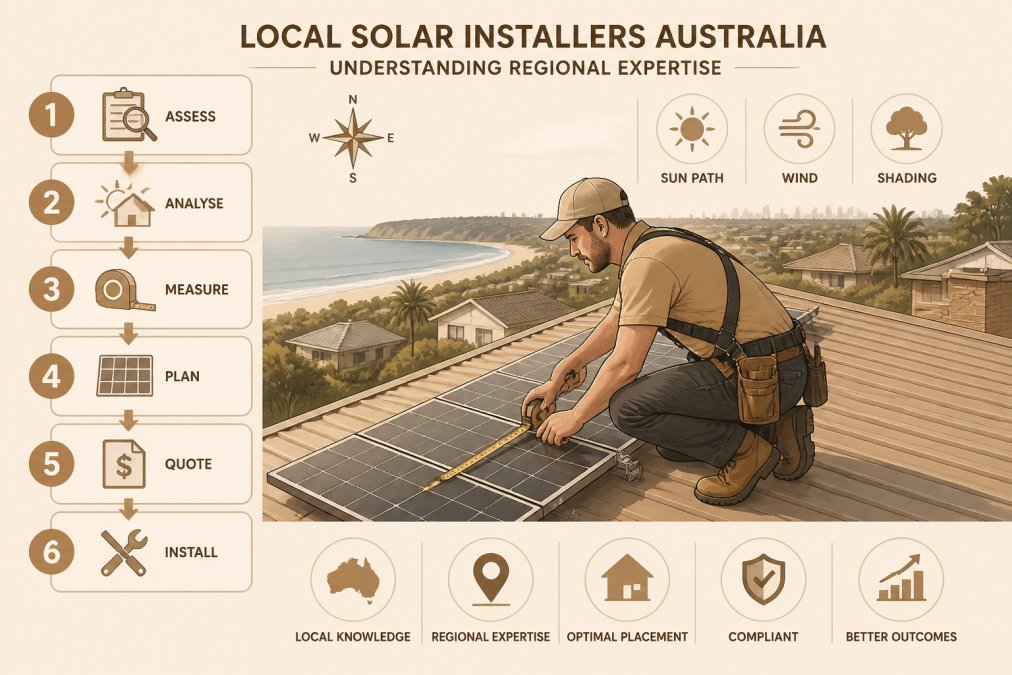
Local Solar Installers Australia: Understanding Regional Expertise
Local solar installers bring deep familiarity with your region’s climate, building codes, and grid infrastructure. An accredited installer operating in Melbourne for 15 years understands summer heat patterns, winter cloud cover, and how rooftop orientation affects seasonal performance.
This expertise translates into better decisions at every stage. A local expert knows which roof angles capture maximum winter sun in your area, understands local council permit requirements, and has worked with your regional electricity distributor.
How Micro-Climates Affect Panel Degradation and System Performance
Australia’s climate varies dramatically across regions, fundamentally changing how your system performs. The Sunshine Coast experiences different humidity levels than inland areas. Melbourne’s winter cloud cover creates unique challenges that don’t apply to Brisbane.
Panel degradation accelerates in certain climates. Coastal salt air corrodes connections faster than inland locations. Extreme heat in inland areas stresses inverters and reduces battery longevity. A local expert designs systems to resist these challenges, recommending equipment suited to your region rather than generic solutions.
Temperature management is critical. Panels lose efficiency as they heat up. In hot climates like inland Queensland, a local installer increases roof ventilation and spaces panels further apart. These decisions compound over 25 years, the difference between 95% and 85% efficiency represents thousands in lost returns.
Why Melbourne and Sunshine Coast Installations Differ
Melbourne and the Sunshine Coast face completely different solar environments, yet some national installers use identical designs for both regions.
Melbourne experiences lower annual solar irradiance due to higher cloud cover and shorter winter days. The optimal panel tilt angle differs from coastal Queensland. Winter performance matters more in Melbourne because heating costs dominate, while the Sunshine Coast sees more consistent year-round generation. Local humidity also differs, coastal moisture affects equipment lifespan differently than Melbourne’s inland conditions. Grid connection requirements vary too, with some Sunshine Coast areas having different voltage standards than Melbourne suburbs.
Clean Energy Council Accredited Installers: What This Really Means
The Clean Energy Council (CEC) accreditation is Australia’s gold standard for solar installer credibility. But accreditation alone doesn’t guarantee local expertise or quality workmanship.
CEC accreditation means an installer has met training requirements, carries appropriate insurance, and follows industry standards. It’s a baseline for competence, not a guarantee of excellence. When evaluating an accredited installer, ask how long they’ve operated in your specific region and what percentage of their installations are in your local area.
CEC Accreditation Versus Unlicensed Installers: The Compliance Gap
The difference between a CEC-accredited installer and an unlicensed operator is substantial. Unlicensed installers cannot legally certify your system for grid connection in most Australian states, meaning you won’t qualify for STCs rebates and lose warranty protection.
CEC accreditation requires ongoing training, insurance coverage, and compliance with industry standards. An accredited installer’s work is verifiable and insurable. If something goes wrong, you have legal protection and a clear path to resolution.
Solar Rebates Australia and Financial Risk Analysis
Australia’s solar rebate system is generous but complex. Understanding how local expertise protects your rebate eligibility is crucial to maximising your financial return.
Small-scale Technology Certificates (STCs) represent the bulk of Australia’s solar rebates. Your system must meet specific technical requirements to generate STCs, and installation must be performed by a CEC-accredited installer. A single mistake, incorrect panel angle, improper inverter sizing, or substandard wiring, can disqualify you from thousands in rebates.
How ‘Too Good to Be True’ Quotes Can Disqualify You from STCs
A suspiciously low quote should trigger caution. Some installers offer cheap prices by cutting corners on compliance, using non-approved components, or skipping proper site assessments.
A system installed with non-compliant components won’t generate STCs. You lose the rebate and end up with a system that may underperform or fail prematurely. A legitimate local installer will explain their pricing clearly, showing the cost of quality components, professional site assessment, and proper installation labour.
Why Local Experts Protect Your Rebate Eligibility
A local solar installer understands every nuance of your region’s rebate requirements. They know which components are approved in your state and understand your local distributor’s grid connection standards. This expertise means your system gets designed and installed to maximise rebate eligibility from the start, with no risk of disqualification.
Solar Company Reviews Australia: Vetting Your Installer
Customer reviews tell you whether an installer delivers on promises, but focus on reviews from your specific region. A glowing review from a Melbourne customer tells you little about an installer’s performance on the Sunshine Coast. Look for reviews mentioning specific details: timeline accuracy, communication quality, and whether the system performs as promised.
Pay attention to how the company responds to negative reviews. A company that responds professionally to criticism shows accountability and customer focus.
Interactive Installer Vetting Checklist: Red Flags and Green Lights
| Evaluation Criteria | Red Flag | Green Light |
|---|---|---|
| Accreditation | No CEC accreditation, vague about credentials | Current CEC accreditation, can provide certificate number |
| Local Experience | National company with no local presence | 10+ years operating in your region, local references |
| Site Assessment | Phone quote without site visit | In-person assessment, detailed shading analysis |
| Component Selection | Generic components, no explanation | Specific brands selected for your climate, explained rationale |
| Warranty | Vague warranty terms, short duration | Clear written warranty, 10+ years on panels and inverter |
| Timeline | Vague completion date, pressure to decide | Specific installation date, realistic permit timeline |
| Communication | Hard to reach, minimal updates | Dedicated contact person, regular progress updates |
| Pricing | Lowest quote by significant margin | Mid-range quote with detailed cost breakdown |
| References | Refuses to provide customer references | Multiple recent references in your suburb |
A local solar expert checks every green-light box.
After-Sales Support and Warranty Reliability: The Hidden Advantage
Your solar system requires maintenance over its 25-year lifespan. A local installer provides support you can actually access when you need it.
National solar companies often outsource after-sales support to call centres. A local installer can visit your home within days, diagnose issues in person, and fix them on the spot. Warranty claims are faster and easier with a local company that has relationships with equipment manufacturers and understands which problems are covered.
Why Local Proximity Matters for Warranty Claims and System Maintenance
A warranty is only valuable if you can actually use it. A local installer who stands behind their work can handle warranty claims directly. System maintenance is another area where proximity matters, your system needs occasional cleaning, inverter checks, and electrical inspections. A local installer can schedule maintenance conveniently and spot developing problems before they become expensive failures.
If your system stops generating electricity, you want someone who can visit within 24 hours, not someone who needs a week to coordinate a service call from interstate.
Post-Installation Troubleshooting: What to Expect in Year One
Your new solar system requires a learning period. A good local installer provides education during this time, walking you through your monitoring system and explaining normal performance variations based on weather and season.
Most year-one issues are minor, a circuit breaker that trips or misunderstanding about seasonal performance. A local installer can address these quickly via phone or brief site visit. For serious problems like inverter failure, a local installer maintains relationships with equipment suppliers and can often arrange same-day or next-day replacement.
Avoiding Common Solar Installation Pitfalls with Expert Guidance
Certain mistakes appear repeatedly in solar installations, almost always caused by installers cutting corners or lacking local knowledge. A quality local installer prevents these pitfalls entirely.
Shading assessment is the most common problem area. An installer who doesn’t properly analyse shading can position panels where trees, buildings, or structures block sunlight during peak hours. Even partial shading reduces system output dramatically. A local expert knows which trees grow quickly in your region and how to position panels to minimise shading year-round.
Roof structural integrity is another critical factor. Some homes cannot safely support standard installations. An installer who doesn’t properly assess structural capacity might install a system that stresses your roof, creating leak risks. A local installer knows which roof types are common in your area and understands their load-bearing capacity.
Grid connection compliance is often mishandled. Your system must meet strict electrical standards for safe grid connection. A CEC-accredited local installer ensures every electrical connection meets standards and documentation is complete.
Shading Assessment, Roof Structural Integrity, and Grid Connection Compliance
These three factors determine whether your system works reliably for 25 years.
Shading assessment requires more than eyeballing your roof. A professional uses solar pathfinder tools or 3D modelling to track how shadows move throughout the year, accounting for seasonal variations and vegetation growth. A local expert knows which trees grow fastest in your climate and plans accordingly.
Roof structural assessment requires understanding your specific roof type. Tile roofs, metal roofs, and flat roofs have different weight-bearing capacities. A proper assessment includes inspection by someone qualified to evaluate structural integrity. A local installer knows which structural engineers in your area specialise in solar installations.
Grid connection compliance involves detailed electrical work. Your system must have proper surge protection, grounding, isolation switches, and monitoring equipment. A local CEC-accredited installer handles all this correctly and completely.
Conclusion: Making the Case for Local Solar Expertise
Choosing a solar installer is one of the largest investments you’ll make in your home. The difference between a quality local installer and a discount national operator compounds over decades. A well-installed system generates reliable energy savings and qualifies for full rebate benefits.
Local solar expertise matters because solar isn’t a commodity product. Your system’s success depends on understanding your specific climate, your roof’s characteristics, your local grid requirements, and your region’s regulatory environment. Solazone Australia brings over 40 years of technical expertise and deep local knowledge to every installation, ensuring your system is designed and installed to maximise performance and longevity. We’ve trained more than 200 staff members and served thousands of satisfied customers across Australia by prioritising personalised service and Australian-made systems. Get started with Solazone Australia and experience the difference that local expertise makes in your solar investment.
Key Takeaways
| Consideration | Why Local Matters | Impact on Your System |
|---|---|---|
| Micro-climate knowledge | Local installers understand regional weather patterns and panel degradation | 10-20% better system performance over 25 years |
| Site assessment | Proper shading and structural analysis prevents costly mistakes | Avoids system underperformance and safety issues |
| Rebate compliance | Local experts navigate STC requirements correctly | Protects thousands in rebate eligibility |
| After-sales support | Proximity enables quick maintenance and warranty service | Faster problem resolution and system uptime |
| Regulatory compliance | Understanding local grid and permit requirements | Ensures legal installation and grid connection approval |
External Sources Cited
The importance of proper solar installation is documented extensively. Research from the Clean Energy Council installer accreditation standards demonstrates that accredited installers significantly outperform unlicensed operators in system reliability and customer satisfaction. Information about Small-scale Technology Certificates and solar rebate eligibility requirements shows how installation quality directly affects rebate qualification. Additionally, the Australian Renewable Energy Agency’s regional climate impact studies confirm that micro-climate factors substantially influence solar system performance across different Australian regions.
Frequently Asked Questions
What accreditations should a local solar installer have in Australia?
Look for Clean Energy Council (CEC) accreditation, which is the industry benchmark in Australia. CEC-accredited installers must meet strict training, compliance, and technical standards. Verify accreditation directly on the CEC website. Additionally, installers should hold relevant electrical licences from your state's regulatory body and comply with the Clean Energy Council's code of conduct. Local solar experts often have these credentials prominently displayed and can explain their compliance obligations clearly.
How do local solar experts handle warranties and after-sales support better?
Local solar installers provide accessible, ongoing support because they're physically present in your region. They can respond quickly to warranty claims, perform system maintenance visits, and troubleshoot issues without lengthy delays. When problems arise, whether inverter faults, panel cleaning, or grid connection issues, a local expert can visit your site promptly. They also understand regional climate challenges and seasonal performance variations, allowing them to provide targeted maintenance advice specific to your area's conditions.
Are local solar companies cheaper than national installers in Australia?
Price varies by installer quality and scope, not by size. However, local solar experts often provide better value because they avoid excessive overhead costs and deliver personalised service. National chains may quote lower upfront prices but sometimes cut corners on site assessment, system design, or after-sales support. Local installers typically conduct thorough site assessments, account for micro-climate factors, and factor in long-term support costs. Always compare obligation-free quotes based on system specifications, warranty terms, and post-installation support, not price alone.
What happens if my electricity usage doesn't drop as much as projected after installation?
Reputable local solar experts provide realistic energy savings projections based on your specific consumption patterns, roof orientation, and regional climate data. If actual savings fall short, they investigate system performance issues, shading problems, inverter faults, or grid connection inefficiencies. Many offer post-installation performance monitoring and can troubleshoot underperformance. Always request a detailed site assessment and written projections before installation. Local installers with decades of regional experience can identify factors (like seasonal usage patterns or roof quirks) that national installers often miss, leading to more accurate forecasts.
This article was written using GrandRanker