
Table of Contents
- Understanding Solar Inverters and Their Role in Your System
- Types of Solar Inverters: String, Hybrid, and Micro
- CEC Approved Solar Inverters: What the Certification Means
- Australian-Made vs Imported: Key Differences in Support and Supply Chain
- Solar Inverter Warranty Australia: Coverage and What to Expect
- Solar Inverter Repair and Maintenance: Local vs Imported Considerations
- Making Your Choice: Performance, Climate, and Grid Stability
- Conclusion
- Frequently Asked Questions
Last Updated: September 18, 2026
Understanding Solar Inverters and Their Role in Your System
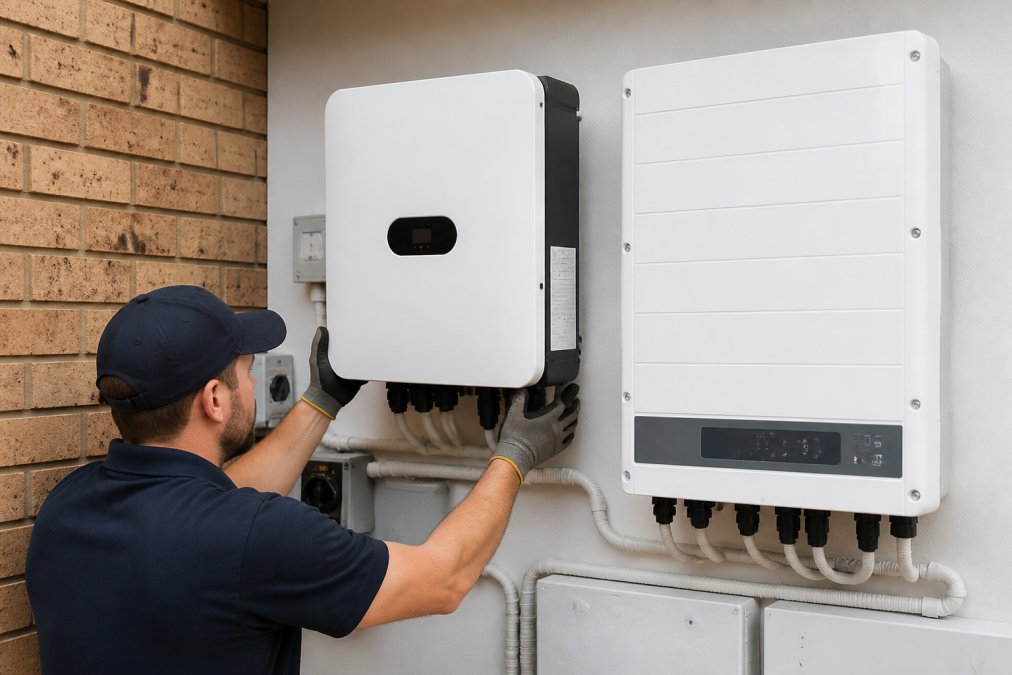
A solar inverter converts direct current (DC) electricity from your solar panels into alternating current (AC) electricity for your home or business. It’s the essential translator between your panels and electrical system.
Modern inverters monitor performance, manage voltage, provide surge protection, integrate with battery storage, enable remote monitoring, and support grid stability. Choosing between Australian and imported solar inverters means understanding how these functions differ based on manufacturing location and local support.
The decision between Australian-made and imported inverters isn’t just about price, it’s about long-term reliability, local support, warranty coverage, and performance in Australian climate conditions.
Types of Solar Inverters: String, Hybrid, and Micro
String inverters connect multiple panels in series and handle DC to AC conversion for the entire string. They’re cost-effective and work well without significant shading, but shading on one panel reduces output for the entire string.
Hybrid inverters combine solar conversion with battery storage management, allowing you to store excess energy and draw from it during peak demand or outages. Both Australian and imported brands (Sungrow, GoodWe) offer hybrid models.
Microinverters attach to individual panels and eliminate string-level shading issues. They’re more expensive but excel in complex layouts. Imported options dominate this category.
CEC Approved Solar Inverters: What the Certification Means
The Clean Energy Council (CEC) maintains the list of approved solar inverters for Australia. CEC approval is required for most installations to qualify for government incentives and meet Australian electrical safety standards.
CEC approval confirms the inverter meets Australian safety standards, handles grid connection safely, and meets efficiency benchmarks. Both Australian-made and imported inverters can carry CEC approval.
Always verify CEC approval status, an imported inverter without certification cannot legally be installed in most Australian systems. All approved inverters meet the same safety and performance thresholds.
Australian-Made vs Imported: Key Differences in Support and Supply Chain
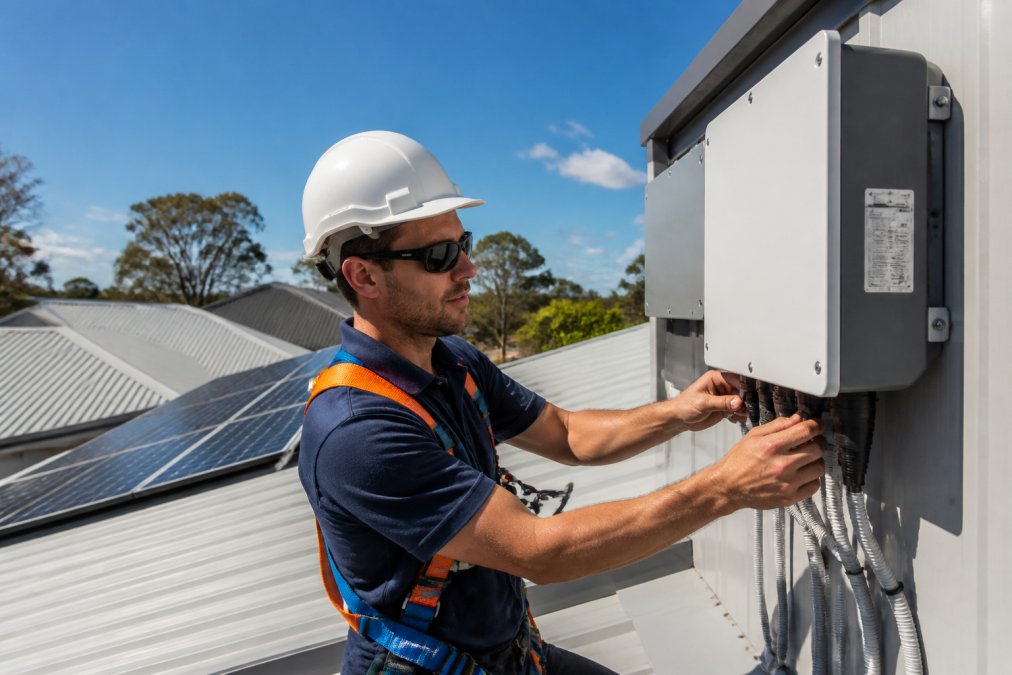
Reliable hardware support remains just as critical for large-scale installations as it is for residential setups, particularly when selecting the right commercial solar panels for long-term energy infrastructure.
Solar inverters Australian imported vary in support infrastructure, whereas Australian-made inverters benefit from established local supply chains and service networks. Warranty claims process quickly through local manufacturers, and spare parts are readily available.
Imported inverters vary in support: Sungrow maintains a dedicated Australian service network; Fronius has established local partnerships; GoodWe has growing distribution but may involve longer lead times.
During warranty claims, local manufacturers arrange on-site service or expedited replacements. Imported brands may require shipping the inverter away, meaning weeks without power and lost energy savings.
Australian manufacturers source components locally, reducing vulnerability to shipping delays or tariff changes. Imported inverters depend on overseas supply chains, which can be disrupted by shipping, customs, or manufacturing issues.
Solar Inverter Warranty Australia: Coverage and What to Expect
Warranty terms typically range from 5 to 10 years and cover manufacturing defects and component failures, but not damage from improper installation, extreme weather, or external electrical surges.
Australian-made inverters process warranty claims through Australian offices, simplifying the process and providing direct access to support.
Imported inverters vary: Sungrow’s warranty is administered through Australian service partners; Fronius offers strong local support; GoodWe may involve longer processing times.
Most warranties exclude damage from improper installation, unprotected electrical surges, normal wear, and environmental factors like extreme heat or salt air.
For coastal systems, verify warranty coverage for climate-specific degradation. Some imported inverters engineered for European climates may not perform as well under Australian heat and humidity.
Solar Inverter Repair and Maintenance: Local vs Imported Considerations
Most inverters require minimal maintenance beyond firmware updates and monitoring. When failures occur, the difference between local and imported equipment becomes critical for cost and downtime.
Common failure modes and repair timelines
Inverter failures typically involve capacitor degradation, cooling system failure, or firmware issues. Electrolytic capacitors degrade faster in high-temperature environments. Australian roof-mounted inverters experience internal temperatures 10-15°C higher than ambient air. Capacitors rated for European climates (85°C) degrade significantly faster under sustained Australian heat, failing in 6-7 years instead of 10.
Cooling system failures are climate-specific. Passive cooling (heatsinks) is reliable but less effective in extreme heat. Active cooling (fans) requires periodic cleaning, dust and salt spray clog fins. Fan failure causes the inverter to throttle output or shut down, leaving your system offline during peak generation.
Australian-made inverters with local service networks typically repair in 3-7 days. Imported inverters with established local distributors (Sungrow, Fronius) follow a similar timeline if parts are in stock; overseas parts extend downtime to 2-3 weeks. Imported brands without local service networks may require 4-6 weeks, during which you pay full grid rates.
Firmware updates and feature parity
Australian manufacturers release firmware updates within weeks, addressing local grid requirements. Imported inverters may experience 2-4 month delays before reaching Australian distributors. Some imported brands require manual USB updates; Australian systems increasingly support over-the-air updates.
Preventive maintenance and climate-specific care
Spare parts availability and cost
Making Your Choice: Performance, Climate, and Grid Stability
Climate-specific performance: Heat, humidity, and salt spray
Three grid-stability features are becoming standard requirements:
Voltage ride-through: The inverter must remain connected and continue operating even when grid voltage fluctuates outside normal ranges (typically 207-253 V for single-phase systems). Voltage fluctuations occur when demand spikes or when other large loads switch on. A poorly designed inverter will disconnect during these events, reducing system reliability and potentially destabilising the grid further. Ask your installer: “Does this inverter support voltage ride-through to ±10% of nominal voltage?” Both Australian and imported inverters now include this feature, but implementation quality varies.
To evaluate grid-stability features:
- Check the inverter’s technical datasheet for “grid support functions” or “grid code compliance.”
- Verify that it meets the requirements of your local DNSP. Contact your distribution network operator (e.g., Ausgrid, Energex, SA Power Networks) to confirm which features are mandatory in your area.
- Ask your installer whether the inverter has been tested and certified for your region’s grid code. Certification is not automatic; some imported inverters require local testing and approval before they can be installed.
Local support infrastructure: The hidden cost of distance
Australian-made inverters typically have:
- Technicians within 50-100 km of most population centres
- Spare parts stocked locally
- Warranty claims processed through Australian offices (5-10 business days)
- Direct phone support from the manufacturer
Imported inverters vary widely:
- Sungrow: Dedicated Australian service network with technicians in major cities; spare parts stocked locally; warranty claims processed in Australia (7-14 business days)
- Fronius: Established local partnerships; technicians available in most regions; spare parts sourced through local distributors (5-10 business days)
- GoodWe, Deye, Huawei: Growing Australian presence but fewer technicians; spare parts may require international ordering (2-4 weeks); warranty claims may require escalation to overseas offices
Decision framework
Use this framework to evaluate your specific situation:
Choose Australian-made inverters if:
- You’re in a coastal area or high-heat inland region and want equipment engineered for Australian climate extremes
- You’re in a regional or remote area where imported service networks are sparse
- You want warranty claims processed entirely within Australia
- You prioritise rapid on-site repair over lowest upfront cost
- You value supply chain stability and local spare parts availability
Consider imported inverters (with established local support) if:
- The manufacturer has a dedicated Australian service network (Sungrow, Fronius)
- You’ve verified that spare parts are stocked locally or available within 1-2 weeks
- Your installer has technicians assigned to your area and offers 24/7 monitoring support
- The inverter’s grid-stability features match your DNSP’s requirements
- You’ve compared the total cost of ownership (purchase price + likely repair costs + downtime risk) rather than purchase price alone
Avoid imported inverters without local support if:
- The distributor cannot confirm spare parts availability within 2 weeks
- Your installer has no local technicians or offers only phone-based support
- The inverter lacks grid-forming or fast frequency response capabilities and your DNSP requires them
- The warranty requires international coordination or claims processing
Conclusion
Choosing between Australian and imported solar inverters requires balancing performance, cost, and long-term support. Both options can work well, the key is understanding what matters most for your situation. Australian-made systems offer local expertise and rapid support backed by Solazone Australia’s 40 years of technical experience. Imported brands like Sungrow and Fronius provide strong performance and established local service networks.
Frequently Asked Questions
What does CEC approval mean for a solar inverter?
CEC (Clean Energy Council) approval confirms that a solar inverter meets Australian safety and performance standards. All grid-connected inverters sold in Australia must be CEC listed. This certification ensures the device has undergone rigorous testing for electrical safety, efficiency ratings, and compatibility with the national grid. When choosing between Australian and imported solar inverters, CEC approval is mandatory, not optional. It protects your system, your warranty, and your eligibility for feed-in tariff schemes.
Are imported solar inverters as reliable as Australian-made options?
Reliability depends on the brand and engineering quality, not origin alone. Imported premium brands like Fronius and Sungrow have extensive track records in Australia and are trusted by installers nationwide. However, imported options mean longer lead times for spare parts and repairs, potentially leaving your system offline for weeks. Australian-made systems typically offer faster local support and quicker resolution times. Both types must meet the same CEC standards, but supply chain resilience and after-sales support differ significantly.
What warranty should I expect on a solar inverter in Australia?
Most solar inverter warranties in Australia range from 5 to 10 years, with some premium brands offering extended coverage to 15 years. Warranty terms vary: some cover parts and labour, while others cover parts only. Check whether your warranty includes remote monitoring and firmware updates, which can extend inverter lifespan. Local suppliers often provide faster warranty claims processing. Always confirm the warranty covers your specific installation location and ask about service response times, this matters more than the warranty length if your system fails.
How often do solar inverters need repair or maintenance?
Well-maintained inverters typically require minimal intervention. Annual inspections check thermal management, firmware updates, and surge protection systems. Most failures occur due to voltage fluctuations during grid disturbances or thermal stress in hot climates. Imported inverters may take 4-8 weeks for spare parts and repairs, while Australian-supported systems usually respond within days. Remote monitoring alerts you to performance degradation early, preventing costly downtime. Budget for professional servicing every 5-7 years, depending on your climate and system age.