
Table of Contents
- What Solar Panel Maintenance Cost Australia Homeowners Actually Pay
- Solar Panel Cleaning Cost: What You Should Expect to Pay
- How Often to Clean Solar Panels: A Practical Schedule
- Solar System Inspection Checklist: What a Professional Checks
- DIY vs Professional Solar Maintenance: Warranty and Safety
- Inverter Maintenance vs Panel Maintenance: Two Different Jobs
- Frequently Asked Questions
Last Updated: September 27, 2026
What Solar Panel Maintenance Cost Australia Homeowners Actually Pay
Most solar owners never budget for maintenance, then get surprised by a bill. The honest answer is that there is no single figure, because what you pay depends on whether you need a clean, an inspection, a repair, or all three. At Solazone Australia, we’ve spent more than 40 years installing and servicing photovoltaic systems, and the pattern is consistent: cleaning is the smallest line item, electrical testing is the largest, and the two get confused constantly.
Here’s the part most guides get wrong. They quote a flat “solar panel maintenance cost” as though every system needs the same work. A 6.6 kW string system on a single-storey roof is a different job to a 20 kW commercial array with micro-inverters and three-phase wiring.
According to the Clean Energy Regulator’s guidance on accredited installers, maintenance work on grid-connected systems should be carried out by appropriately accredited personnel, which affects what you’re paying for: labour with credentials, not just labour.
Cleaning, Inspection, and Repair: Where the Money Goes
Three separate jobs, three separate cost drivers. Cleaning removes soiling so more sunlight reaches the cells. Inspection verifies the system is safe and performing. Repair replaces failed components. Bundling them into one vague “service” is how people end up overpaying for work they didn’t need.
A common mistake is assuming a wash is a service. It isn’t. Cleaning addresses output; inspection addresses safety and warranty compliance. You need both, but not always on the same schedule.
System Size and Pricing: How Capacity Drives Cost
Larger arrays take longer to access, clean, and test, so labour hours rise with system capacity. A single-storey 6.6 kW system might take one technician under an hour; a two-storey 13 kW array with steep roof pitch and multiple strings can take half a day.
Pricing depends on quantity of panels, roof access, and travel, so we quote per site rather than publishing a flat rate. Check current pricing on our website or request a quote.
| Job Type | What It Covers | Typical Frequency | Main Cost Driver |
|---|---|---|---|
| Cleaning | Debris removal, soiling removal | 6-12 months | Panel count, roof access |
| Inspection | Electrical testing, thermal imaging | 12-24 months | System capacity, storeys |
| Repair | Component replacement | As needed | Parts, warranty status |
Cleaning and inspection are not interchangeable. Skipping inspection to save money can void warranty compliance and hide faults that cost far more to fix later.
What a Typical Bill Looks Like
Because we quote per site, the most useful thing we can give you is the shape of a typical invoice rather than a fake flat rate. Most residential jobs break down into three components:
- Call-out and travel, a fixed charge that covers the technician’s time to reach you, which is why rural and remote properties pay more than metro ones for identical work.
- Labour hours, billed at an hourly rate that reflects accreditation, insurance, and working-at-heights competency. This is the single biggest variable.
- Parts and consumables, replacement isolators, MC4 connectors, conduit, bird mesh, or a failed inverter, priced separately so you can see exactly what you’re paying for.
A clean-only visit on an accessible single-storey roof sits at the low end of the range. A full clean plus electrical inspection on a two-storey array sits in the middle. Anything involving a repair, a roof-access issue, or a commercial three-phase system pushes toward the top. If a quote arrives as one lump sum with no breakdown, ask for it itemised, that’s the fastest way to tell whether you’re being charged for work you actually need.
Why We Don’t Publish a Flat Rate
Competitors love publishing a single number because it ranks well. It also sets you up for a surprise when your site doesn’t match their assumption. Roof pitch, storey count, tile versus tin, distance from the depot, and whether the inverter is roof- or wall-mounted all change the labour required. A flat rate either overcharges the easy jobs or undercharges the hard ones, and the hard ones are where safety matters most. Per-site quoting is slower, but it’s the only honest way to price work that carries a fall-risk and electrical component.
Solar Panel Cleaning Cost: What You Should Expect to Pay
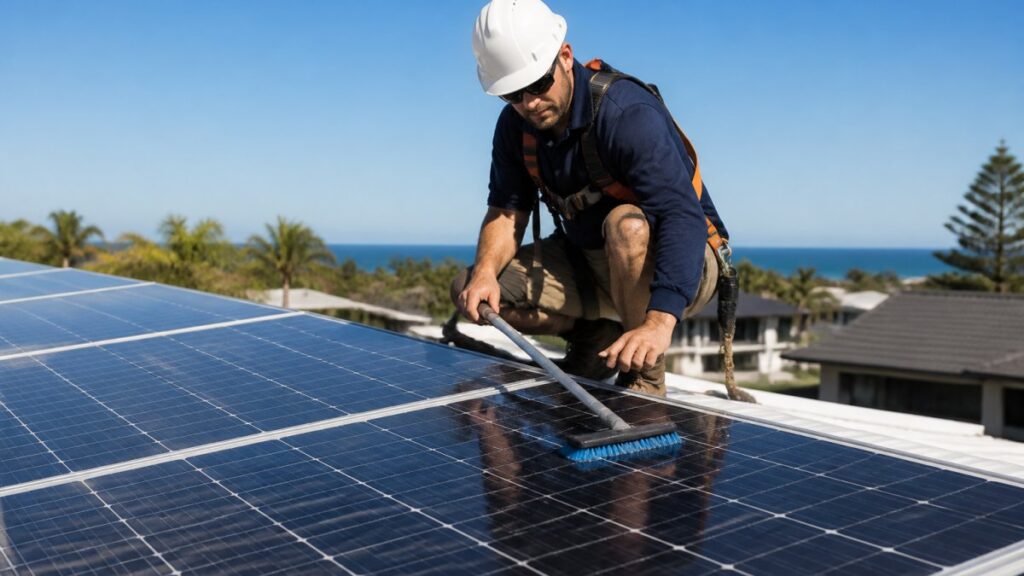
Solar panel cleaning cost is driven by access, not by the number of panels alone. A ground-mounted array is quick. A tiled roof at height with a steep pitch needs fall protection, which adds time and equipment.
Several factors push the price up:
- Roof pitch and height, which determine access method
- Panel count and total array area
- Soiling type: dust, bird droppings, and coastal salt need different approaches
- Water access on site
- Travel distance to the property
Bird proofing is often quoted alongside cleaning because it prevents the problem recurring. If your roof has a persistent bird issue, mesh guarding usually pays for itself faster than repeated cleans.
How Often to Clean Solar Panels: A Practical Schedule
How often to clean solar panels depends on where you are and what’s landing on them. In most suburban settings, once every 6 to 12 months is sensible. Properties near farmland, main roads, or the coast need more frequent attention.
Use this as a starting point:
- Coastal or high-dust areas: every 4 to 6 months
- Suburban rooftops: every 6 to 12 months
- Wooded or bird-heavy areas: every 6 months plus bird proofing
- After any major dust event or bushfire smoke: as soon as practical
Rain helps but doesn’t replace cleaning. It clears loose dust and leaves the baked-on film that actually cuts system efficiency.
Solar System Inspection Checklist: What a Professional Checks
A proper inspection goes well beyond looking at the panels. It verifies the whole photovoltaic system is safe, compliant, and producing what it should. This is where the real value sits, and it’s the part DIY owners most often skip.
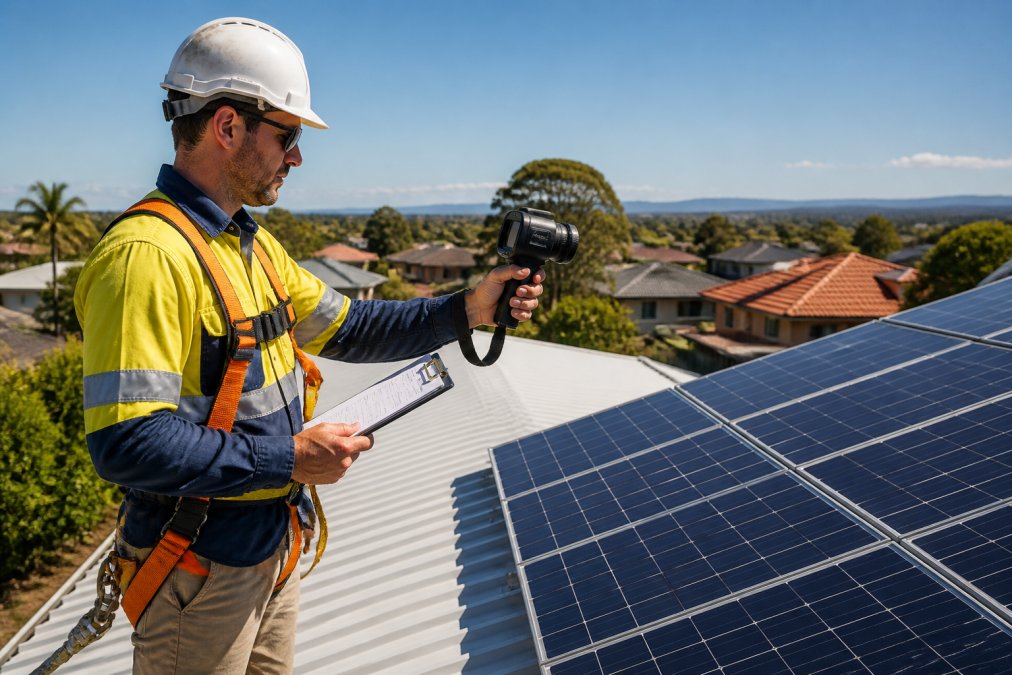
A standard solar system inspection checklist covers:
- Visual check of panels for cracks, hotspots, and panel degradation
- Thermal imaging to find failing cells and loose connections
- Voltage testing and electrical testing at the isolators
- Wiring integrity and corrosion check on all exposed connections
- Solar inverter fault log review and firmware status
- Mounting hardware and roof penetration check
- System monitoring data review against expected output
- Safety inspection of DC isolators and earthing
What most guides miss is the inverter log. Fault codes recorded months ago often explain a slow decline in output that owners blame on dirty panels.
DIY vs Professional Solar Maintenance: Warranty and Safety
DIY cleaning is fine for ground-level arrays with soft water and a soft brush. Anything involving roof access, electrical testing, or DC isolators is not a DIY job, and the risks go beyond injury.
The warranty implications are the part nobody tells you about.
Pressure washing panels can force water past seals and crack cells. It also risks voiding warranty compliance. Use low-pressure cleaning or a professional service instead.
What You Can Safely Do Yourself
DIY isn’t all-or-nothing. There’s a genuine middle ground that protects your warranty while still saving money:
- Visual inspection from the ground, look for cracked glass, hot spots, bird nests, or debris shading the array. Binoculars are fine. No roof access required.
- Monitoring review, check your inverter app or portal weekly. A sudden drop in daily kilowatt-hours with no weather explanation is the earliest signal of a fault.
- Ground-level cleaning, if your array is ground-mounted and reachable without a ladder, soft brush and low-pressure water is safe.
- Keeping records, log every clean, every fault code, and every professional visit. This is the evidence you’ll want if a warranty claim is ever disputed.
The Record-Keeping Angle Most Owners Miss
A warranty claim is a paperwork exercise as much as a technical one. Owners who keep a simple log, date, work performed, who performed it, and any fault codes observed, are in a far stronger position than owners who can only say “I think it was serviced at some point.” If you do nothing else after reading this, start that log today.
Inverter Maintenance vs Panel Maintenance: Two Different Jobs
Panel maintenance protects generation; inverter maintenance protects the conversion step. They fail for different reasons and need different service intervals.
For most homes, the practical split looks like this:
- Panels: clean every 6-12 months, inspect annually
- Inverter: check monitoring monthly, service every 12-24 months
- Batteries: review state of health annually
Frequently Asked Questions
Do solar panels need a lot of maintenance?
Solar panels are largely self-sufficient, but they are not maintenance-free. Rain handles most cleaning, yet soiling from dust, bird droppings, and pollen builds up over time. An annual inspection catches loose wiring, corrosion, and inverter issues before they become expensive. Budget for at least one professional check per year, plus occasional cleaning if your roof pitch is low or you live near trees or busy roads.
How often should solar panels be inspected by a professional?
Most accredited installers recommend a professional inspection every 12 months. Systems older than five years, or those in dusty or coastal areas, may need a check every six months. An inspection covers electrical testing, thermal imaging, voltage testing, and a corrosion check. Regular servicing also keeps your warranty compliant, since many manufacturers require documented maintenance to honour claims.
Is it worth getting solar panels cleaned?
Yes, if your panels are visibly dirty or your system monitoring shows a drop in output. Cleaning removes soiling that blocks sunlight and reduces system efficiency. On a 6.6 kW system, a 5% loss from dirt can add up over a year. If you have a steep roof pitch and regular rain, cleaning may only be needed every 12 to 24 months. Otherwise, an annual clean is a sensible baseline.
What are the signs that my solar system needs maintenance?
Watch for a drop in performance monitoring data, visible dirt or bird droppings on panels, inverter error codes, unusual noises, or a spike in your electricity bill. Physical signs include cracked glass, corroded frames, or loose wiring. If your system is over five years old and has never been serviced, book an inspection. Catching panel degradation early protects both your output and your warranty.