
Table of Contents
- How Heat and Ambient Temperature Reduce Solar Panel Output
- Solar Panel Temperature Coefficient Explained
- How Cloud Cover Affects Solar Power Output
- Humidity, Salt Spray and Coastal Conditions
- Solar Panel Maintenance for Coastal Areas
- Dust, Soiling and Regional Climate Variations
- Mitigation Strategies and the Economic Impact of Efficiency Loss
- Frequently Asked Questions
Last Updated: October 1, 2026
How Heat and Ambient Temperature Reduce Solar Panel Output
Australia’s climate is brutal on solar hardware, and the numbers prove it. A solar panel’s output falls as its cells heat up, and in a country where summer ambient temperatures regularly climb past 35°C, rooftop arrays run far hotter than the air around them. This guide from Solazone Australia explains why the Australian climate affects solar panel performance, and what you can do about it.
The core problem is physics. Panels are rated at 25°C cell temperature under standard test conditions, but a black panel bolted to a roof in full sun can sit 30°C or more above ambient. Every degree above that rating shaves a fraction off your output.
Why Photovoltaic Cells Lose Efficiency as They Warm
Photovoltaic cells lose efficiency as they warm because heat increases the internal resistance of the semiconductor material, which reduces the voltage the cell can produce. Current holds up reasonably well, but voltage drop is the killer. A hotter cell generates less power at the same current, so your inverter sees less usable energy even on a cloudless day.
This is why two identical systems, one in Tasmania and one in the Pilbara, can produce noticeably different energy yields from the same panel count. Ambient temperature is not a side detail. It is a primary input into photovoltaic output.
The Effect of Extreme Heat on Inverter Performance
Inverters suffer in the heat too, and this is the part most homeowners never consider. Most inverters derate once ambient temperature passes roughly 40°C, meaning they throttle output to protect their own electronics. A unit mounted in a closed garage or against a west-facing wall can hit that threshold on a regular summer afternoon.
Mounting an inverter in an unventilated garage or against a sun-baked wall is one of the most common installation mistakes. Once it derates, you lose generation on exactly the days you need it most, and sustained heat exposure shortens the unit’s service life.
Solar Panel Temperature Coefficient Explained
The solar panel temperature coefficient explained in plain terms is the rate at which a panel’s power output falls for every degree Celsius its cells rise above 25°C. It appears on every datasheet as a negative percentage per degree, and it is the single most useful number for predicting real-world performance in a hot climate.
Reading the Numbers on a Panel Datasheet
Datasheets list three coefficients: power, voltage and current. The power coefficient is the one that matters for energy yield calculations. Voltage falls with heat, current rises very slightly, and the net result is a power loss.
| Datasheet Term | What It Measures | Why It Matters Here |
|---|---|---|
| Power coefficient | Output loss per °C above 25°C | Directly predicts hot-weather energy yield |
| Voltage coefficient | Voltage drop per °C | Explains inverter voltage drop issues |
| Current coefficient | Current gain per °C | Small, usually negligible |
| NOCT | Cell temp at real-world conditions | More realistic than 25°C rating |
How Cloud Cover Affects Solar Power Output
Cloud cover affects solar power output less dramatically than most people assume. Panels still generate on overcast days because they respond to diffuse solar irradiance, not just direct sunlight. Output might drop to a fraction of a clear-sky day, but it rarely falls to zero.
Humidity, Salt Spray and Coastal Conditions
Coastal installations face a compounding problem. Humidity levels reduce effective solar radiation and encourage condensation inside junction boxes, while salt spray accelerates corrosion on frames, mounting rails and connectors. Over years, this causes performance degradation that has nothing to do with the panels themselves.
Solar Panel Maintenance for Coastal Areas
Solar panel maintenance for coastal areas is mostly about removing salt residue and inspecting for corrosion before it spreads. Salt film on glass scatters light, and corroded connectors create resistance that shows up as voltage drop under load.
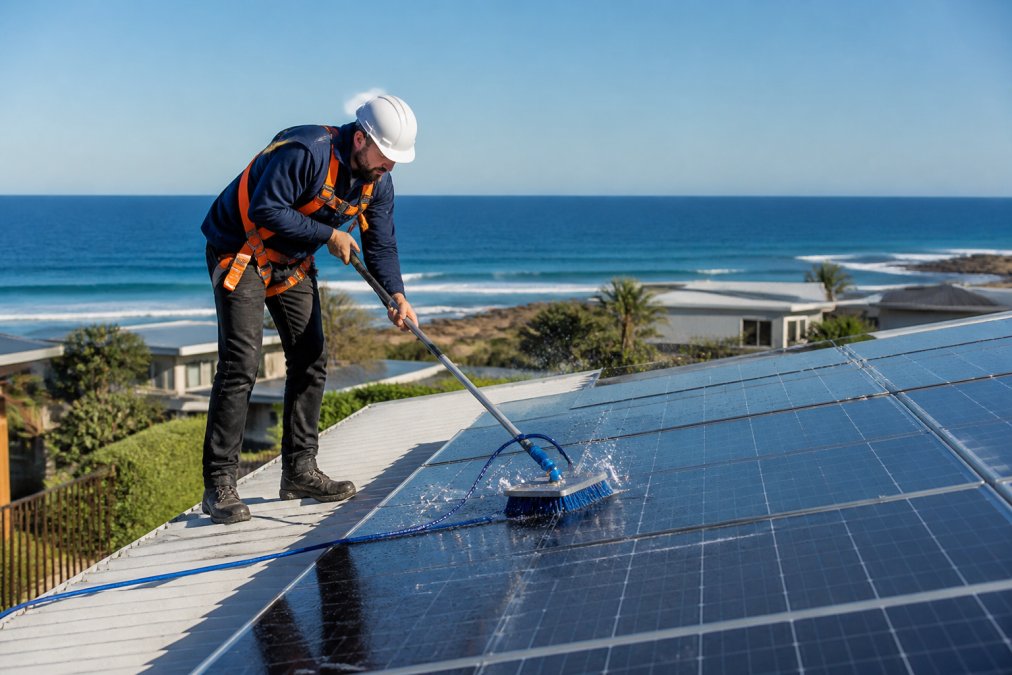
A practical coastal maintenance routine looks like this:
- Rinse panels with fresh water every 4-8 weeks to remove salt film
- Inspect frame edges and mounting bolts for white corrosion deposits
- Check DC isolators and connectors for moisture ingress
- Clear gutters and roof valleys of debris that traps damp
- Book a professional inspection annually, more often in exposed locations
Rinsing early in the morning, before the panels heat up, avoids thermal shock to the glass and lets the water evaporate before peak generation hours. It also keeps you off a hot roof.
Dust, Soiling and Regional Climate Variations
Soiling losses are not evenly distributed, and treating ‘Australia’ as one climate is the fastest way to get maintenance wrong. The continent spans at least four distinct operating environments for rooftop solar, and each one stresses a system differently.
How the Major Climate Zones Differ
Tropical north. High humidity, heavy wet-season rainfall and intense diffuse radiation. Panels here often self-clean during the wet season but accumulate biological growth, mould, lichen and bird droppings, in the dry. Salt spray extends well inland in cyclone-prone coastal areas. The dominant loss driver is heat and humidity rather than dust.
Why Soiling Matters More Than Most Owners Realise
Dust, pollen, bird droppings and agricultural spray all block irradiance before it reaches the cell. The effect is not linear: a thin, even film causes a modest loss, but a single opaque dropping can effectively disable a cell string, because cells wired in series are limited by the weakest performer. That is why a small, localised deposit can cost more output than a uniform layer of dust.
A Zone-by-Zone Maintenance Rhythm
- Tropical north: inspect quarterly for biological growth and corrosion; clean before the wet season and again after it.
- Arid interior: inspect monthly during dry spells; clean after any dust event; consider a tilt angle steep enough to shed dust.
- Temperate south: inspect twice a year; rely on rainfall but clear debris from gutters and roof valleys.
- Subtropical east coast: inspect quarterly; prioritise salt and pollen removal; check mounting hardware for corrosion annually.
the Bureau of Meteorology’s climate data provides the rainfall and sunshine-hour records that underpin these zone differences, and the Clean Energy Council’s consumer resources notes that correct system design must account for site-specific soiling and temperature.
If you live in a dusty or agricultural area, a steeper tilt angle does double duty: it improves convective cooling and helps rainfall shed accumulated dust more effectively.
Mitigation Strategies and the Economic Impact of Efficiency Loss
Heat losses are unavoidable, but the size of the loss is a design decision. Two systems with identical panel counts can differ by several percentage points of annual yield purely on mounting, inverter placement and panel technology, and that difference compounds over 20 years.
Hardware Choices That Handle Heat Better
The temperature coefficient is the first lever. Panels with a power coefficient closer to -0.29%/°C will hold output better in hot conditions than a cheaper panel at -0.40%/°C, even at the same nameplate wattage. In hot climates, the lower-coefficient panel is usually the better long-term buy.
Inverter Placement Is Part of the Thermal Design
Most inverters derate once ambient temperature passes roughly 40°C, and a unit in a closed garage or against a west-facing wall can hit that threshold on a regular summer afternoon. Shading the inverter, mounting it in a ventilated position and keeping it out of direct afternoon sun protects generation on exactly the days it matters most. This is a design decision made at installation, not something you can easily fix later.
What Efficiency Loss Actually Costs
Translating thermal loss into dollars is site-specific, but the mechanism is straightforward. A system losing 10% of annual output loses 10% of its generation, and the value of that lost generation depends on how you use it. If you self-consume at a high retail tariff, the loss is worth more than if you export at a low feed-in rate. A household that offsets daytime air-conditioning load loses more value per kilowatt-hour than one exporting to the grid.
Specify for heat at the design stage: low temperature coefficient, ventilated mounting, shaded inverter. These choices cost little upfront and recover output every summer for the life of the system.
Frequently Asked Questions
How does extreme heat affect solar panel efficiency?
Solar panels lose efficiency as cell temperature rises above 25°C, typically dropping 0.3% to 0.5% per degree for common silicon panels. On a 40°C day, a panel can reach 65°C or more, cutting output by 15% to 25% compared with its rated capacity. Good mounting ventilation and correct tilt angle help dissipate heat and limit these losses.
Do solar panels perform better in cooler temperatures?
Yes. Cooler ambient temperatures improve solar panel performance because photovoltaic cells convert sunlight more efficiently when they are not overheated. Clear winter days often produce strong energy yield even though daylight hours are shorter. The trade-off is that winter also brings lower sun angles and more cloud cover, so total daily generation can still be lower than in summer.
How does cloud cover impact solar energy production?
Cloud cover reduces solar irradiance reaching the panels, so output drops. Light overcast may cut generation by 10% to 25%, while heavy cloud can reduce it by 60% to 80%. Panels still produce some power from diffuse light, and modern inverters track voltage to capture what is available. System monitoring helps you see how much your own roof loses on cloudy days.
Does dust and salt spray affect solar panel output?
Yes. Dust, pollen and salt spray accumulate on the glass and block sunlight, causing soiling losses that can reach 5% to 15% in dusty or coastal areas if panels are not cleaned. Salt spray is a particular concern near the coast because it also accelerates corrosion on frames and mounting hardware. Regular cleaning and inspection keep output closer to rated levels.
Australia’s climate will always work against your panels to some degree, but the losses are predictable and largely preventable. Solazone Australia designs and installs solar power systems, battery back-up and solar ventilators built for local conditions, backed by more than 40 years of technical expertise and a focus on Australian-made equipment. Get started with Solazone Australia and specify a system that holds its output through the worst of summer.