
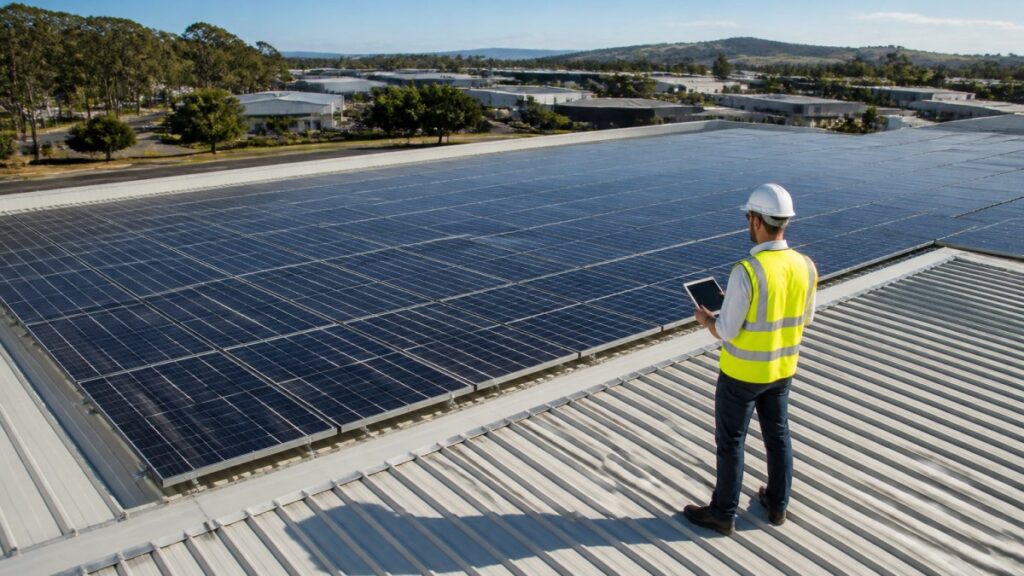
Last Updated: October 22, 2026
Quick Summary
Commercial solar financial benefits are especially significant for businesses with consistent daytime operations, as systems reduce electricity bills from month one by offsetting grid power and generating credits from excess energy. Over a typical 25-30 year lifespan, commercial solar delivers substantial long-term savings that compound as grid electricity rates climb, with most systems achieving payback in 5-10 years and then generating 17-22 years of additional savings.
- Commercial solar payback typically ranges from 5 to 10 years depending on system size, local electricity rates, and available incentives.
- Inverter replacement in year 10-15 is the single most likely significant cost in a 25-30 year horizon and should be budgeted explicitly.
- Self-consumption ratio is the dominant financial variable: moving from 50% to 75% self-consumption typically improves lifetime returns more than any other single change.
- Small-scale technology certificates (STCs) and accelerated depreciation rules provide meaningful upfront tax benefits that reduce net installation cost.
- A defensible business case requires three scenarios (conservative, realistic, optimistic) built from clearly stated assumptions, not a single-point payback estimate.
Table of Contents
- How Commercial Solar Reduces Electricity Bills
- Understanding Commercial Solar ROI and Long-Term Savings
- Commercial Solar Payback Period: What to Expect
- Commercial Solar Financing Options and Capital Planning
- Commercial Solar Panel Lifespan and Equipment Replacement Costs
- Tax Benefits, Incentives, and Accounting Implications
- Scenario-Based Financial Modelling and Risk Assessment
- Frequently Asked Questions
How Commercial Solar Reduces Electricity Bills
Commercial solar systems generate electricity from sunlight, offsetting grid power and lowering electricity bills, the commercial solar financial benefits are especially significant for businesses with consistent daytime operations.
Panels convert sunlight into direct current, which an inverter converts to alternating current for facility use.
Most commercial operations see bill reductions from month one.
Matching when you use power with when solar produces it is where real savings begin.
Understanding Commercial Solar ROI and Long-Term Savings
Return on investment measures the total financial benefit your system generates over its lifetime against the upfront capital cost. This is where commercial solar financial benefits become compelling.
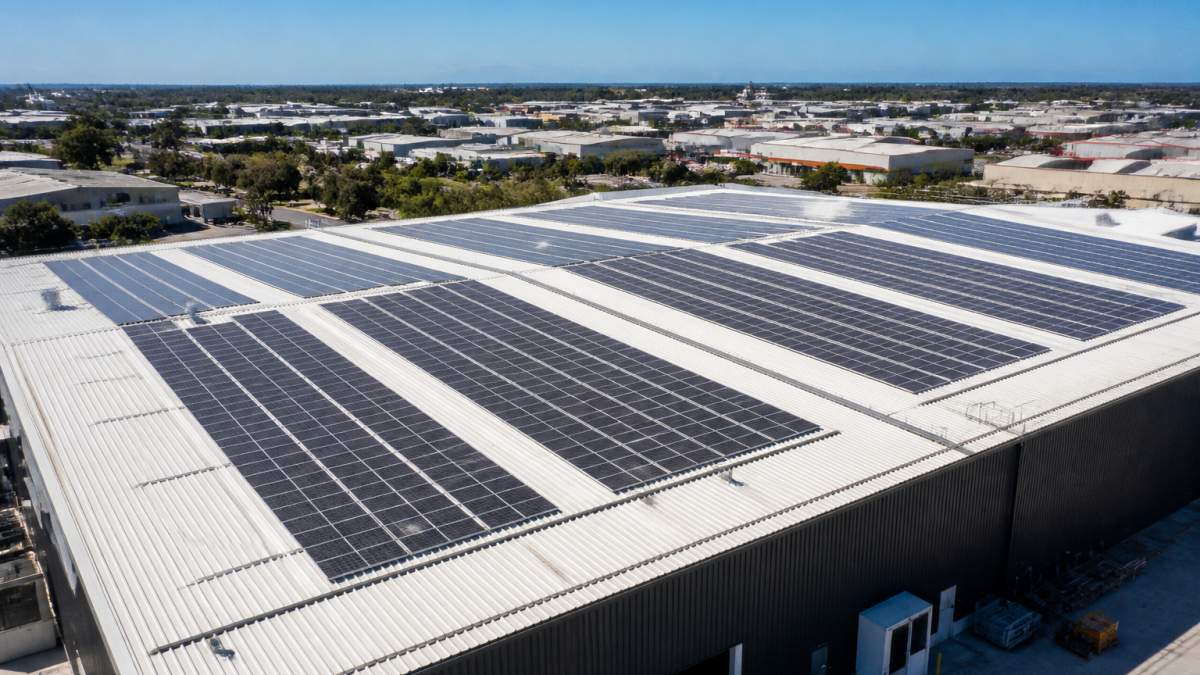
Your ROI calculation rests on electricity bill savings, government incentives, tax deductions, and maintenance costs.
Commercial solar panels typically remain productive for 25-30 years, so your business benefits from reduced electricity costs for decades.
As electricity rates climb, your solar system’s value increases.
Commercial Solar Payback Period: What to Expect
The payback period is the time it takes for electricity bill savings to equal your initial investment. For commercial solar, this typically ranges from 5 to 10 years, depending on system size, local electricity rates, and available incentives.
High electricity consumption accelerates payback because you save more per month. Businesses in areas with higher grid rates see faster returns, and government rebates and tax incentives reduce your net capital outlay, shortening payback.
Honest financial modelling is essential.
Payback matters, but it’s not the whole story. A system with an 8-year payback provides 17-22 years of additional savings after breakeven, that’s where the real financial benefit compounds.
Commercial Solar Financing Options and Capital Planning
Most commercial businesses don’t pay cash for solar. They choose from several financing structures, each with different cash flow implications and long-term costs.
A solar loan lets you borrow the capital cost and repay over a set term, typically 5-10 years. Monthly payments are usually offset by electricity bill savings, so the system pays for itself while you build equity. It suits businesses with stable cash flow and moderate to high electricity consumption.
Solar leases work like PPAs but with fixed monthly payments rather than per-unit pricing.
Outright purchase requires significant capital but delivers maximum long-term returns: you own the system, claim all tax benefits, and capture 100% of electricity savings for 25+ years.
Commercial Solar Panel Lifespan and Equipment Replacement Costs
Lifetime savings are only meaningful once you subtract lifetime costs. A proper lifecycle view accounts for every cost between commissioning and decommissioning, and how those costs interact with warranty terms and your ownership structure.
Degradation: the slow, predictable decline
Commercial panels typically degrade around 0.5% of output per year, and most tier-one warranties guarantee at least 80-85% of nominal output at year 25. A system doesn’t fail at year 25, it simply produces less, so degradation is a gentle downward slope, not a cliff, and savings don’t stop when the warranty does. Because that gradual decline leaves savings in place for years, financing the upfront investment through SCORE Commercial Capital can be weighed against the system’s long-term production.
The replacement schedule you should budget for
A commercial system is a set of components with different expected lives, and the lifecycle model should treat each separately:
- Inverters, commonly expected to last 10-15 years, with many commercial inverters warranted for 10 years and extended warranties available at additional cost. A mid-life inverter replacement is the single most likely significant cost in a 25-30 year horizon. Budget for it explicitly rather than treating it as a contingency.
- Battery storage, if installed, typically 10-15 years depending on chemistry and cycle depth, with capacity fading over that period. Battery replacement in the second decade is a realistic line item, and replacement costs have been falling, so modelling today’s price is conservative.
- Mounting and balance of system, rails, clamps, cabling, and isolators generally outlast the panels but are not maintenance-free. Connectors and isolators are common failure points and should be inspected periodically.
Build a simple replacement reserve into your cash-flow model: an annual set-aside that covers expected inverter replacement, minor component failures, and battery replacement if applicable. A project that only works if nothing is ever replaced is not a long-term investment case.
Warranty is not the same as cost-free
Warranties are valuable but don’t eliminate lifecycle cost. They typically cover replacement of defective equipment, not labour, access, scaffolding, or lost generation; performance warranties guarantee a minimum output percentage, not a payment if output falls short; and workmanship warranties depend on the installer still being in business. Read the terms for what’s excluded, who performs the work, and how a claim is made.
Insurance, maintenance, and site-specific costs
Ongoing costs vary with site and ownership structure, but the categories are consistent:
- Insurance, the array should be listed on your property or business insurance policy; premiums may rise modestly to reflect the added asset value and any hail or wind exposure.
- Preventive maintenance, periodic inspection, cleaning where soiling is significant, thermal imaging to detect underperforming strings, and tightening of connections. For most commercial sites this is a modest annual cost, but it protects yield and warranty validity.
- Roof and access, if the roof needs repair or replacement before the panels reach end of life, removal and reinstallation is a real cost. Check roof condition before installation, not after.
Decommissioning and end-of-life
Panel recycling infrastructure is developing, and end-of-life costs are uncertain but should not be assumed to be zero. A prudent model includes a modest decommissioning and recycling allowance at year 25-30, or at least acknowledges that removal and disposal will carry a cost. This is a small line item relative to lifetime savings, but including it makes the model honest and avoids a nasty surprise for whoever owns the building at end of life.
How lifecycle costs change the ownership decision
Lifecycle costs fall differently depending on ownership. Under outright purchase, you bear inverter replacement, insurance, maintenance, and decommissioning, but capture every kWh of savings and any residual value. Under a PPA or lease, the third party owns replacement and maintenance obligations, and you pay for that through the rate or rental. Neither structure is inherently better; the lifecycle cost sits somewhere in the deal, and a comparison that ignores it is not a comparison.
Netting it all out
Present long-term financial benefits net, not gross: projected generation over 25-30 years times the value of self-consumed and exported energy under stated assumptions, minus capital cost net of incentives, minus the replacement reserve, insurance, maintenance, and end-of-life allowances. If that net figure is positive under conservative assumptions, the case is robust; if it only works when nothing is ever replaced and tariffs rise every year, it’s a hope rather than a plan.
Tax Benefits, Incentives, and Accounting Implications
Australia’s tax framework provides meaningful incentives for commercial solar.
Small-scale technology certificates (STCs) are another significant incentive (Small-scale technology certificates).
Accelerated depreciation rules let businesses write off solar systems faster than traditional assets, front-loading tax benefits and improving early-year cash flow.
Accounting treatment depends on ownership. Owned systems appear as depreciable assets on your balance sheet, with annual depreciation reducing taxable income.
Scenario-Based Financial Modelling and Risk Assessment
Most commercial solar business cases fail not because the technology underperforms, but because the model behind them was a single-point estimate dressed up as a forecast. A defensible case needs three things: clearly stated assumptions, a few scenarios built from them, and a sensitivity test showing which variables actually move payback and lifetime return.
Start with stated assumptions, not headline savings
A transparent model lists every input so a reviewer can challenge it. Core assumptions for a typical commercial installation:
- System size and generation yield, for example, a 100 kW system in a temperate zone might be modelled at 1,350-1,500 kWh per kW of capacity per year, giving roughly 135,000-150,000 kWh annually. Use a yield figure sourced from a bankable design tool or your installer’s modelling, not a marketing estimate.
- Self-consumption ratio, the share of generation used on site rather than exported. A business operating 8am-5pm on weekdays might self-consume 60-75% of generation; a 24-hour operation with high base load can exceed 85%; a business closed on weekends may drop to 50% or lower.
- Retail tariff and tariff structure, the per-kWh rate you avoid, plus demand charges if your network applies them. Time-of-use tariffs mean midday generation may offset a lower off-peak rate unless you also shift load.
Ask your installer for the modelling file, not just the summary. A one-page payback figure cannot be stress-tested; a spreadsheet with named assumptions can.
Build three scenarios from the same assumptions
Conservative, realistic, and optimistic cases should differ only in inputs you can justify varying, not in the model’s structure.
- Conservative, lower self-consumption (say 50%), a flat retail tariff with no real escalation, a low export rate, higher maintenance, and a capital cost at the top of the quoted range.
- Realistic, self-consumption in line with your metered load profile, retail tariff escalation roughly in line with recent long-run averages, mid-range capital cost, and standard degradation.
- Optimistic, high self-consumption from load shifting, stronger tariff escalation, and capital cost at the bottom of the range after incentives.
The purpose isn’t to pick the middle case and call it a forecast, but to see whether the project still clears your hurdle rate in the conservative case. If payback stretches beyond your acceptable window under conservative assumptions, the project is a bet on favourable conditions rather than a robust investment.
Sensitivity analysis: which variables actually matter
A sensitivity test changes one input at a time and records the effect on payback and 25-year net benefit. Four variables dominate:
- Self-consumption ratio. Moving from 50% to 75% self-consumption typically improves lifetime returns more than any other single change, because each self-consumed kWh avoids the full retail rate while each exported kWh earns only the export rate. Load matching is therefore a financial lever, not just an engineering detail.
- Retail tariff escalation. If tariffs rise faster than modelled, payback shortens; if they stagnate, it lengthens. Because you cannot control this, the honest approach is to test a zero-escalation case and confirm the project still works.
- Export rate and export limits. Many networks cap export per phase or per site, and some no longer offer a premium feed-in tariff for new commercial systems. If your model assumes you can export unlimited surplus at a generous rate, it is fragile.
- Capital cost and incentive value. STC prices move with the market, and rebate availability depends on scheme rules and installation dates. Model the net cost you can actually lock in, not the best-case certificate price.
Interest rates matter for financed projects but not cash purchases; degradation and maintenance matter, but usually by a smaller margin than self-consumption and tariff assumptions. Rank your sensitivities so you know where to spend diligence effort.
Model the risks, not just the returns
The risks that erode long-term returns are predictable and belong in the model as line items or scenarios:
- Load profile drift, a tenant change, shift pattern change, or new equipment can move self-consumption materially. Model a downside case where your daytime load falls.
- Network and tariff reform, demand charges, export charges, and changes to solar-specific tariffs are live policy questions. A model that assumes today’s tariff structure persists for 25 years is optimistic by default.
- Equipment failure outside warranty, inverter replacement in year 12-15 is a real cost; include it.
A payback figure quoted without its assumptions is not a financial analysis. Treat any single-number payback claim, from an installer, a lender, or a competitor’s website, as a prompt to ask what self-consumption, tariff, and export assumptions sit behind it.
What a defensible model looks like in practice
A credible commercial solar business case fits on two pages: an assumptions table, a three-scenario summary showing payback and 25-year net benefit, a sensitivity table ranking the four variables above, and a short risk register. If your installer can’t produce that, the modelling is being done for you rather than with you, and the long-term financial benefits you’re relying on haven’t been tested.
Frequently Asked Questions
How long does it take for a commercial solar system to pay for itself?
Payback periods vary based on system size, electricity consumption, and local tariffs, typically ranging from 5 to 10 years. The actual timeline depends on your current electricity bills, available roof space, and whether you choose to finance or purchase outright. Factors like feed-in tariff rates and seasonal load patterns affect cash flow timing. Request a personalised financial model for your specific situation to see realistic payback scenarios.
What is the commercial solar ROI for a typical business?
Return on investment depends on your electricity usage, system size, and financing method. Businesses that offset high daytime consumption typically see stronger returns. Over a 25-year system lifespan, operational savings, reduced grid reliance, and protection against electricity price increases contribute to a positive return. Your actual ROI requires analysis of your load profile and local electricity rates.
Can a business claim tax deductions for commercial solar?
Yes. Businesses may claim depreciation on solar equipment under the Capital Allowances scheme, and the Australian Taxation Office permits deductions for installation and associated costs. Consult your accountant about eligibility, timing, and how depreciation interacts with your specific business structure. Tax treatment varies by company type and financial circumstances, so professional advice is essential before installation.
What financing options are available for commercial solar panels?
Common options include outright purchase, solar loans, leases, and power purchase agreements (PPAs). Each has different cash flow, ownership, and tax implications. Loans allow you to own the system and claim tax benefits; leases minimise upfront costs but limit long-term savings; PPAs shift risk to a third party. Compare scenarios based on your capital availability, expected system lifespan, and preference for ownership versus operational simplicity.