
Table of Contents
- Why Local Solar Manufacturing Has a Lower Environmental Impact
- The Carbon Footprint of Solar Energy: Production vs. Operation
- Sustainable Solar Manufacturing Practices That Matter
- Comparing Local Production vs. Global Shipping Emissions
- Solar Panel Recycling Australia: Managing End-of-Life
- Myths vs. Facts in Solar Manufacturing
- How to Choose a Solar System with a Lower Footprint
- Conclusion
- Frequently Asked Questions
Last Updated: September 6, 2026
When you picture solar panels, you likely imagine them soaking up sunlight on a roof, silently generating clean power for decades. What most people don’t picture is the energy-intensive process of manufacturing those panels, which involves mining quartz, purifying silicon at extreme temperatures, and assembling components across a global supply chain. At Solazone Australia, we believe homeowners deserve to understand the full picture before making a significant investment in renewable energy.
The reality is more nuanced: a panel made in a factory powered by coal carries a different footprint than one made with renewable energy. The manufacturing location matters enormously. Below, we break down the carbon footprint of solar energy, explain how local production reduces emissions, and give you a practical checklist for choosing a system with genuinely lower environmental impact.
Why Local Solar Manufacturing Has a Lower Environmental Impact
Solar panel manufacturing is energy-intensive, particularly the silicon purification stage, which requires temperatures above 1,000°C. When panels are made in regions that rely heavily on coal-fired electricity, the embodied carbon of each panel rises significantly. Local manufacturing, particularly in a country with a growing renewable energy grid, reduces the emissions intensity of the production process itself.
Beyond the factory floor, local manufacturing shortens the supply chain. Panels shipped from overseas travel thousands of kilometres by sea and road, adding transport emissions to every unit. Local production also tends to face stricter environmental regulations regarding hazardous materials and waste management, which reduces the risk of toxic pollution during manufacturing.
The two biggest factors driving the footprint of a solar panel are the energy mix of the factory that made it and the distance it travelled to reach your roof. Local manufacturing improves both.
The Carbon Footprint of Solar Energy: Production vs. Operation
A solar panel’s carbon footprint is front-loaded. The greenhouse gas emissions occur during manufacturing, while the operational phase produces negligible emissions. This is the opposite of fossil fuel energy, where emissions occur continuously during combustion.
Energy payback time measures how long a panel must operate to generate the same amount of energy that was used to produce it. For modern photovoltaic systems, this is typically between one and three years, depending on the manufacturing location and the solar resource at the installation site. Given that panels last 25 to 30 years, the vast majority of a panel’s life is spent producing clean energy.
Energy Payback Time Explained
A panel with a payback period of two years installed in sunny conditions will deliver roughly 25 years of net-positive energy output. Shorter payback periods mean lower overall environmental impact.
Sustainable Solar Manufacturing Practices That Matter
While the energy source is the dominant factor, several other practices significantly reduce the overall environmental burden.
Closed-Loop Water Systems
Solar cell production is water-intensive, particularly for washing and cooling. Closed-loop water systems recycle up to 90% of process water on-site through filtration, reverse osmosis, and ion-exchange steps. This practice is critical in water-stressed regions and reduces the strain on local municipal water supplies and natural waterways.
Chemical Management and Abatement
The manufacturing process, especially the etching and cleaning of silicon wafers, relies on hazardous chemicals like hydrofluoric acid, nitric acid, and various solvents. A sustainable facility employs a multi-stage abatement system:
- Neutralisation: Acidic and basic waste streams are neutralised in dedicated tanks before entering the main treatment system.
- Precipitation: Heavy metals like lead and cadmium, if present, are precipitated out of the solution as solid sludge, which is then disposed of as hazardous waste at a licensed facility.
- Biological Treatment: Organic solvents are broken down using biological digestion processes, similar to a municipal wastewater plant, before the final effluent is released.
Leading manufacturers publish their chemical usage and abatement efficiency rates in annual sustainability reports, allowing for third-party verification of their claims.
Renewable Energy Procurement
The most direct way to lower a panel’s embodied carbon is to power the factory with renewable energy. Many manufacturers enter into long-term Power Purchase Agreements (PPAs) with wind or solar farms, while others purchase Renewable Energy Certificates (RECs). The distinction matters: a PPA adds new renewable capacity to the grid, while RECs may not directly reduce a factory’s emissions. The most credible claims are backed by a PPA or direct investment in on-site generation.
Supply Chain Transparency and Certifications
Reputable manufacturers now provide detailed traceability for their products, allowing customers to see where the polysilicon was produced and the wafers were cut. This is often verified through third-party certifications, including:
- ISO 14001: An international standard for environmental management systems, confirming a facility has a structured approach to managing its environmental responsibilities.
- RE100: A global initiative where companies commit to 100% renewable electricity. A manufacturer’s membership is a clear signal of its commitment.
- NSF/ANSI 457: A sustainability leadership standard specifically for solar modules, which evaluates a product’s environmental, social, and governance (ESG) performance across its entire life cycle.
When evaluating a manufacturer’s claims, look for specific data in their sustainability report, such as the percentage of water recycled, the energy mix of their production facility, and the names of the third-party auditors who verified their data. A vague statement like ‘we care about the environment’ is not a substitute for audited metrics.
Comparing Local Production vs. Global Shipping Emissions
The debate between local and overseas manufacturing is a complex calculation involving production energy mix, freight logistics, and supply chain architecture. The most significant advantage of local manufacturing is the ability to control and decarbonise the entire production process.
The Carbon Cost of Shipping
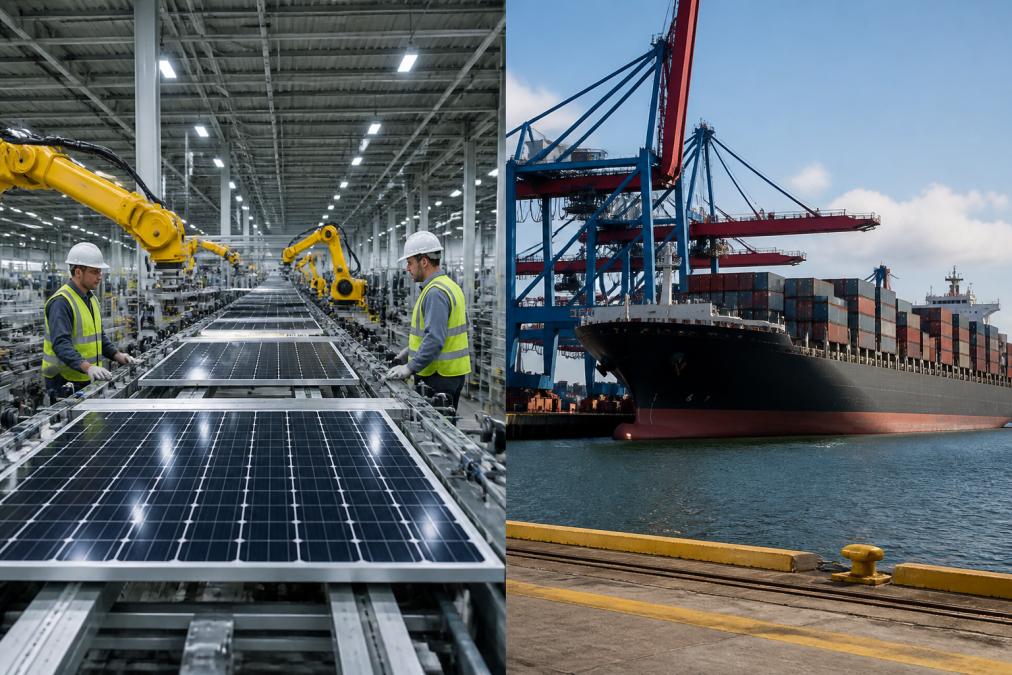
Shipping a standard 20-kilogram panel from Asia to Australia adds approximately 20 to 30 kilograms of CO2-equivalent emissions, compared to a panel’s total embodied carbon of typically 500 to 700 kilograms. While this shipping component is often less than 5% of the total, it is a completely avoidable emission that local manufacturing eliminates.
The Decarbonisation Advantage
A factory powered by 100% renewable energy can reduce the panel’s production-phase emissions by over 70% compared to a coal-powered facility. When a country invests in local manufacturing, it can pair that investment with new renewable energy generation, creating a virtuous cycle where the panels themselves are made with clean energy.
The Circular Economy and Supply Chain Proximity
Local manufacturing enables efficient take-back and recycling programs, feeding glass, aluminium, and silicon directly back into the manufacturing process. This reduces the environmental impact of raw material extraction and the emissions associated with transporting waste.
A Framework for Evaluation
A consumer or business should ask not just ‘where was this made?’ but ‘what is the specific carbon footprint of this product, from mine to installation?’. A useful comparison requires a detailed assessment of the entire supply chain, including:
- Polysilicon Source: Where was the raw silicon produced, and what energy source was used?
- Ingot and Wafer Production: This is the most energy-intensive step. What is the energy mix of that facility?
- Cell and Module Assembly: What is the energy mix of the final assembly plant?
- Logistics: What is the total distance travelled by sea, rail, and road?
A panel assembled locally but using imported cells from a coal-powered factory may have a higher footprint than one assembled overseas in a hydroelectric-powered facility. The ‘local’ label is only a proxy for a more complex set of factors.
The most significant carbon savings from ‘local’ manufacturing come not from the shorter shipping distance, but from the opportunity to power the entire production process with renewable energy. The key question is not just where a panel is assembled, but the carbon intensity of the energy used at every stage of its supply chain.
Solar Panel Recycling Australia: Managing End-of-Life
Solar panel recycling Australia is an emerging industry and a critical piece of the environmental puzzle. Panels contain valuable materials, including aluminium frames, glass, and silicon, along with small amounts of heavy metals such as lead and cadmium. Without proper recycling, these panels end up in landfill, where the heavy metals present a long-term contamination risk.
Mechanical recycling processes can recover glass and aluminium frames with high efficiency. More advanced processes use thermal or chemical treatments to separate and purify silicon cells for reuse. As the first wave of panels reaches the end of its 25-year life, the volume of decommissioned panels will grow substantially, making investment in recycling infrastructure a priority.
Do not dispose of old panels in general waste. The heavy metals inside them can leach into soil and groundwater. Check with your state or territory environment agency for accredited panel recyclers in your area.
Myths vs. Facts in Solar Manufacturing
Several myths persist about solar manufacturing, often discouraging adoption of one of the lowest-impact energy technologies available.
Myth: Solar panels produce more pollution than they save.
Fact: The energy payback time of a modern panel is one to three years, meaning the panel generates clean energy for over two decades after offsetting its production footprint.
Myth: Manufacturing solar panels creates toxic waste that outweighs the benefits.
Fact: While hazardous materials are used in production, regulated factories treat and manage these chemicals. The emissions avoided during a panel’s 25-year operating life vastly exceed the manufacturing impacts.
Myth: Solar panels can’t be recycled, so they all end up in landfill.
Fact: Panel recycling is commercially viable and growing. Glass, aluminium, and silicon are all recoverable, and new facilities are being established to handle the coming wave of end-of-life panels.
How to Choose a Solar System with a Lower Footprint
The most important factor is the energy mix of the manufacturing facility. Panels made in factories powered by renewable energy have a significantly lower embodied carbon than those made with coal-fired electricity.
Durability matters: a panel that lasts 30 years has a lower lifetime footprint than one that needs replacement after 15 years, even if the initial manufacturing footprint is identical. Look for panels with strong degradation warranties and proven performance records.
Consider the inverter and mounting system, which have their own manufacturing footprints and lifespans. A high-quality inverter that lasts 15 years is better than a cheaper unit that fails after five.
Finally, choose an installer who thinks about the whole system. At Solazone Australia, we recommend Australian-made systems where possible, not because of sentiment but because local production shortens transport routes and supports domestic environmental standards. Our team applies its experience to designing systems that balance cost, performance, and environmental impact.
Conclusion
Shorter transport distances, cleaner production energy, and stronger regulatory oversight all contribute to a lower overall footprint. Combined with a panel’s 25-year clean energy output and the growing recycling industry, solar power remains one of the most effective tools for reducing household emissions.
The challenge is choosing wisely. Not all panels carry the same environmental burden, and the questions you ask your installer matter. Ask about manufacturing locations, energy sources, and degradation warranties. Ask about end-of-life options and recycling pathways. Then choose a system that aligns with your values and your energy needs.
Solazone Australia combines over 40 years of technical expertise with a commitment to Australian-made systems, personalised customer service, and experienced installation teams. We help homeowners and businesses reduce energy costs while supporting genuinely sustainable energy infrastructure. Get started with Solazone Australia and put a lower-footprint solar system on your roof.
Frequently Asked Questions
How does local manufacturing reduce the carbon footprint of solar energy?
Local manufacturing cuts the carbon footprint of solar energy by reducing long-distance freight. Shipping panels from overseas adds significant emissions from container ships and trucks. Producing panels closer to where they are installed also allows for tighter quality control and compliance with local environmental regulations, which often enforce cleaner energy sources in factories. Over a panel’s 25-30 year life, the manufacturing phase is a small part of total emissions, but choosing locally made panels lowers that upfront cost noticeably.
What materials in solar panels are recyclable in Australia?
In Australia, solar panel recycling focuses on recovering glass, aluminium frames, and copper wiring, which make up about 80-85% of a panel’s weight. The remaining materials, including silicon cells and silver contacts, are harder to separate. Specialist recyclers are developing processes to recover these valuable materials. The PV module stewardship scheme is being developed to create a national framework, but it is not yet fully operational. Ask your installer about take-back programs to ensure proper end-of-life handling.
What are the main environmental impacts of manufacturing solar panels?
The main impacts occur during the raw material extraction and purification stages. Producing polysilicon requires high temperatures, which is energy-intensive. Manufacturing also uses hazardous chemicals like hydrochloric acid and produces by-products that need careful handling. These steps contribute to the carbon footprint of solar energy, but they are offset by the clean electricity generated over the panel’s lifetime. Choosing a manufacturer with strong environmental regulations and waste management practices reduces these impacts.
Does the environmental impact of local solar manufacturing justify a higher upfront cost?
For many buyers, yes. Panels made locally often have a slightly higher purchase price, but they carry a lower carbon footprint because they avoid long shipping routes and are produced under stricter environmental regulations. You also gain assurance that the factory follows sustainable solar manufacturing practices. To decide, compare the payback period of the system against the emissions saved. If reducing your total environmental impact is a priority, the premium for local manufacturing is a direct investment in that goal.