
Table of Contents
- What Makes a High Quality Solar Power System in Australia
- Best Solar Panels Australia: Premium Tier-1 Manufacturers
- Solar Panel Warranty Australia: Product vs Performance Protection
- Inverter Selection for High Quality Solar Power Systems
- Solar System Cost Australia: Pricing, ROI & Financial Incentives
- Choosing a Solar Installer Australia: Reviews & Red Flags
- Battery Storage Compatibility & Post-Installation Monitoring
- Environmental Impact: Panel Recycling & Sustainability
Last Updated: July 24, 2026
High quality solar power systems reduce energy costs while contributing to sustainability. At Solazone Australia, we’ve spent over 40 years helping homeowners and businesses navigate solar technology, installation standards, and long-term performance. This guide separates premium systems from mediocre installations, covering panel efficiency, warranty protection, and real-world degradation rates.
According to Clean Energy Council Australia 2026 market analysis, over 3.3 million Australian homes now have rooftop solar, yet satisfaction varies wildly depending on installer quality and component selection. This guide cuts through marketing noise and shows you exactly what to prioritize when investing in high quality solar power systems.
What Makes a High Quality Solar Power System in Australia
A high quality solar power system combines tier-1 panel manufacturers with proven track records, inverters that maximise energy conversion efficiency, and professional installation by CEC-accredited technicians. A cheap system might save $3,000 upfront but cost $15,000 in lost energy production over 25 years.
Key Performance Indicators: Efficiency, Degradation & Warranties
Panel efficiency tells you how much sunlight converts to usable electricity. Modern premium panels achieve 22-24% efficiency, while budget options sit at 18-20%. That 4-6 percentage point difference translates directly to kilowatt-hours generated annually.
Degradation rate is equally important but often overlooked. Quality panels degrade at approximately 0.5% per year, meaning a 6kW system loses roughly 300W of output annually. Budget panels can degrade at 0.8-1% per year, compounding losses significantly over 25 years.
| Performance Metric | Premium Systems | Budget Systems | Real-World Impact |
|---|---|---|---|
| Panel Efficiency | 22-24% | 18-20% | ~15% more annual energy |
| Degradation Rate | 0.5%/year | 0.8-1%/year | ~$4,000 difference over 25 years |
| Inverter Efficiency | 97-98% | 94-96% | ~2% more usable power |
| Warranty Coverage | 25-40 years | 10-15 years | Peace of mind + replacement costs |
Warranties come in two types: product warranties (covering physical defects) and performance warranties (guaranteeing minimum output levels). Premium manufacturers like SunPower offer 40-year product warranties and 93% performance guarantees. Mid-tier brands like REC and JinkoSolar provide 25-year product warranties with 92% performance protection. Budget options often cap at 10-12 years on products and 80-85% performance.
CEC Approval and Safety Standards
Australia’s Clean Energy Council (CEC) accreditation is non-negotiable. Any installer you hire must employ CEC-certified electricians and installers. This is a legal requirement for accessing Small-scale Technology Certificates (STCs) and feed-in tariff payments.
Your system must comply with AS/NZS 4777 (grid connection standard) and AS/NZS 5033 (installation standard). These standards ensure your system won’t damage the grid, won’t pose fire hazards, and won’t create safety risks during maintenance. Clean Energy Council installer accreditation requirements outlines specific qualifications your installer must hold. Non-compliant installations can void warranties and result in system disconnection by your local network operator.
Best Solar Panels Australia: Premium Tier-1 Manufacturers
The solar panel market divides clearly between tier-1 manufacturers (established, financially stable, proven performance) and tier-2/3 options (newer, less data, higher risk). For high quality solar power systems, tier-1 panels are the only sensible choice.
SunPower Maxeon: Maximum Efficiency & Longevity
SunPower’s Maxeon panels use Interdigitated Back Contact (IBC) cell technology, achieving 24.2% efficiency, the highest in residential solar. These panels generate more power per square metre than competitors, ideal for roofs with limited space or heavy shading constraints.
The Maxeon 7 panel includes a 40-year product warranty and 93% performance guarantee. SunPower panels have the lowest degradation rates in the industry at 0.3% annually. Over 25 years, that means your system retains 92.5% output versus 87.5% for average panels, an extra 5% energy production with zero additional cost beyond the panel premium.
Best for: Homes with limited roof space, properties facing significant shading challenges, or owners prioritising maximum lifespan and minimal maintenance.
REC Alpha Pure-R: Sustainability Meets Performance
REC Solar positions itself as the sustainability-conscious choice. Their Alpha Pure-R panels are lead-free, RoHS compliant, and manufactured using renewable energy. Performance-wise, REC delivers 22.6% efficiency with a 25-year product warranty and 92% performance guarantee. The panels handle Australian heat exceptionally well, crucial for regions regularly exceeding 35°C.
The real differentiator: REC’s warranty covers labour costs for replacements within the first 10 years. Most manufacturers only cover the panel itself, leaving you with $1,500+ in installation costs if a panel fails.
Best for: Environmentally conscious homeowners, properties in hot climates, or owners wanting comprehensive warranty protection beyond hardware.
JinkoSolar Tiger Neo: Proven Reliability in Australian Conditions
JinkoSolar is the world’s largest solar module manufacturer by volume. Their Tiger Neo series uses N-type cell technology, which outperforms traditional P-type cells in low-light conditions and heat stress. The Tiger Neo achieves 22.84% efficiency with a 25-year product warranty. JinkoSolar has been in Australia for over a decade with established local support networks.
Best for: Large-scale residential installations, properties with partial shading, or owners wanting proven reliability from a globally-backed manufacturer with local support.
LONGi Hi-MO X6 & Trina Vertex S+: Value Without Compromise
LONGi’s Hi-MO X6 panels deliver 23.3% efficiency using gallium-doped cells for improved stability. Trina’s Vertex S+ series achieves 23% efficiency and handles Australia’s heat exceptionally well with 25-year warranty. Both manufacturers represent the "sweet spot" for most Australian installations, tier-1 reliability without SunPower premiums.
Best for: Budget-conscious installations that refuse to compromise on reliability, medium-sized systems (5-10kW), or owners wanting proven Australian field performance data.
Solar Panel Warranty Australia: Product vs Performance Protection
Understanding warranty differences is critical because they directly impact your long-term costs. Product warranties cover manufacturing defects, cracked cells, junction box failures, and delamination. Performance warranties guarantee minimum output levels.
A product warranty promises the panel won’t physically fail for X years. Most product warranties run 10-25 years, with premium brands like SunPower extending to 40 years. A performance warranty guarantees the panel produces at least X% of its rated output. Most performance warranties run 25-30 years, with SunPower extending to 40 years at 93% output.
A product warranty without a performance warranty is almost useless. A panel could technically function while producing only 70% of rated output. Premium manufacturers combine strong product warranties (25+ years) with aggressive performance guarantees (90%+ output at year 25).
Check whether your warranty covers labour costs for replacement installation. Most manufacturers cover only the panel itself. REC and SunPower cover labour within specific timeframes, saving you $1,500-2,500 if a panel fails during year 5-10.
Real-World Degradation Rates & Long-Term Performance
Laboratory testing shows average annual degradation of 0.5-0.8%. Real-world Australian installations vary by climate. Coastal installations (salt air, humidity) see 0.6-0.8% annually. Inland installations in hot, dry climates show lower degradation, 0.4-0.6% annually.
Poor installation dramatically accelerates degradation. Panels installed at incorrect angles or with inadequate ventilation can degrade at 1.2-1.5% annually. CEC-accredited installers know how to position panels for optimal airflow and protection from environmental hazards.
After 25 years, a premium panel (0.5% degradation) produces 87.5% of original output. A budget panel (0.9% degradation) produces 77.5% of original output. That 10% difference compounds to roughly $3,000-4,000 in lost energy production.
Inverter Selection for High Quality Solar Power Systems
The inverter converts DC power from panels into AC power your home uses. It’s the system’s most failure-prone component, typically lasting 10-15 years versus panels lasting 25-40 years.
String Inverters: Fronius Primo & Sungrow Hybrid
String inverters connect multiple panels in series. If one panel is shaded, the entire string’s output drops proportionally. This remains the most cost-effective approach for unshaded roofs.
The Fronius Primo achieves 97.5% efficiency, includes integrated monitoring, and has exceptional local support through offices in Melbourne and Perth. Sungrow’s hybrid inverters dominate the "best value" category in Australian installer surveys, delivering 97% efficiency and integrating seamlessly with battery storage systems at 20-30% lower cost than European alternatives.
String inverters work best when shading is minimal and roof layout is straightforward.
Microinverters: Enphase IQ for Shading & Complex Roofs
Microinverters attach to individual panels, converting DC to AC at the source. If one panel is shaded, only that panel’s output drops. Enphase IQ microinverters achieve 96.5% efficiency with 25-year warranty and exceptional real-time monitoring.
Microinverters cost roughly 40% more than string inverter systems per watt. However, if your roof has significant shading, complex layout, or you anticipate adding panels later, microinverters often deliver superior long-term value.
Microinverters are overkill for unshaded roofs with simple layouts. You’ll pay premium pricing for capability you don’t need. Evaluate your specific roof conditions before committing to microinverter technology.
Solar System Cost Australia: Pricing, ROI & Financial Incentives
System costs vary dramatically based on panel quality, inverter choice, battery inclusion, and installer expertise. A basic 5kW system with budget components might cost $7,000-9,000 installed. A premium 10kW system with battery storage could reach $25,000-30,000.
Understanding System Sizing & Energy Yield Calculations
System sizing depends on your annual electricity consumption, roof space available, and budget constraints. Most Australian homes use 15-20 kWh daily, requiring 5-8kW systems to achieve 80-100% self-sufficiency.
Energy yield calculations account for your location’s peak sun hours, seasonal variation, and system losses. Brisbane receives approximately 4.5 peak sun hours daily (annual average). Melbourne receives 3.8. A 5kW system in Brisbane generates roughly 8,250 kWh annually. The same system in Melbourne generates 7,100 kWh annually, a 14% difference driven purely by geography.
STCs, Feed-In Tariffs & Rebate Programs
Small-scale Technology Certificates (STCs) are tradeable credits issued for solar installations. A 5kW system typically generates 40-50 STCs, worth roughly $3,000-4,000 at current market prices. These credits reduce your upfront installation cost directly. STCs are only available for CEC-accredited installations.
Feed-in tariffs vary by state and retailer. Queensland currently pays 10-14 cents per kWh for excess solar exported to the grid. Victoria pays 10-13 cents. New South Wales pays 9-12 cents. Even modest feed-in tariffs add $300-500 annually to your savings if you generate surplus power.
Australian Government Small-scale Renewable Energy Scheme (SRES) details current STC eligibility and market prices.
Return on Investment Timeline
A typical 6kW system costs $12,000-15,000 after STCs in 2026. Annual energy savings typically reach $1,800-2,400 depending on consumption patterns and feed-in rates. Simple payback occurs in 5-8 years for most Australian installations. After payback, you’re generating essentially free electricity for the remaining 17-20 years of panel lifespan, totalling $20,000-30,000 in additional savings.
Return on investment improves dramatically with battery storage. A Tesla Powerwall 2 (13.5 kWh capacity) costs approximately $13,900-18,070 installed before rebates. With battery backup, you avoid peak-rate electricity charges (often 50-100% higher than off-peak rates), accelerating payback to 6-7 years.
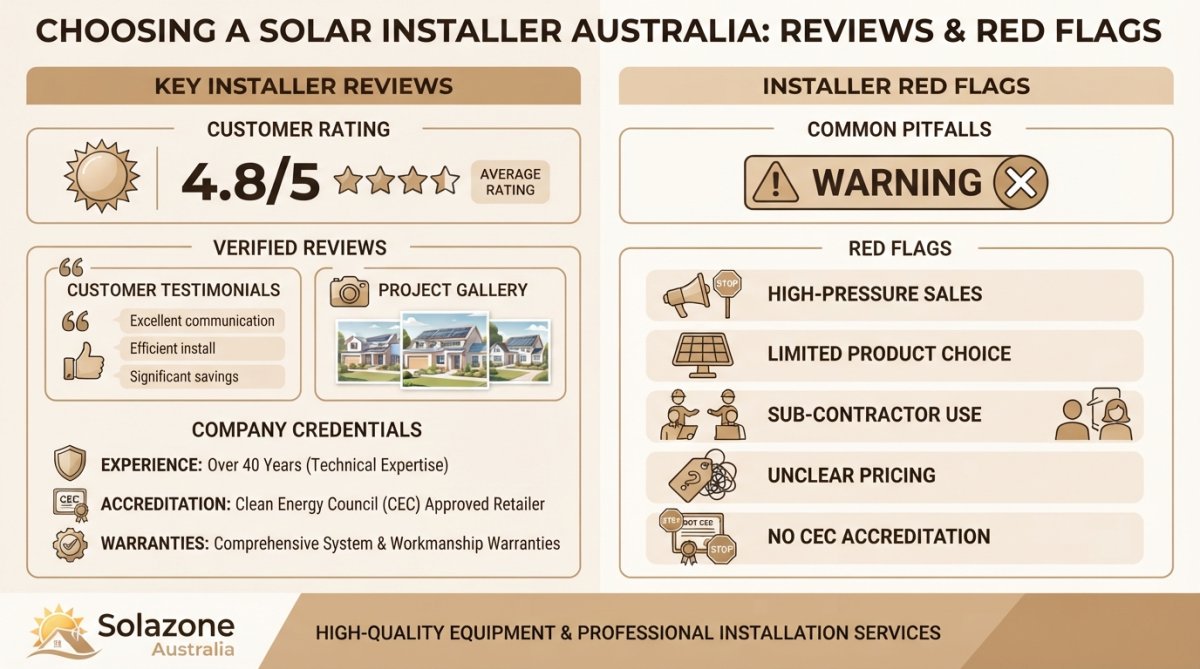
Choosing a Solar Installer Australia: Reviews & Red Flags
Installation quality matters as much as component quality. A premium panel installed incorrectly produces mediocre results. A competent installer with mid-tier components outperforms a poor installer with premium panels.
CEC Accreditation & Installation Standards
Your installer must employ CEC-accredited electricians and designers. This is a legal requirement for grid connection and STC eligibility. Verify accreditation directly on the Clean Energy Council installer database rather than trusting installer claims.
Installation standards (AS/NZS 5033) specify requirements for cable sizing, earthing, surge protection, and structural safety. A compliant installation protects your home from fire hazards and electrical faults. Non-compliant installations create insurance liability.
Ask installers about their design process. Do they conduct site surveys? Do they model shading throughout the year? Do they specify cable sizes based on your specific roof layout? Competent installers invest time in design.
What to Ask Before You Commit
-
Are all electricians CEC-accredited? Verify directly on the CEC database.
-
What’s your design process? Ask about site surveys, shading analysis, and system modelling.
-
What panels and inverters do you recommend, and why? Competent installers explain component choices based on your specific situation.
-
What’s your timeline from quote to grid connection? Realistic timelines are 4-8 weeks.
-
Do you include STCs in the quoted price, or are they separate? This affects true cost comparison.
-
What warranty support do you provide post-installation? Ask about response times for faults and monitoring system support.
-
Can you provide references from customers with similar installations? Genuine installers have happy customers willing to discuss their experience.
-
What happens if my system underperforms? Competent installers guarantee performance targets and investigate underperformance.
The cheapest quote is rarely the best value. A $2,000 discount from an inexperienced installer often costs $5,000-10,000 in lost performance, warranty complications, and future maintenance headaches. Solazone Australia’s 40+ years in the industry reflects our commitment to quality over price competition.
Battery Storage Compatibility & Post-Installation Monitoring
Battery storage transforms solar from a daytime-only energy source into a 24/7 power solution. However, not all systems integrate with batteries seamlessly.
Tesla Powerwall 2 & Hybrid System Integration
The Tesla Powerwall 2 offers 13.5 kWh usable capacity with integrated inverter functionality. It automatically charges from panels during the day and discharges during peak-rate hours or grid outages.
Compatibility depends on your inverter choice. String inverters like Fronius Primo require a separate battery inverter (additional cost and complexity). Hybrid inverters like Sungrow integrate battery management directly, simplifying installation.
Powerwall 2 includes 10-year warranty with 70% capacity guarantee. After 10 years, the battery typically retains 80-85% capacity. Battery storage becomes financially viable when your feed-in tariff is low (under 12 cents) or your peak-rate electricity is high (above 40 cents). In Queensland and NSW, battery payback typically occurs in 7-10 years.
Smart Energy Management & Long-Term Maintenance
Modern solar systems include monitoring platforms that track generation, consumption, and battery status in real-time. Solazone Australia recommends reviewing your monitoring data quarterly to identify performance issues early.
Typical maintenance requirements are minimal: annual panel cleaning (particularly in dusty regions), inverter firmware updates, and battery system checks if applicable. Performance monitoring reveals degradation trends. If your system’s output drops 5-10% year-over-year unexpectedly, investigation is warranted.
Environmental Impact: Panel Recycling & Sustainability
Solar panels contain valuable materials (silicon, glass, aluminium, copper) and small quantities of hazardous substances. Responsible recycling recovers 95%+ of panel materials. Australia’s solar recycling infrastructure is developing, with most end-of-life panels currently exported to Europe or Asia where established recycling processes exist.
Panel lifespan (25-40 years) means recycling remains a future concern for most current installations. However, choosing durable panels from manufacturers committed to sustainability reduces environmental impact even before recycling becomes necessary.
The environmental benefit of solar vastly outweighs the minimal environmental cost of panel manufacturing and eventual recycling. A 6kW system avoids approximately 8-10 tonnes of CO2 emissions annually, offsetting manufacturing emissions within 2-3 years of operation.
Choosing high quality solar power systems requires balancing component specifications, installer expertise, warranty protection, and long-term value. The decision shouldn’t rest on price alone, it should reflect your home’s specific conditions, your energy goals, and your comfort with technology.
Solazone Australia has guided thousands of Australian households through this decision over 40+ years. We specialise in specifying tier-1 panels, professional installation by CEC-accredited teams, and ongoing monitoring to ensure your system performs as promised. Contact us for a personalised assessment of your home’s solar potential and a transparent quote that includes STC value and realistic performance projections.
Frequently Asked Questions
What defines a high quality solar power system in Australia?
A high quality solar power system combines tier-1 manufacturer panels (SunPower, REC, JinkoSolar, LONGi, Trina) with efficient inverters, CEC-approved installation, and comprehensive warranties. Key markers include panel efficiency ratings (22-24%), product warranties of 25+ years, performance warranties of 90%+ after 25 years, ISO certification, and real-world degradation rates below 0.7% annually. Systems must meet Australian installation standards and include proper weatherproofing and grid-connection compliance.
How do I choose between string inverters and microinverters for my solar system?
String inverters (Fronius Primo, Sungrow Hybrid) suit most roofs, offer lower upfront costs, and deliver high inverter efficiency. Microinverters (Enphase IQ) excel in homes with significant shading, complex roof layouts, or multiple roof angles, each panel has its own inverter, eliminating single-point failure. Microinverters cost more per watt but maximise energy yield in challenging conditions. Assess your roof's sun exposure and layout before deciding.
What warranties should I expect with high quality solar panels in Australia?
Premium panels typically include 25-40 year product warranties (SunPower offers 40 years) and 25-30 year performance warranties guaranteeing 90-93% output retention. Product warranties cover defects; performance warranties protect against premature degradation. Check warranty terms carefully, some cover labour and shipping, others don't. Ensure your installer is CEC-accredited to validate warranty claims. Warranty length often reflects manufacturer confidence in panel durability.
What financial incentives are available for solar systems in Australia?
Australia offers Small-scale Technology Certificates (STCs) that reduce upfront costs, typically worth several thousand dollars depending on system size and location. Feed-in tariffs reimburse excess solar energy exported to the grid (rates vary by state and retailer). Some states offer additional rebates for battery storage. Calculate your system's energy yield using peak sun hours data for your postcode, then compare quotes against available incentives to estimate true ROI and payback period.
How do I know if a solar installer is reputable and trustworthy?
Verify CEC accreditation, check customer reviews on independent platforms, and ask for references from recent installations. Reputable installers provide detailed site assessments, transparent quotes with itemised costs, clear timelines, and post-installation support. Red flags include pressure to sign quickly, vague warranties, no mention of compliance standards, or reluctance to discuss shading issues. Request proof of insurance and ask about their communication process and warranty support after installation.
This article was written using GrandRanker