
Table of Contents
- Why Verifying Australian Made Solar Panels Matters
- What You’ll Need Before You Start Checking
- Step 1: Check the Clean Energy Council Approved Solar Panels List
- Step 2: Run a Solar Panel Serial Number Lookup
- Step 4: Verify Supply Chain Transparency and Manufacturing Claims
- Common Mistakes When Verifying Australian Made Solar Panels
- Conclusion: A Simple Verification Checklist
- Frequently Asked Questions
Last Updated: October 3, 2026
Why Verifying Australian Made Solar Panels Matters
The phrase “Australian made” gets thrown around a lot in solar sales. This guide from Solazone Australia walks you through how to verify australian made solar panels using official records, not marketing brochures.
A common mistake is trusting a sticker alone. Any supplier can print a flag on a box. Real verification means checking government-approved lists, running a solar panel serial number lookup, and confirming certification through the bodies that actually police these claims.
So why bother? Three reasons:
- Local manufacturing standards are easier to trace and enforce
- Warranty claims are simpler when the maker has a local presence
- Climate-resilient design matters in harsh conditions
The only claims that count are the ones backed by an official register or a certification body. Everything else is sales copy.
What You’ll Need Before You Start Checking
Gather these details before you begin. The process runs faster when you have everything on hand.
- The panel model number from the datasheet or quote
- The serial number from the physical panel
- The installer’s details, including their accreditation status
- Your quote or invoice, which lists the exact brand and model
- A phone or laptop to search the registers
One insider point: ask for the datasheet before you sign anything. If a supplier hesitates to hand over the exact model number, that is a warning sign.
Now you are ready to work through the four verification steps below. Each one takes a few minutes.
Step 1: Check the Clean Energy Council Approved Solar Panels List
Start with the Clean Energy Council approved solar panels list. This is the first checkpoint for any panel claiming to be Australian made solar. If a model is not on this list, it does not qualify for government incentives, and that alone should stop you.
The Clean Energy Council’s approved products page is the industry body that maintains this register. It exists so buyers can confirm a panel meets the standards required for rebates.
How to Search the Approved Module List
Follow these steps:
- Open the approved modules list on the Council’s website
- Enter the brand name exactly as it appears on your quote
- Match the model number character for character
- Confirm the listing is current, not expired
- Note the certificate number for your records
A mismatch in even one character usually means the model is not approved. Check it twice before moving on.
Step 2: Run a Solar Panel Serial Number Lookup
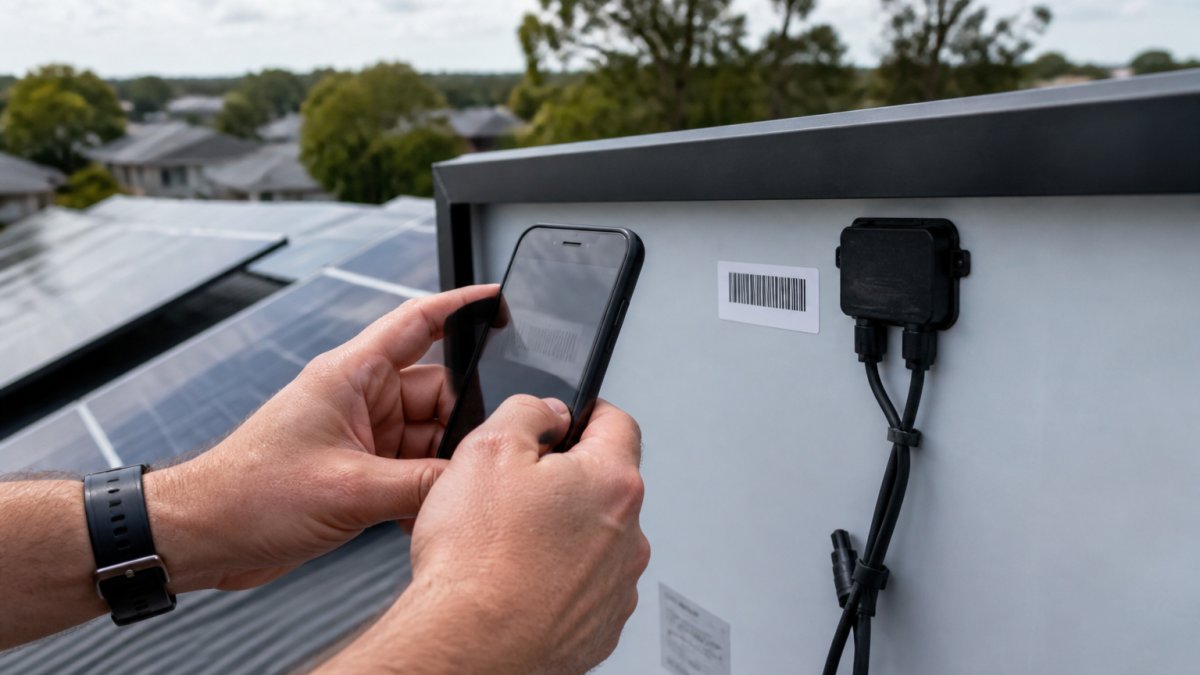
A solar panel serial number lookup confirms the physical panel matches the paperwork. This step catches counterfeit products and mismatched stock, which is more common than most buyers expect.
Find the serial number on the back of the panel, usually on a sticker near the junction box.
(https://australianmade.com.au/why-buy-australian-made/about-australian-made) lets you search registered licensees by company name or product category.
What the Logo Actually Looks Like
Genuine Australian Made logos share consistent visual features:
- A green and gold colour scheme (though monochrome versions exist for packaging)
- The kangaroo graphic in a triangular or rounded-rectangle frame
- The words “Australian Made” in a specific typeface
- A licence number printed somewhere near the mark on packaging or documentation
Counterfeit or unauthorised versions often get the proportions wrong, use the wrong shade of green, or omit the licence number entirely. If you are unsure, photograph the logo and compare it against the official image on the Campaign’s website before accepting the claim.
‘Assembled In’ vs ‘Made In’: The Legal Distinction
This is where most buyers get caught out, and it is worth understanding the framework behind it.
Country-of-origin claims in Australia are governed by the Australian Consumer Law, which prohibits false or misleading representations about where a product comes from.
- Made in Australia generally means the product was substantially transformed in Australia. For a solar panel, that typically means the cells were manufactured into modules here, not merely bolted together from pre-built components.
- Assembled in Australia means imported parts were put together here. The panel may still be a quality product, but the manufacturing value-add happened offshore.
- Product of Australia is a stricter claim still, requiring that all significant ingredients or components come from Australia. Very few solar panels meet this threshold.
Both “made in” and “assembled in” can be legitimate claims.
Ask which one applies, and get it in writing. If a salesperson says “Australian made” but the documentation says “assembled in Australia,” the documentation wins.
A panel labelled “assembled in Australia” from imported cells is not the same as one manufactured here from raw materials. Neither is necessarily bad, but you should know which one you are buying before you sign.
Checking the Licence Number
Every legitimate use of the Australian Made logo carries a licence number. You can verify it through the Campaign’s online register. If the number does not match the company name on your quote, or if no number is provided at all, treat the claim as unverified until proven otherwise.
This step takes two minutes and closes off one of the most common gaps between marketing language and documented fact.
Step 4: Verify Supply Chain Transparency and Manufacturing Claims
Supply chain transparency is the hardest claim to check, because it sits behind the brand and often spans multiple countries. But you can still test it, and this is where a methodical approach separates genuine suppliers from those relying on vague assurances.
Cells vs Modules: Why the Distinction Matters
A solar panel is not a single manufactured object. It is an assembly of components, and the origin of each component can differ:
- Solar cells, the photovoltaic wafers that actually convert sunlight to electricity. These are typically manufactured in a handful of countries with large-scale cell fabrication plants.
- Glass, frame, and backing, the structural components. These may be sourced regionally or imported.
- Module assembly, the process of encapsulating cells into a finished panel. This is the step that often happens in Australia for panels marketed as locally assembled.
When a supplier says “Australian made,” ask specifically: which part was made here? If the answer is “the module was assembled here from imported cells,” that is a legitimate answer, but it is a different claim from “the cells were manufactured here.” Knowing which you are buying affects everything from warranty logistics to your own understanding of the product’s provenance.
Questions That Reveal Supply Chain Depth
Ask the supplier these questions in writing, and pay attention to how quickly and completely they answer:
- Where are the solar cells manufactured?
- Where is the module assembled?
- Which testing checkpoints apply to this model, and who performed them?
- Can you provide the product certification documents and the testing laboratory name?
- What is the serial number range for this batch, and does it match the manufacturer’s register?
A supplier with nothing to hide answers these quickly and without deflection. Vague answers, or a redirect to “industry standards,” tell you plenty about how much they actually know, or want you to know.
Tracing Components Beyond the Final Assembly Point
For extra confidence, cross-check the brand against the Clean Energy Regulator’s guidance on approved systems, which explains what qualifies for the small-scale technology certificates tied to your rebate. The Regulator’s records show which models are eligible, and eligibility depends on meeting specific standards, not on marketing claims.
You can also ask for the bill of materials or a component origin declaration.
Documentary Evidence to Request
Ask for these documents before you sign:
- The product datasheet with the exact model number
- The certificate of conformity or compliance certificate
- The testing laboratory report or a reference to it
- The warranty terms in writing, including who honours them locally
If a supplier cannot provide these, that is not necessarily fraud, but it is a reason to slow down and verify independently before committing.
Ask for the certificate number and the testing lab name. Genuine suppliers have both on file and will send them without a fight. If they hesitate, ask why.
What to Do If Answers Don’t Add Up
If the supply chain answers are inconsistent with the certification documents, or if the serial number range does not match the manufacturer’s register, stop and seek clarification.
The goal is not to catch anyone out. It is to make sure the panel on your roof matches the paperwork in your file, and that both match the official records that determine your rebate eligibility and warranty coverage.
Common Mistakes When Verifying Australian Made Solar Panels
Most verification failures come down to a handful of avoidable errors. Here are the ones we see most often.
- Trusting a logo without checking the register
- Confusing “assembled in” with “made in”
- Skipping the serial number check entirely
- Accepting a verbal claim instead of a document
- Not confirming the installer’s accreditation
The pattern is the same each time: a buyer accepts a claim at face value and never checks the official record.
One more point on after-sales support and warranty claims. A panel with a local maker or a local distributor is easier to chase if something fails.
Conclusion: A Simple Verification Checklist
Use this checklist before you sign:
- Model appears on the Clean Energy Council approved list
- Serial number matches the invoice
- Australian Made trademark confirmed in the official register
- “Made in” vs “assembled in” clarified in writing
- Supply chain questions answered with documents
- Installer accreditation confirmed
That is the whole process. No jargon, no guesswork, just four checks against official records.
Verifying solar claims should not feel like detective work, but too often it does. At Solazone Australia, we have spent more than 40 years working with solar systems, and we promote Australian-made equipment because we know how much easier it is to trace, service, and stand behind.
Frequently Asked Questions
Are there any solar panels actually manufactured in Australia?
Yes, though the number is small. Most panels sold in Australia are imported and assembled locally. True Australian made solar panels carry the Australian Made certification trademark, which requires meeting specific local content thresholds. You can verify a manufacturer’s claim by checking the trademark on the product, running a serial number lookup, and confirming the brand appears on the Clean Energy Council approved solar panels list.
How do I check if a solar panel serial number is genuine?
Start by locating the serial number sticker on the back of the panel. Then visit the manufacturer’s website and use their solar panel serial number lookup tool, or contact them directly with the number. Cross-reference the result against the Clean Energy Council approved list to confirm the model is certified for installation in grid-connected systems. If the number returns no match or the model details differ, treat the panel as suspect and ask your installer for written confirmation.
Does ‘Australian Made’ mean the same as ‘Australian Designed’?
No. ‘Australian Designed’ only means the concept or engineering originated here. It says nothing about where the panel was built or how much local content it contains. The Australian Made certification trademark is a formal accreditation that requires meeting specific manufacturing and local content criteria. Always look for the official trademark logo rather than relying on wording like ‘designed in Australia’ or ‘Australian owned’.
What is the Clean Energy Council approved solar panels list and why does it matter?
The Clean Energy Council maintains a list of photovoltaic modules that meet Australian standards for safety and performance. Only panels on this list are eligible for small-scale technology certificates under the Small-scale Renewable Energy Scheme. If a panel is not on the list, you cannot claim rebates and your installer may be using non-compliant equipment. Always check the list before signing a contract.