
Table of Contents
- Why Authenticity Matters for Australian-Made Solar Panels
- Understanding Solar Panel Certification and Compliance Standards
- Clean Energy Council Approved Solar Panels: What the Approval Means
- Serial Number Validation and Product Authenticity Checks
- Using a Solar Panel Validation Tool to Verify Genuine Components
- Visual Identification Guide: Spotting Counterfeit Components
- Supply Chain Transparency and Accredited Installers
- Frequently Asked Questions
Last Updated: September 20, 2026
Why Authenticity Matters for Australian-Made Solar Panels
Counterfeit solar components cost homeowners thousands in lost efficiency and failed warranties. When you buy a system that claims to be Australian-made, you’re trusting that claim with your energy future and your money.
The problem runs deeper than just poor performance. Fake panels often fail within months. They don’t meet safety standards. They void your warranty the moment an installer discovers they’re not genuine. Worse, many homeowners don’t realise they’ve been sold counterfeits until problems emerge.
Genuine Australian made solar panels deliver what they promise. They’re built to local standards. They work in local climate conditions. They come with real support when something goes wrong.
This guide walks you through the exact steps to identify genuine Australian-made solar panels before installation.
Understanding Solar Panel Certification and Compliance Standards
A genuine solar panel meets specific compliance standards set by Australian regulators and industry bodies. These standards ensure the panel performs as rated and won’t damage your home’s electrical system.
Key standards that matter:
- Australian Standards (AS/NZS): These define safety and performance requirements for photovoltaic modules
- IEC certifications: International standards that Australian panels often exceed
- Grid connection rules: Your system must meet local network operator requirements
The Clean Energy Council (CEC) maintains lists of approved products and installers. If a panel isn’t on these lists, it hasn’t been independently verified for the Australian market.
Look for panels that carry certification marks on the frame or documentation. These marks show the product has been tested and meets the standards. Without them, you’re buying blind.
Clean Energy Council Approved Solar Panels: What the Approval Means
Clean Energy Council approval isn’t just a badge. It means the panel has passed rigorous testing and the manufacturer meets ongoing compliance requirements.
What CEC approval actually guarantees:
- The panel’s rated output matches real-world performance
- The frame and components meet safety standards
- The manufacturer maintains quality control processes
- The installer is trained and accredited
- Your system qualifies for government rebates and incentives
An approved panel gives you legal protection. If performance falls short of the rating, you have recourse. With unapproved panels, you typically have none.
Check the CEC’s approved products list before you buy. Search by manufacturer name or model number. If it’s not there, ask your installer why they’re recommending an unapproved product.
Clean Energy Council approved products database
Serial Number Validation and Product Authenticity Checks
Every genuine solar panel has a unique serial number. This number is your first line of defence against counterfeits.
Where to find the serial number:
The serial number appears on a label attached to the frame, usually on the back or side of the panel. The label also shows the manufacturer name, model, rated output (in watts), and manufacturing date.
What to check:
- The serial number format matches the manufacturer’s standard pattern
- The label is printed clearly, not faded or smudged
- The manufacturing date is recent (within the last 2-3 years for new stock)
- The rated output matches what your installer quoted
Counterfeit panels often have poorly printed labels or mismatched serial numbers. The font might look wrong. The spacing might be off. These details matter because they indicate whether the panel was made with proper quality control.
Ask your installer for the serial numbers before installation begins. Cross-reference them with the manufacturer’s records if you have doubts.
Using a Solar Panel Validation Tool to Verify Genuine Components
Several validation tools now let you check a panel’s authenticity using the serial number and QR code.
How validation tools work:
Many manufacturers now embed QR codes on panels. Scan the code with your smartphone. The manufacturer’s database confirms whether that serial number is genuine and what the panel’s specifications are.
Some tools also check whether the panel was registered for warranty coverage. If the serial number doesn’t appear in the manufacturer’s system, that’s a red flag.
If your installer can’t or won’t scan the code, ask why. Genuine installers expect this question.
Not all panels have QR codes yet. For older or international models, contact the manufacturer directly with the serial number and ask them to verify it.
Australian solar panel validation standards
Visual Identification Guide: Spotting Counterfeit Components
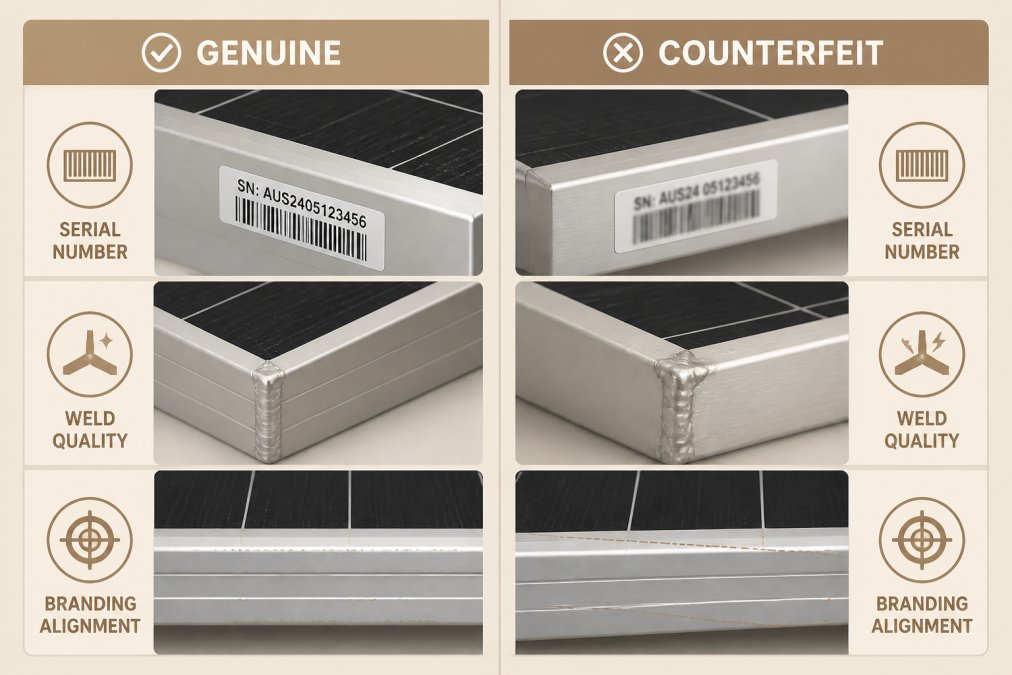
Counterfeit panels often show telltale signs if you know exactly what to inspect. Unlike text-based certifications, visual inspection is something you can perform yourself during the site survey before installation begins.
Frame and welds: Genuine panels have frames welded with consistent bead width (typically 2-3 mm) and smooth, even finish. The welds should show no gaps, spatter, or discolouration. Counterfeit frames often display uneven bead width, visible gaps between frame sections, or rough, pitted welds that suggest lower-quality equipment or untrained labour. Run your finger along the frame edge (carefully, as edges can be sharp), genuine frames feel smooth; counterfeits often have burrs or rough spots.
Serial number and manufacturer label: The label should be permanently affixed (usually with adhesive or rivets) and feature crisp, professionally printed text. Font size should be consistent, colours should match the manufacturer’s brand standard, and text should be perfectly aligned with no skew. Counterfeit labels often show blurry or pixelated text (a sign of poor printing equipment), misaligned rows of information, spelling errors in the manufacturer name, or labels that peel away easily when you gently lift a corner. The manufacturing date code should be recent, within 2-3 years for new stock. Dates older than 5 years may indicate old inventory or rebranded stock.
Glass and cell appearance: Hold the panel up to natural light and inspect the front glass surface. Genuine panels have crystal-clear glass with no visible bubbles, cracks, or internal delamination. The solar cells underneath should appear uniform in colour, typically dark blue or black with a consistent sheen across all cells. Counterfeit panels sometimes show uneven cell colouring (darker patches or lighter streaks), visible dust or debris trapped between the glass and cells, or hairline cracks in the glass that may not be immediately obvious. Look for any sign of moisture ingress, which appears as discolouration or white residue around cell edges.
Junction box and connectors: Flip the panel over and inspect the junction box mounted on the back. The box should be sealed with no visible gaps, cracks, or loose components. Connectors should fit snugly and show no corrosion or discolouration. Counterfeit junction boxes sometimes have poor sealing (visible gaps or cracked plastic), loose or corroded connectors, or wiring that appears uninsulated or damaged. These defects create electrical hazards and are grounds for rejecting the panel before installation.
Weight and balance: Genuine panels of the same model have consistent weight. If you’re inspecting multiple panels, pick up two or three (with your installer’s permission and proper safety precautions) and compare their feel. Counterfeits sometimes use cheaper materials or thinner glass, resulting in noticeably lighter weight or uneven weight distribution that feels ‘off’ when you hold the panel.
Packaging and documentation: Genuine panels arrive in branded packaging with manufacturer logos, batch numbers, and safety warnings clearly printed.
Supply Chain Transparency and Accredited Installers
Where your panel comes from and how it was made are two different things. Understanding this distinction is essential because marketing language often blurs the line between genuine local manufacture and simple assembly of imported components.
- Certificate of origin showing where the panel was manufactured
- Batch or lot numbers linking the panel to a specific production run
- Quality control test reports from the manufacturer
- Distributor invoice showing the authorised supplier’s name and contact details
- Chain of custody documentation proving the panel moved from manufacturer to distributor to installer without diversion to grey-market channels
Red flags in the supply chain:
-
Your installer cannot name their supplier or distributor
-
Panels arrive with no documentation, test certificates, or batch numbers
-
The price is significantly lower than market rates (often 20-30% below comparable genuine panels)
-
Your installer pressures you to decide and pay quickly without time for inspection
-
The supplier claims the panels are ‘Australian-made’ but cannot specify where cells are sourced
-
Panels arrive in unmarked or plain cardboard boxes rather than branded packaging
-
Your installer discourages you from contacting the manufacturer directly to verify serial numbers
-
Cross-referencing serial numbers against the manufacturer’s database
-
Confirming the panel model matches the CEC approved products list
-
Inspecting panels for physical damage or signs of counterfeiting
-
Documenting all components in the system design and warranty paperwork
-
Ensuring the system meets local grid connection standards
Clean Energy Council accredited installer search
Verify installer accreditation and check supply chain standards
Frequently Asked Questions
How can I verify the authenticity of my solar panels using a serial number?
Each genuine photovoltaic module carries a unique serial number printed on the back or junction box. Record this number and cross-reference it with the manufacturer’s database or use a solar panel validation tool to confirm the module’s production date, specifications, and warranty status. Counterfeit panels often have missing, duplicated, or incorrectly formatted serial numbers. Accredited installers can assist with this verification as part of their quality assurance process.
What does Clean Energy Council approval mean for solar panel authenticity?
Clean Energy Council approved solar panels have undergone rigorous product certification and compliance testing to meet Australian industry standards. This approval confirms the panels meet performance requirements and quality assurance benchmarks. When selecting genuine Australian-made solar panels, verify the installer is accredited by the Clean Energy Council and that the panels appear on the approved product list. This certification protects your investment and ensures warranty validation.
Are there actually solar panels manufactured in Australia?
Yes, some photovoltaic modules are assembled or manufactured in Australia, though the volume is limited compared to imported panels. Australian manufacturing typically involves assembly of imported cells with local frame production and quality control. Look for ‘Australian-assembled’ or ‘Australian-manufactured’ labelling and verify the claim through the manufacturer’s supply chain documentation. Genuine Australian-made systems offer local warranty support and technical specifications suited to local climate conditions.
What should I check during a site inspection to ensure genuine components?
During installation or inspection, verify that all hardware authenticity matches documentation: check frame rigidity and finish quality, inspect junction boxes for proper sealing, confirm serial numbers match the invoice and certification documents, and ask your accredited installer to show you product durability testing results. Request copies of the technical specifications and warranty documentation. Genuine components will have consistent branding, proper labelling, and professional packaging. Any discrepancies warrant immediate investigation.