
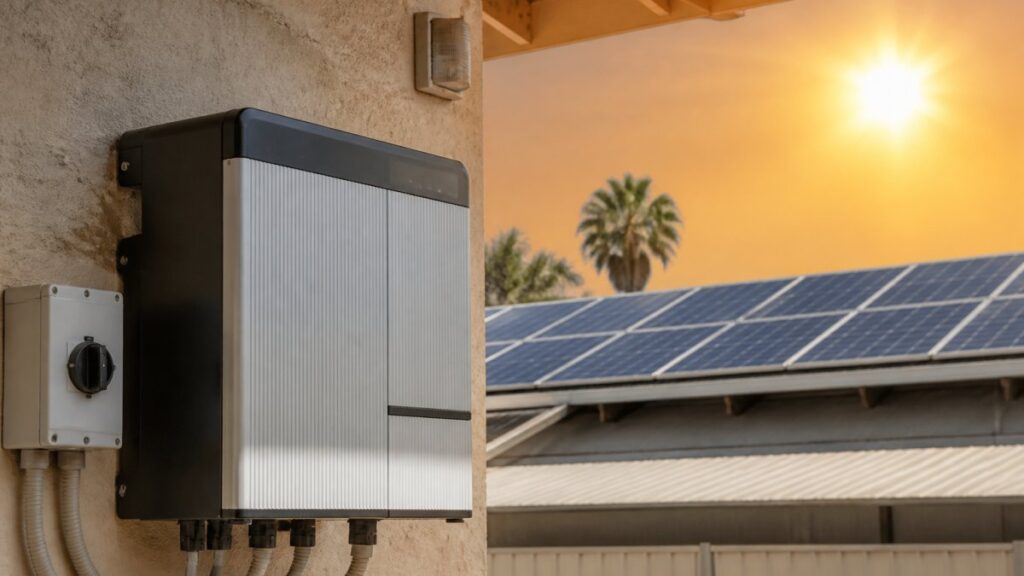
Last Updated: October 23, 2026
Quick Summary
The impact of extreme heat on solar battery life is cumulative: sustained high temperatures speed up the chemical reactions inside the cells, causing permanent capacity loss that never comes back. Most home solar batteries perform best when cell temperature sits between roughly 15°C and 30°C, and heat damage builds up above that band.
- Short-term heat effects are reversible, but sustained high temperature causes permanent chemical damage.
- Lead-acid batteries are the most heat-sensitive: every 10°C rise above 25°C roughly halves service life.
- LFP manufacturers commonly specify a charge window of roughly 0°C to 45°C and a recommended band nearer 15°C to 35°C.
- Watch for overheating signs such as a hot enclosure, high-temperature warnings and sharply dropping backup time.
- Check cell temperature monthly during summer, not just ambient temperature, and keep the enclosure ventilated.
Table of Contents
- How Extreme Heat Affects Solar Battery Performance
- Solar Battery Temperature Range: What’s Safe
- Solar Battery Overheating Signs to Watch For
- Protecting Solar Batteries from Heat: Practical Steps
- Solar Battery Performance in Summer: What to Expect
- Quantifying Heat Damage: Lifespan and Degradation Rates
- Warranty, Safety, and Emergency Response
- Frequently Asked Questions
How Extreme Heat Affects Solar Battery Performance
Heat is the quiet killer of solar battery life, and the impact of extreme heat on solar battery life shows up slowly. The impact of extreme heat on solar battery life shows up slowly: a little less capacity each summer, a shorter backup window each year, and a battery that dies well before its warranty runs out. At Solazone Australia, we have spent more than 40 years watching how heat stress plays out in real installations, and the pattern is consistent. A battery that runs hot ages faster than one that runs cool, even when both are rated for the same job.
Short-Term Output Changes vs Long-Term Damage
Short-term heat effects are reversible. Long-term damage is not.
On a hot day, a battery’s internal resistance rises and its power output dips. Cool it down and performance returns. That is the temporary side.
The permanent side is chemical. Sustained high temperature speeds up the reactions inside the cells. Capacity loss builds up and never comes back. So a battery that “recovers” after a heatwave may still have lost a slice of its service life. Most owners never notice the difference until a blackout exposes it.
Solar Battery Temperature Range: What’s Safe
Most home solar batteries perform best when cell temperature sits between roughly 15°C and 30°C. Above that band, heat stress starts to accumulate. The exact safe solar battery temperature range varies by chemistry, so always check the manufacturer’s datasheet for your model.
Here is the key distinction most guides skip: battery temperature versus ambient temperature. A battery in a garage can run several degrees hotter than the air outside, especially in an unventilated enclosure. The number that matters is cell temperature, not the weather forecast. A battery management system usually reports this, and it is worth checking during summer.
Battery Chemistry Differences: Lithium-Ion vs Lead-Acid
Lithium-ion and lead-acid batteries handle heat very differently. Rather than treat “lithium” as one thing, it helps to separate the common chemistries by how their manufacturers typically specify temperature limits and how each responds to sustained heat.
Lithium iron phosphate (LFP) is the chemistry most often installed in new home batteries. Manufacturers commonly specify a charge temperature window of roughly 0°C to 45°C and a discharge window of about −20°C to 60°C, with a recommended operating band nearer 15°C to 35°C. LFP is comparatively tolerant of heat in the sense that it is less prone to thermal runaway than older lithium chemistries, but that tolerance is not immunity: sustained operation near the top of the charge window still accelerates calendar ageing.
Nickel manganese cobalt (NMC) lithium cells typically carry a narrower recommended operating band, often around 10°C to 40°C for charging, and are more sensitive to heat than LFP. They generally offer higher energy density, which is why some compact wall-mounted units use them, but the trade-off is that heat management matters more.
Lead-acid (flooded, AGM and gel) is the most heat-sensitive of the common options over the long run. Manufacturers commonly specify a reference life at 25°C and then apply a rule of thumb that every 10°C rise above that roughly halves service life, a pattern widely cited in battery technical literature. Lead-acid also vents hydrogen when charging, so enclosure ventilation is a safety requirement, not just a performance one. Gel variants such as Sonnenschein are more tolerant of cycling duty but still reward cool placement.
What this means in practice: the same enclosure that is merely suboptimal for an LFP battery can be genuinely damaging for a lead-acid bank. Match the placement to the chemistry, not the other way round.
If you are weighing up lead-acid options, it helps to see the hardware itself. Both reward cool, ventilated placement.
Datasheet temperature windows usually list separate charge and discharge limits. The charge limit is the one that matters most in summer, because charging a hot battery is where the most stress accumulates.
Here is how the common battery chemistries compare on heat tolerance, as the article describes them.
| Chemistry | Typical temperature limits | Heat sensitivity |
|---|---|---|
| Lithium iron phosphate (LFP) | Charge 0°C to 45°C; discharge −20°C to 60°C; recommended 15°C to 35°C | Less prone to thermal runaway; still ages faster near top of charge window |
| Nickel manganese cobalt (NMC) | Often around 10°C to 40°C for charging | More sensitive to heat than LFP |
| Lead-acid (flooded, AGM, gel) | Reference life at 25°C | Most heat-sensitive; every 10°C rise roughly halves service life |
Solar Battery Overheating Signs to Watch For
Watch for these solar battery overheating signs before they become expensive:
- The enclosure feels hot to the touch on a summer afternoon
- The battery management system logs high-temperature warnings
- Backup time drops sharply after hot weather
- You notice a faint chemical or burning smell near the unit
- The cooling fan runs constantly, or there is no fan at all
Any of these means the installation location needs attention. A common mistake is assuming a garage is “shaded enough” when it actually traps heat all day.
Protecting Solar Batteries from Heat: Practical Steps
Protecting solar batteries from heat comes down to location, airflow, and monitoring. Start with these steps:
- Move the battery out of direct sun and away from west-facing walls that bake in the afternoon.
- Add ventilation to the battery enclosure so hot air can escape.
- Fit shade or a reflective cover where sunlight hits the wall.
- Check cell temperature monthly during summer, not just ambient temperature.
- Keep the space clear so air can move around the unit.
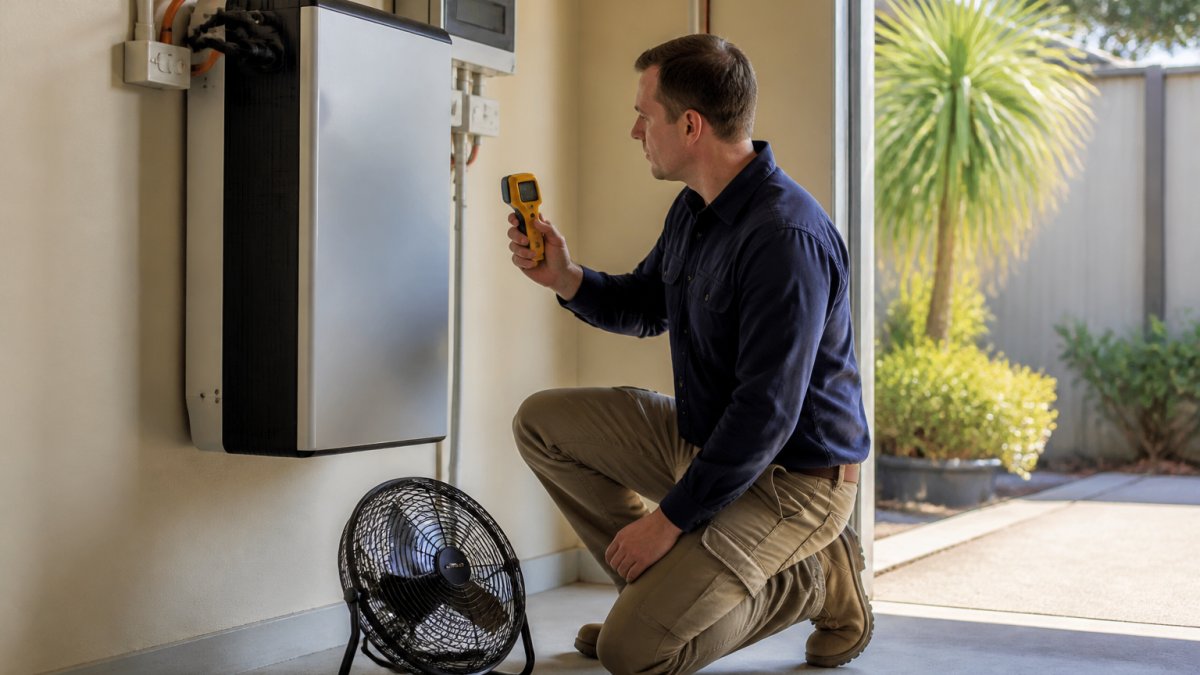
If you want a proper schedule for checks and cleaning, our guide to long-term solar system maintenance covers what to do and when.
Heat rises, so a battery mounted high on a garage wall often runs hotter than one mounted lower. If you have a choice, keep it low and let the cool air sit around it.
Solar Battery Performance in Summer: What to Expect
Expect lower usable capacity in summer, not a dead battery. Solar battery performance in summer typically shows a modest dip in output during the hottest hours, then a return to normal once temperatures ease. The real risk is not one hot day. It is a run of hot days with no cool-down overnight. A battery that spends several nights without cooling can accumulate heat stress, making it worth applying the same temperature-conscious habits when you maintain electric bike battery.
Plan for this by:
- Scheduling heavy loads for cooler morning hours
- Checking that the enclosure vents are clear before summer
- Reviewing the battery management system logs weekly in January and February
Quantifying Heat Damage: Lifespan and Degradation Rates
Heat damage is cumulative, and it shows up as accelerated degradation. Every degree above the ideal band adds to the long-term toll on cycle life and calendar life. A battery kept cool tends to hold capacity longer than one that bakes.
We cannot give you a precise percentage without your specific model’s datasheet, and we would rather be honest about that than invent a number. What we can do is explain how to read the numbers manufacturers do publish, so you can judge your own installation rather than rely on a general claim that heat shortens life.
Cycle life versus calendar life. Cycle life is the number of charge-discharge cycles a battery delivers before capacity falls to a stated threshold, commonly 70% or 80% of original. Calendar life is how long the battery lasts at rest, regardless of cycling. Heat attacks both, but calendar life is often the binding constraint for a home battery that sits mostly idle.
How to interpret a temperature derating. Many manufacturers publish a capacity-retention curve or a derating table showing expected life at 25°C, 35°C and 45°C. Read it as a multiplier, not a promise.
Why sustained heat beats peak heat. A single 40°C afternoon does relatively little. Weeks of 35°C nights with no cool-down do more, because the battery never returns to its reference temperature and the chemical side reactions that cause capacity fade keep running. This is why overnight minimums matter as much as daytime maximums in a hot climate.
What to record. If you want a defensible estimate for your own system, log three things monthly through summer: cell temperature at the hottest part of the day, cell temperature overnight, and usable capacity (many battery management systems report state of health). A steady decline in state of health across successive summers is the clearest signal that placement or ventilation needs attention.
For a broader look at how heat affects the whole system, see our guide to solar panel degradation rates.
Ignoring high-temperature warnings from the battery management system is the most common mistake we see. The consequence is a battery that fails early, often just outside the warranty window.
Warranty, Safety, and Emergency Response
Heat damage often raises warranty questions, because many manufacturers exclude damage caused by poor installation conditions. Read the fine print on ventilation and operating temperature before you assume a claim will succeed.
Safety matters too. A battery that has been overheating should be checked by a qualified technician, not prodded by hand. If you smell burning or see swelling, isolate it and call for help. If you need guidance on finding support and understanding warranty terms, our guide to reliable solar energy support explains the process.
Cool placement and good airflow protect both the battery’s lifespan and your warranty position. Treat ventilation as part of the installation, not an afterthought.
Heat will always be part of the picture in a hot climate, but the damage it does is not inevitable. A well-placed, ventilated battery with a watched temperature log will outlast one crammed into a hot corner. Solazone Australia brings more than 40 years of technical expertise, personalised service, and a focus on quality equipment to every installation, so your battery is set up to last. Get in touch with Solazone Australia to review your battery placement and protect your investment before the next hot summer.
Frequently Asked Questions
What temperature is too hot for a solar battery?
Most lithium-ion solar batteries have a recommended operating temperature range of 15°C to 35°C. Temperatures above 40°C accelerate degradation, and sustained exposure above 45°C can trigger thermal management systems or reduce charge acceptance. Lead-acid batteries tolerate slightly higher temperatures but still degrade faster above 30°C. Always check your battery’s datasheet for specific limits, and keep the enclosure ventilated and shaded to avoid exceeding these thresholds.
How does extreme heat affect solar battery performance?
Heat increases internal resistance and speeds up chemical reactions inside the battery, which temporarily reduces charge capacity and power output. Over time, sustained high temperatures cause permanent capacity loss and shorten the battery’s service life. In summer, you may notice slower charging or reduced backup time, but the bigger concern is the long-term impact on battery lifespan.
What are the signs that a solar battery is overheating?
Watch for a hot casing, unusual smells, swelling, electrolyte leakage, or a battery management system that frequently derates or shuts down. Your inverter or battery app may show temperature warnings or reduced charge/discharge rates. If the battery feels too hot to touch or you see smoke, isolate the system and contact a licensed installer immediately. Regular temperature monitoring and a clean, ventilated installation location help prevent these issues.
Should I change how I use my solar battery during a heatwave?
Yes. During heatwaves, avoid heavy charging or discharging during the hottest part of the day. Shift high-load activities to cooler morning or evening hours. If your battery system allows, set a lower depth of discharge or reduce charge rate to lessen heat stress. Ensure the battery enclosure is well ventilated and shaded. These steps help protect solar batteries from heat and maintain performance in summer.
