
Table of Contents
- Why Solar Belongs in the Design Phase, Not After Handover
- Step 1: Assess Site Suitability, Orientation and Solar Exposure
- Step 2: Commercial Solar System Design and Load Matching
- Step 3: Commercial Rooftop Solar Panels and Structural Coordination
- Step 4: Building-Integrated Photovoltaics (BIPV) for Façades and Envelopes
- Step 5: Commercial Solar Battery Storage, Load Shifting and Grid Integration
- Step 6: Compliance, Approvals and the Design-to-Commissioning Workflow
- Step 7: Financial Modelling, Operations and Performance Verification
- Frequently Asked Questions
Last Updated: October 12, 2026
Why Solar Belongs in the Design Phase, Not After Handover
Integrating solar energy into commercial building design means treating panels, batteries and inverters as part of the building itself, not equipment bolted on later.
At Solazone Australia, 40-plus years of solar work shows a consistent pattern: projects that bring solar into the design phase avoid the expensive rework retrofits run into.
The case for early planning rests on three things:
- Structural capacity. Roofs designed for panel loads need less reinforcing than roofs that were never assessed.
- Electrical headroom. Switchboards and cable pathways sized for solar from the start cost far less to install.
- Aesthetic control. Panels and building-integrated products can be positioned deliberately rather than fitted wherever space allows.
Most guides treat solar as a procurement decision; it is really a design decision. The seven steps below cover the full process.
Solar planned at design stage costs less to install, looks better, and performs more predictably than solar added after handover. The earlier the decision, the more options stay open.
Step 1: Assess Site Suitability, Orientation and Solar Exposure
Site suitability is the first filter: heavy shading or a poorly oriented roof will underperform no matter how good the equipment is.
Start with these checks:
- Roof orientation. North-facing roofs produce the most energy across the day. East and west roofs still work but generate less.
- Tilt angle. A pitch close to latitude generally performs well for fixed arrays.
- Shading. Nearby trees, taller buildings and rooftop plant all cut output. Even partial shading can drag down a whole string.
Shading is the most common reason a site underperforms. Microinverters limit the impact, but good design is still the cheapest fix.
Clean Energy Council solar design guidance sets out the standards installers work to when assessing sites.
Skipping a proper shading study is the most expensive shortcut in commercial solar. A string that is shaded for two hours a day can lose far more output than the shade itself covers, because the weakest panel drags down the rest.
Step 2: Commercial Solar System Design and Load Matching
Commercial solar system design starts with the load, not the roof, matching generation to when the building actually uses power.
A building running heavy daytime loads gets far more value from solar than one peaking at night, so design works backwards from the load profile:
- Pull 12 months of interval meter data.
- Identify the daytime base load and peak demand.
- Size the array to cover as much daytime consumption as possible.
- Check whether export limits or network constraints affect the design.
Load matching separates a system that pays back quickly from one that mostly exports cheap power. A common mistake is sizing to the roof rather than the load.
Step 3: Commercial Rooftop Solar Panels and Structural Coordination
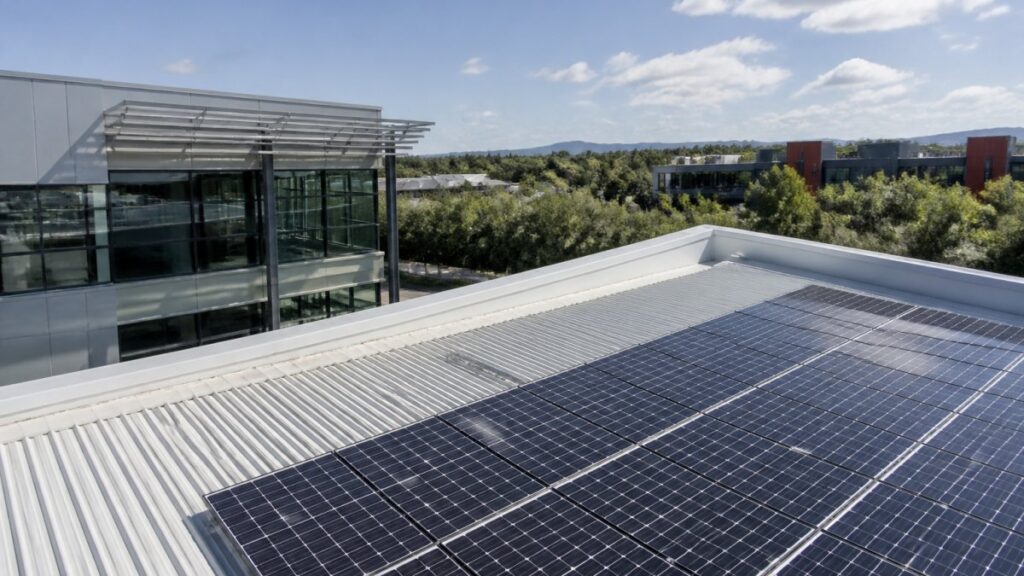
Commercial rooftop solar panels add weight, wind loading and point loads the roof must carry. Structural coordination is not optional.
Key checks include:
- Dead load. Panel and mounting weight per square metre.
- Wind uplift. Critical on exposed sites and tall buildings.
- Roof type. Metal standing seam, concrete, membrane and tile roofs each need different mounting.
Fixings matter as much as panels: non-penetrating clamps avoid drilling on metal roofs, while ballasted systems spread the load on membrane roofs but add weight.
Step 4: Building-Integrated Photovoltaics (BIPV) for Façades and Envelopes
Building-integrated photovoltaics (BIPV) replace part of the building envelope rather than sitting on top of it, doubling as cladding, glazing or shading so the solar element earns its place.
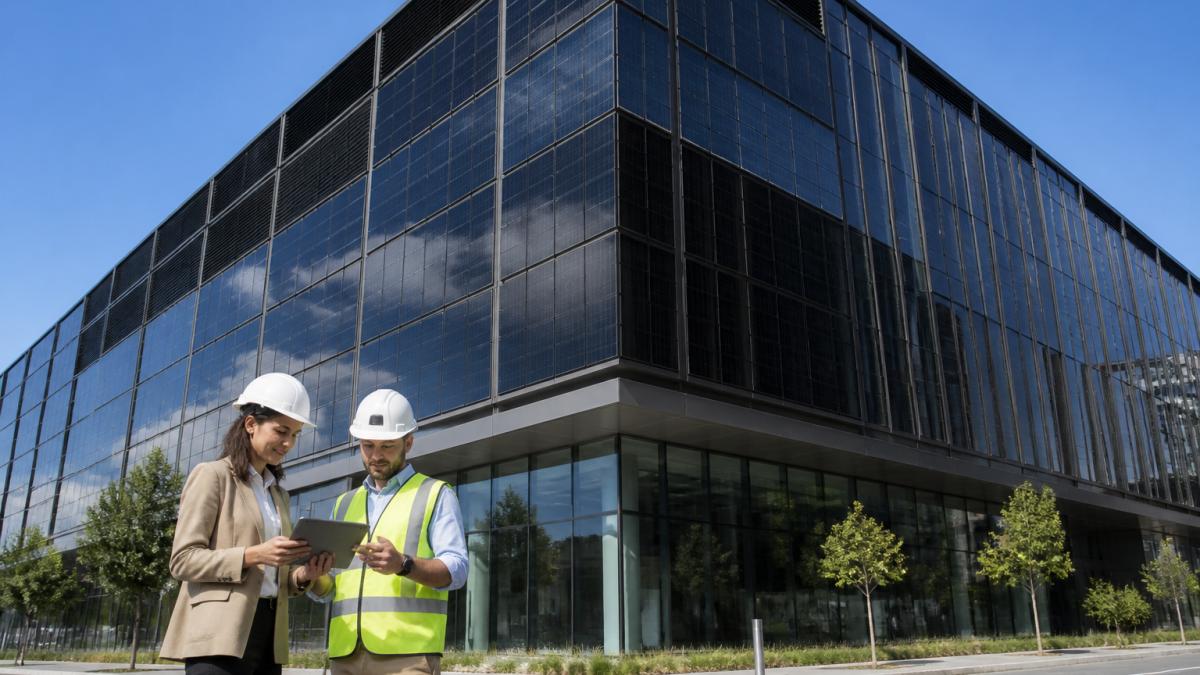
BIPV covers a wider family of products than most people realise:
- Façade-specific PV panels that form the external wall.
- Solar glazing that generates power while letting light through.
- Building-integrated photovoltaic/thermal (PV/T) systems that produce electricity and heat at once.
The trade-off is cost. BIPV usually costs more per kilowatt than rooftop panels, but it can replace cladding you were buying anyway. On a high-rise with limited roof space, the façade may be the only large solar surface available.
Step 5: Commercial Solar Battery Storage, Load Shifting and Grid Integration
Commercial solar battery storage changes when a building uses its solar power, storing midday generation for evening peaks instead of exporting it.
Storage makes sense when:
- Demand charges or time-of-use tariffs are high.
- The building needs backup during outages.
- Export limits cap how much power can be sent to the grid.
Grid integration is the other half: inverters must meet network requirements, some sites need approval before connecting, and smart grid features let the system respond to network signals and shift load automatically.
Ask your network operator about export limits early. A site approved for a small export capacity will need a different design than one with unlimited export, and finding out late forces a redesign.
Step 6: Compliance, Approvals and the Design-to-Commissioning Workflow
Compliance and approvals run in parallel with design, not after it. Missing a step is the most common cause of delays, and each approval depends on the one before it.
A practical workflow looks like this:
- Concept design. Site assessment, load review and system sizing. Confirm the array area, inverter location and battery room early so later trades are not retrofitting space.
- Structural and electrical review. Confirm roof capacity, wind uplift resistance and switchboard readiness. A structural engineer signs off on dead load and point loads; the electrical designer confirms board capacity, main switch rating and cable routes.
- Development approval. Check council requirements, especially for visible façade work, heritage overlays and bushfire-prone areas. Many councils treat façade-mounted solar as a variation to the approved envelope, so submit early.
- Network application. Submit the connection application to the distribution network. Export limits, inverter standards and metering changes are assessed here, and approval can take weeks on constrained feeders.
- Installation. Mounting, wiring, inverter and battery fit-out by an accredited installer.
- Commissioning. Testing, verification and handover documentation, including as-built drawings, monitoring access and warranty registration.
The standards and rules that actually apply
Electrical work must follow Safe Work Australia’s electrical safety guidance, and installations should meet the relevant Australian Standards. The ones that come up most often on commercial projects include:
- AS/NZS 5033 for photovoltaic array installation and safety requirements.
- AS/NZS 4777.2 for grid connection of energy systems via inverters, which governs inverter settings and network compliance.
- AS/NZS 5139 for battery energy storage systems, covering installation, ventilation and separation.
Fire requirements matter too. Batteries should sit away from sleeping areas and escape paths, clearly labelled for firefighters. Roof arrays should leave access paths and set-backs for emergency crews, and DC isolators must be reachable without climbing onto the roof.
Solar-ready provisions for new builds
If the building is still in design, the cheapest compliance step is making it solar-ready. That means:
- A roof structure designed for the intended array load, documented in the structural drawings.
- A conduit route from roof to switchroom sized for the future cable run.
- Switchboard space reserved for a solar supply main switch and inverter isolation.
These provisions cost little at design stage and save significant rework. A building that is not solar-ready can still be retrofitted, but the electrical and structural work often costs more than the panels. Selecting appropriate roofing materials for solar mounting ensures that the structural integrity of the building remains uncompromised while simplifying the installation process for future energy upgrades.
Do not treat the network application as a formality. On constrained parts of the grid, export approval can be limited or refused, and a design built around full export may need to be reworked around self-consumption and storage instead.
Retrofit versus new build
The workflow above assumes a new build, but the same steps apply to a retrofit with different constraints. On an existing building, roof condition and remaining life drive the decision: if the roof needs replacing within a few years, do it before installing solar rather than paying to remove and refit the array. Switchboard capacity is often the binding constraint on older buildings, and a board upgrade may be needed before the solar connection is approved.
Step 7: Financial Modelling, Operations and Performance Verification
Financial modelling turns a technical design into a business case. Payback period, internal rate of return and lifetime savings matter, but the model is only as good as its assumptions.
Build the model on:
- Actual interval meter data, not estimates.
- Realistic self-consumption, not nameplate output.
- Maintenance and inverter replacement costs.
The cost side of the model
Installed cost for commercial rooftop solar in Australia varies with system size, roof type and whether the switchboard needs upgrading. Larger systems cost less per kilowatt because fixed costs, design, approvals, switchboard work and commissioning, spread across more capacity.
Battery storage is hardest to justify on energy arbitrage alone. It usually stacks value streams: shifting solar into evening peak tariffs, reducing demand charges, backing up critical loads, and sometimes capturing network support payments.
Demand charges and tariff sensitivity
For many commercial sites, demand charges, based on the highest interval of power drawn from the grid, exceed energy charges. Solar reduces them only when generating at the same time as the peak, which is why load matching matters financially as well as technically.
Run the model against at least two tariff scenarios. A flat tariff gets most value from energy offset; a time-of-use tariff with a high evening peak gets more from storage; a high demand charge gets value from peak shaving.
Incentives and certificates
Australia’s renewable energy certificate scheme creates tradable certificates for eligible small-scale and large-scale generation, reducing upfront cost. Value depends on the location’s zone rating and current certificate price, so model it as a range, not a fixed number. State and territory programs plus some network and council incentives vary by jurisdiction and change over time, so confirm what applies before finalising the business case.
Model the business case on a range of electricity price escalation scenarios, not a single forecast. Solar’s value rises as retail prices rise, so a conservative escalation assumption produces a conservative payback and a more defensible proposal.
Operations and maintenance
Operations and maintenance keep the system performing. The main cost items over a 25-year life are:
- Inverter replacement. Most string inverters are replaced once during the system life, typically around the 10 to 15 year mark. Budget for it in the model.
- Panel cleaning. Required more often in dusty, coastal or high-pollen locations. In many urban and coastal sites, annual cleaning is enough; in heavy soiling environments it may be more frequent.
- Monitoring and fault response. Remote monitoring catches underperformance early, but someone still has to act on the alerts.
Performance verification
Performance verification compares actual generation against the model so problems get caught early. Compare monthly generation against a weather-adjusted expectation, not the raw design figure, because a cloudy month is not a fault.
| Stage | What Happens | Who Leads |
|---|---|---|
| Concept design | Site and load assessment | Architect and solar designer |
| Structural review | Roof capacity check | Structural engineer |
| Network application | Connection approval | Electrical contractor |
| Installation | Mounting and wiring | Accredited installer |
| Commissioning | Testing and handover | Installer and building owner |
| Performance review | Actual vs modelled output | Facility manager |
The work does not stop at commissioning: a monitored, maintained system outperforms an identical one left alone, and the performance data feeds back into the next project’s assumptions.
Frequently Asked Questions
At what stage should solar be included in a commercial building project?
Solar should enter the conversation at concept design, before structural, electrical and façade decisions are locked in. Bringing it in early lets the design team orient the building for good solar exposure, reserve roof space and cable routes, and size the structural framing for panel loads. Retrofitting solar later usually costs more and limits system size. For commercial solar projects, early coordination between architects, engineers and developers is the single biggest factor in how much generation the finished building can support.
What is building-integrated photovoltaics and when is it worth using?
Building-integrated photovoltaics (BIPV) replace conventional building materials with solar-generating equivalents, such as façade cladding, roofing or glazing that also produce electricity. BIPV suits projects where roof space is limited, where the façade has strong solar exposure, or where the design brief calls for a visible sustainability statement. It typically costs more per kilowatt than standard rooftop panels, so it makes most sense when the cladding or glazing budget can absorb part of the cost.
Should a commercial building include battery storage with solar?
Commercial solar battery storage is worth modelling when the building has high evening demand, needs backup during outages, or faces demand charges that storage can shave. Batteries let you store daytime generation and discharge it when grid electricity is most expensive. Whether storage pays off depends on your load profile, tariff structure and how much of your solar generation you currently export. A load-matching study before purchase shows how much of your generation you can actually use on site.
How do you assess whether a commercial roof is suitable for solar panels?
A roof suitability check covers structural capacity, remaining roof life, shading, orientation and available area. Panels add load, so a structural engineer confirms the roof can carry it without reinforcement. If the roof needs replacing within a few years, do that first. Shading from nearby buildings, trees or rooftop plant reduces output, so map it across a full day and year. North-facing roof areas with minimal shading and good structural capacity are the strongest candidates for commercial rooftop solar panels.