

Table of Contents
- How Solar Panels Reduce Electricity Bills
- Net Metering Explained: Turning Surplus Energy Into Credits
- Solar Incentives 2024: Tax Credits and Rebate Programs
- Key Factors Affecting Your Solar Savings
- Using a Solar Energy Savings Calculator
- Energy Efficient Home Upgrades to Maximize Solar Savings
- Battery Storage vs. Grid-Tied: Which Reduces Bills More?
- Long-Term Cost Savings and Real-World ROI
Reduce Electricity Bills With Solar: A 2024 Guide
Last Updated: July 22, 2026
When Australian households examine their energy costs, they often discover that solar can reshape their entire power consumption landscape. At Solazone Australia, we’ve spent over 40 years helping thousands of customers reduce electricity bills with solar by matching their specific needs with high-quality equipment and professional installation. This guide breaks down exactly how solar systems offset utility bills, what incentives are available in 2026, and which factors determine whether your home will actually save money long-term.
The core mechanism is straightforward: solar panels generate electricity during daylight hours, reducing how much power you pull from the grid. Real savings depend on understanding net metering, your local utility rates, time-of-use pricing, and how much energy your household actually consumes. Below, we’ll show you exactly how to calculate your potential savings, identify hidden costs most guides overlook, and decide whether battery storage makes sense for your situation.
How Solar Panels Reduce Electricity Bills
Solar panels reduce electricity bills by converting sunlight into usable electricity through photovoltaic cells. When your system generates power during peak sun hours, that energy flows directly into your home’s electrical circuits, displacing electricity you’d otherwise purchase from your utility company.
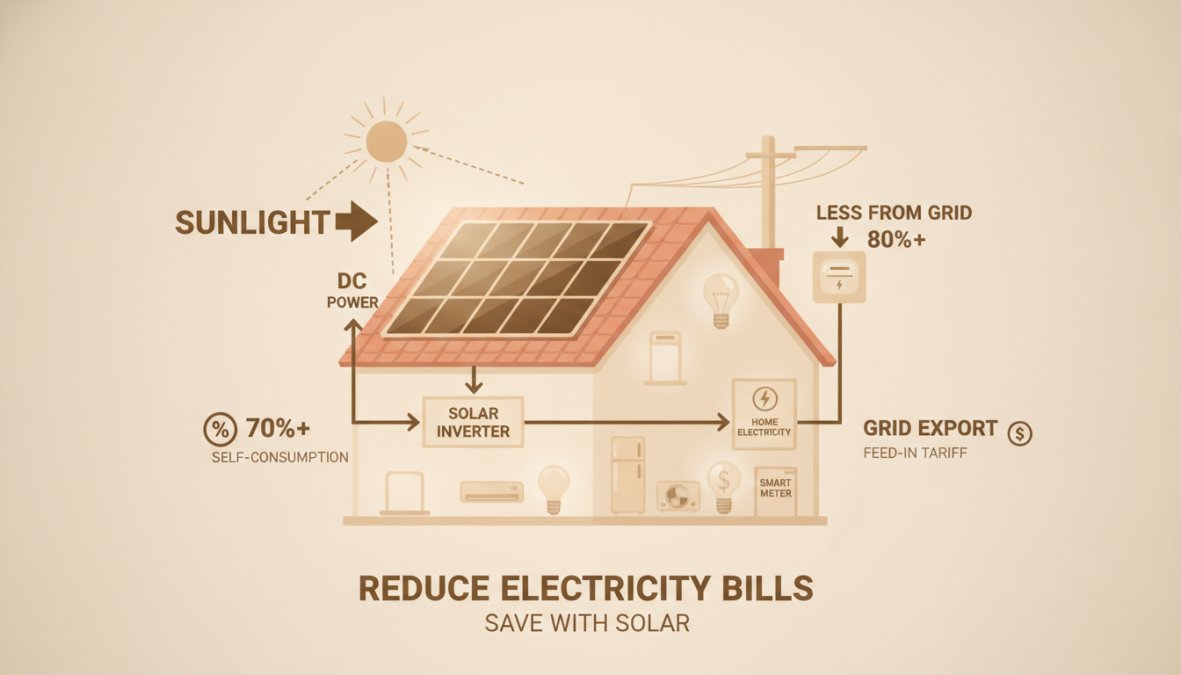
A typical 6kW residential system in Australia generates between 7,000 and 9,000 kilowatt-hours annually, depending on geographic location and seasonal variation. Your system produces maximum power between 10 AM and 3 PM, when the sun is highest. If your home uses electricity during these hours, running air conditioning, washing machines, or pool pumps, you capture maximum savings. Evening consumption still comes from the grid because your panels stop producing after sunset.
Shifting energy consumption toward midday hours can increase savings by 15-25%. Running dishwashers, laundry, and pool pumps during peak solar production hours amplifies the bill reduction effect without requiring any system upgrades.
Professional system sizing is critical. An undersized system won’t generate enough power to offset your consumption patterns. An oversized system produces excess electricity that flows back to the grid at lower compensation rates. Solazone Australia performs detailed energy audits to ensure your system capacity matches your actual consumption habits.
Net Metering Explained: Turning Surplus Energy Into Credits
Net metering transforms excess solar production into utility bill credits. When your panels generate more electricity than your home consumes, typically mid-afternoon on sunny days, that surplus flows back into the grid. Your utility company credits your account for each kilowatt-hour you export, effectively running your meter backward.
These grid credits offset electricity you consume during non-production hours: mornings, evenings, and cloudy days. The grid acts as your storage medium, and your utility bill reflects the net difference between what you produced and what you consumed over the billing period.
Most Australian utilities offer net metering on a monthly basis, meaning credits from high-production months can offset consumption in lower-production months. However, export rates vary significantly. Some retailers offer 1:1 credit ratios, where each kilowatt-hour exported equals one kilowatt-hour of consumption credit. Others offer lower export rates, 5-15 cents per kilowatt-hour, while charging full retail rates (30-40 cents) for imported electricity.
This asymmetry is crucial. If your retailer pays 10 cents per kilowatt-hour for exports but charges 35 cents for imports, you’re financially incentivized to maximize self-consumption rather than maximize exports. A battery system becomes attractive in this scenario because it stores midday surplus for evening use, avoiding the unfavorable export rate entirely.
The difference between a 1:1 net metering agreement and a 3:1 ratio can reduce your annual savings by 30-50%. Always confirm your retailer’s exact net metering terms before system installation.
Solar Incentives 2024: Tax Credits and Rebate Programs
Australia’s solar incentive structure in 2026 centers on Small-scale Technology Certificates (STCs), which provide upfront cost reduction. When you install a solar system, you receive STCs based on the expected kilowatt-hours your system will generate over 15 years. You can trade these certificates immediately, receiving cash that reduces your out-of-pocket installation cost.
The STC value currently sits around $30-40 per certificate for residential systems. A 6kW system typically generates approximately 60-70 STCs, translating to $1,800-2,800 in upfront rebates. This reduction applies at the point of purchase, making it immediately accessible.
State-based incentives vary significantly. New South Wales, Victoria, and Queensland offer additional rebate programs that stack on top of the federal STC scheme. Some states provide interest-free loans for solar installation, others offer direct cash rebates for battery systems. Solazone Australia automatically applies available rebates during the quote process, identifying every incentive your situation qualifies for.
| Incentive Type | Typical Value | Application Timing | Eligibility |
|---|---|---|---|
| Small-scale Technology Certificates | $1,800-2,800 | At purchase | All residential systems |
| State rebate programs | $500-3,000 | At purchase or post-installation | Varies by state |
| Battery storage incentives | $1,000-5,000 | At purchase | Select states, income limits apply |
| Interest-free loans | Up to system cost | At purchase | Select states, credit-dependent |
Key Factors Affecting Your Solar Savings
System capacity, panel efficiency, and geographic location form the foundation of your potential savings. Panel efficiency, typically 18-22% for modern residential panels, determines how much of the sunlight hitting your roof converts to electricity. Geographic location determines how many peak sun hours your location receives annually.
Sydney receives approximately 4.5 peak sun hours daily on average, while Perth receives 5.2 and Melbourne receives 4.1. This geographic variation means an identical system produces 20-30% more electricity in Perth than Melbourne. Your roof orientation and tilt angle matter significantly too. North-facing roofs in the Southern Hemisphere capture maximum solar radiation.
Time-of-use (TOU) rates fundamentally change how you should evaluate solar savings. TOU pricing charges different rates for different hours: peak rates (typically 3-9 PM), shoulder rates (7-10 AM and 9 PM-midnight), and off-peak rates (midnight-7 AM and 10 AM-3 PM).
If your retailer charges peak rates of 50+ cents per kilowatt-hour during evening hours but only 25 cents during off-peak midday hours, solar’s value proposition changes. Your system produces maximum power during the cheapest hours (off-peak), while you consume most electricity during the most expensive hours (peak evening). This timing mismatch means solar offsets lower-value off-peak consumption rather than high-value peak consumption.
Your energy consumption habits directly determine savings. A household that runs air conditioning all day benefits more from solar than one that only uses AC in the evening. A family that does laundry and cooking during midday captures more solar value than one that does these tasks in the evening.
Many solar quotes assume 80-90% electricity cost savings. In reality, most households save 40-60% because they consume significant electricity during non-production hours. If you receive a quote projecting savings above 70%, ask specifically how the installer calculated evening consumption.
Using a Solar Energy Savings Calculator
A solar energy savings calculator takes your specific location, roof characteristics, consumption patterns, and utility rates to project realistic annual savings. The most accurate calculators use your actual electricity bills for the past 12 months rather than assuming average consumption.
A proper savings calculator factors in seasonal variation. Winter production is significantly lower than summer production, typically 40-50% lower depending on your location. Monthly calculators that don’t account for seasonal variation dramatically overstate winter savings.
Calculating ROI and payback period requires comparing total system cost (after incentives) against annual savings. If your system costs $12,000 after STCs and saves $1,500 annually, your payback period is 8 years. If the system lasts 25+ years (standard warranty), you have 17 years of free electricity after payback. Electricity rates typically increase 3-5% annually, improving solar’s ROI over time.
Solazone Australia provides detailed savings projections using actual consumption data from your electricity bills rather than industry averages, showing monthly production estimates and conservative savings projections specific to your retailer.
Energy Efficient Home Upgrades to Maximize Solar Savings
Before installing solar, consider whether energy efficiency upgrades make financial sense. Reducing consumption through insulation, LED lighting, efficient appliances, and HVAC improvements often delivers faster payback than solar alone. A household that reduces consumption by 20% through efficiency measures needs a smaller solar system, reducing overall installation cost.
Insulation improvements in the ceiling and walls reduce heating and cooling loads significantly, potentially delivering 15-25% reduction in HVAC energy consumption. LED lighting uses 75% less electricity than incandescent bulbs and lasts 15+ times longer. Efficient appliances, particularly refrigerators and washing machines, consume substantially less electricity than older models.
The strategic approach combines efficiency with solar. Improve insulation and lighting first, which has rapid payback and reduces your solar system size requirement. Then install solar to offset remaining consumption. This sequence typically delivers lower total cost and faster overall payback.
Battery Storage vs. Grid-Tied: Which Reduces Bills More?
Grid-tied systems without batteries offset bills through net metering, exporting excess midday production for evening consumption credits. Battery backup systems store excess production on-site, allowing you to use that stored energy during peak evening hours rather than exporting it at unfavorable rates.
Grid-tied systems and utility rate structures determine whether batteries make financial sense. If your retailer offers 1:1 net metering, batteries provide minimal financial benefit. If your retailer pays 10-15 cents per kilowatt-hour for exports while charging 35+ cents for peak-hour imports, battery storage becomes financially attractive.
A 10kWh battery system typically costs $12,000-18,000 installed. If it captures $2,000-3,000 in annual savings through rate arbitrage, payback exceeds 5 years. After payback, battery owners enjoy 10-15 additional years of free evening electricity. Battery backup also appeals to customers seeking energy independence, protection against future rate increases, or reduced grid dependence for environmental reasons.
Long-Term Cost Savings and Real-World ROI
Understanding payback periods requires acknowledging that solar is a 25+ year investment. Modern residential solar panels retain 80-85% of their original efficiency after 25 years. Inverters typically last 10-15 years and require replacement mid-system life, adding $2,000-4,000 to total ownership cost.
A $12,000 system (after incentives) saving $1,500 annually has an 8-year payback period. After payback, you enjoy 17 years of electricity at near-zero cost. Over the full 25-year lifespan, that system generates $37,500 in electricity value, delivering $25,500 net profit after the initial investment.
This calculation improves when accounting for electricity rate increases. If rates increase 3.5% annually, your year-10 savings are $2,100 annually rather than $1,500, and year-25 savings approach $3,200 annually. Cumulative savings over 25 years exceed $50,000 for the same $12,000 investment.
Professional system sizing ensures maximum long-term value. An undersized system leaves money on the table. An oversized system exports excess production at unfavorable rates, reducing ROI. Real-world performance data from Solazone Australia’s thousands of installations shows that properly designed systems consistently meet or exceed production projections, with systems installed 10+ years ago still delivering 90%+ of their original output.
Reducing your electricity bills requires understanding how solar production aligns with your consumption patterns, what incentives apply to your situation, and whether your home’s characteristics support solar viability. Solazone Australia has guided over 40 years of customers through this analysis, using quality equipment and professional installation to ensure systems deliver projected savings. We provide detailed consumption audits, transparent ROI calculations, and personalized system designs that account for your roof characteristics, utility rates, and energy habits. Get started with Solazone Australia and transform your electricity costs into long-term savings.
Frequently Asked Questions
Do solar panels really reduce electricity bills?
Yes, solar panels reduce electricity bills by generating clean energy that offsets your grid consumption. A properly sized solar array can cover 50-100% of your annual kilowatt-hours (kWh), depending on your location, roof orientation, and energy consumption habits. Net metering allows you to send excess energy back to the grid and receive credits, further lowering your utility bills. Most homeowners see measurable reductions within the first month of operation.
How does net metering explained help me save money with solar?
Net metering allows your grid-tied solar system to send surplus energy to the utility company and receive credits on your bill. When your solar array produces more kilowatt-hours than you use, the excess flows to the grid; your utility company credits you at their retail electricity rate. On cloudy days or at night, you draw from the grid and use those credits. This mechanism transforms your system into a virtual energy storage solution without the cost of batteries, making net metering one of the most effective ways to maximize your long-term cost savings.
What solar incentives 2024 can I claim to reduce my upfront costs?
Solar incentives vary by region but typically include tax credits, rebates, and renewable energy credits. Many Australian states offer feed-in tariffs that pay you for excess energy exported to the grid. Before installation, check with your local utility company and government energy programs for current incentive programs. These incentives directly reduce your system cost and improve your ROI. Combining incentives with professional system sizing ensures you capture maximum savings from day one.
What factors affect how much I'll save with solar panels?
Multiple factors influence your solar savings: system capacity (measured in kilowatts), panel efficiency and inverter quality, geographic location and climate variability, your current electricity rates, time-of-use (TOU) rate structures, and your energy consumption habits. Shading from trees or buildings reduces output significantly. Peak demand patterns matter too, if you use most energy at night, battery storage may improve savings. A professional cost-benefit analysis tailored to your home accounts for all these variables to project realistic payback periods and long-term ROI.
This article was written using GrandRanker