
Table of Contents
- Residential Wind Turbine Zoning Laws: What Actually Decides Your Approval
- Residential Wind Turbine Site Assessment: Rated Capacity, Height, and Setback Basics
- Small Wind Turbine Planning Approval: Complying Development vs Development Application
- Wind Turbine Setback Requirements and Property Boundary Rules
- Wind Turbine Planning Application Checklist: Documents, Costs, and Timelines
- How to Verify Local Zoning Rules and Interpret Planning Maps
- Ground-Mounted vs Building-Mounted Turbines: Which Zoning Path Applies
- Conclusion: Turning Zoning Rules Into a Workable Approval Plan
- Frequently Asked Questions
Last Updated: October 15, 2026
Residential Wind Turbine Zoning Laws: What Actually Decides Your Approval
Residential wind turbine zoning laws are the local planning rules that determine whether you can install a small wind turbine on your property, and they decide your project long before you choose a turbine model. At Solazone Australia, we have more than 40 years of technical expertise in helping homeowners navigate energy decisions, and the pattern is consistent: the zoning question comes first, the hardware comes second.
Why Zoning, Not Turbine Choice, Is the First Hurdle
Most homeowners start by comparing turbine specifications. That is backwards.
A small wind turbine can meet every technical requirement you set and still be refused because the land use is prohibited, the setback is short, or the noise limit is breached at a neighbouring dwelling.
The planning scheme for your area controls what can be built, where, and under what conditions. Until you know your zone and the applicable planning code, any turbine quote is speculative.
Skipping the zoning check is the most expensive mistake in this process. A refused development application means lost fees, lost time, and a redesign, and in some cases the turbine must be removed entirely.
Residential Wind Turbine Site Assessment: Rated Capacity, Height, and Setback Basics
A residential wind turbine site assessment measures your block against the planning thresholds for turbine size, height, and distance from boundaries. It answers one question: does your property physically and legally fit a turbine?

The main variables are:
- Rated capacity in kilowatts, which often determines which approval pathway applies
- Height limit, measured to the top of the turbine or the blade tip
- Setback, the separation distance from your property boundary and from neighbouring dwellings
Many councils apply stricter limits to ground-mounted turbines than to building-mounted units, because a ground-mounted mast is taller and its noise reaches further. Check both before you commit.
Small Wind Turbine Planning Approval: Complying Development vs Development Application
Small wind turbine planning approval in most residential areas follows one of two statutory paths: complying development, a fast-tracked code-assessable approval, or a development application (DA), a full merit assessment by the consent authority. Which path applies is set by the planning instrument that governs your land, not by preference.
The framework sits in layers:
- State-level planning policies and codes set the template for complying development, including the standard instrument that most local environmental plans are built from.
- The local environmental plan (LEP) zones your land and lists what is permitted with consent, permitted without consent, or prohibited.
- A development control plan (DCP) adds the detailed siting, height, setback, and amenity controls that a DA is assessed against.
Complying development: fast, but binary
Complying development is a self-assessable or certifier-assessable pathway. If your proposal meets every standard in the applicable code, it can be approved without a full public merit assessment. The trade-off is rigidity: there is no discretion. Exceed the height limit by 200 mm, or fail the noise criterion at the nearest dwelling, and the proposal becomes a DA.
Typical matters a complying development code will pin down:
- Maximum overall height, measured to the highest point of the structure (often the blade tip, not the hub)
- Minimum setback from each boundary and from any dwelling on an adjoining lot
- Maximum rated capacity in kilowatts
Development application: slower, but arguable
A DA goes to the consent authority, usually the local council, sometimes a regional panel or the state for larger or contested proposals, and is assessed on its merits against the LEP, the DCP, and any relevant SEPP.
A DA also triggers notification and, in many schemes, exhibition. Neighbours can make submissions, which become part of the assessment. That is not automatically fatal, but it changes the work you need to do.
How to tell which path applies to you
Work through this sequence before you spend money on a design:
- Confirm the zone on your council’s online planning map and read the LEP’s land use table. If the use is prohibited, no design will fix it.
- Check whether a complying development code exists for your zone and turbine type. Many codes cover only building-mounted or small ground-mounted units, not larger masts.
- Measure your block against the code’s numeric limits. Inside every limit, complying development is likely available; outside even one, plan for a DA.
- Check for overlays, bushfire, flood, heritage, biodiversity, that can remove complying development rights entirely or add a concurrence requirement.
- Confirm the consent authority and any referral bodies, because a referral can add weeks to either pathway.
Read the complying development code in full before assuming you need a DA. A common pattern is a homeowner paying for a full merit assessment when a slightly shorter mast or a marginally larger setback would have qualified as complying development.
Complying development is not the same as “no approval”. You still need a complying development certificate from a council or an accredited private certifier, and the certificate must be issued before work starts. Building a turbine on the assumption that it is exempt is one of the most common compliance failures.
::: Similar regulatory rigor applies to the installation of sustainable infrastructure, where navigating the complexities of off-grid building permits ensures that your project remains legally sound from the outset.
What changes the answer
Three factors most often push a project from the fast path to the slow one: height (blade tip is usually the measured point), proximity to a dwelling on an adjoining lot, and noise. If your block is small, narrow, or hemmed in by neighbouring dwellings, expect the DA pathway even for a modest turbine.
Wind Turbine Setback Requirements and Property Boundary Rules
Wind turbine setback requirements define the minimum distance between your turbine and the property boundary, neighbouring dwellings, and other sensitive land uses.
Typical setback rules address three distances:
| Setback type | Measured from | Purpose |
|---|---|---|
| Property boundary | Turbine base or mast | Structural fall zone |
| Neighbouring dwelling | Turbine location | Noise and amenity |
| Sensitive land use | Turbine location | Cumulative impact |
The exact figures vary by council and zone, so treat any generic number with suspicion. Your planning scheme sets the rule, not a national standard.
Easements matter too. A turbine cannot be placed over a drainage or access easement, and neighbour consent may be required where it sits close to a shared boundary.
Wind Turbine Planning Application Checklist: Documents, Costs, and Timelines
A wind turbine planning application checklist keeps your submission complete, and completeness is the single biggest lever on how long approval takes. An incomplete application is the most common cause of delay, because the clock typically stops until the missing information is supplied.
Documents to prepare
- Site plan at a recognised scale showing the turbine location, all boundaries, the dwelling, and the measured setback to each boundary
- Elevation drawings with overall height and blade tip clearly dimensioned, plus the height above natural ground level
- Turbine specifications from the manufacturer, including rated capacity in kilowatts, rotor diameter, tower or mount type, and published noise data
Costs: what you are actually paying for
Application fees are set by each council under a published fee schedule, scaling with the type of approval and, in some cases, the estimated cost of works. Rather than quote a figure that will be out of date, budget for these cost categories:
- Council application fee, payable on lodgement, non-refundable, and set by the council’s current schedule
- Complying development certificate fee, paid to the council or an accredited private certifier, usually lower than a DA fee
- Acoustic report, a consultant fee, and the most variable line item because it depends on how many receivers must be assessed
Confirm the current fee schedule with your council before you lodge. Fees change, and secondhand figures are a common source of budget error.
Timelines: what drives them
Timelines depend on the pathway and whether the application is contested:
- Complying development, assessed against the code, and if the documentation is complete, typically the shortest pathway. Delays come from incomplete documents or a certifier requesting further information.
- Development application, assessed on merit, and the statutory clock can be paused while the consent authority requests further information. Notification and exhibition periods add time, and a single objection can extend the assessment.
- Referrals and concurrences, where an overlay triggers a referral to another agency, add time on top of the base assessment period.
Budget for the pathway, not the turbine. A complying development certificate on a well-documented application is usually the cheapest and fastest route. A contested DA with an acoustic report, a planning consultant, and a neighbour objection is the most expensive, and the cost is incurred whether or not the application is approved.
Before you lodge
Ring your council’s duty planner and ask three questions: which pathway applies to your zone and turbine type, what the current fee is, and what documents they expect. That single call resolves more uncertainty than any generic checklist.
How to Verify Local Zoning Rules and Interpret Planning Maps
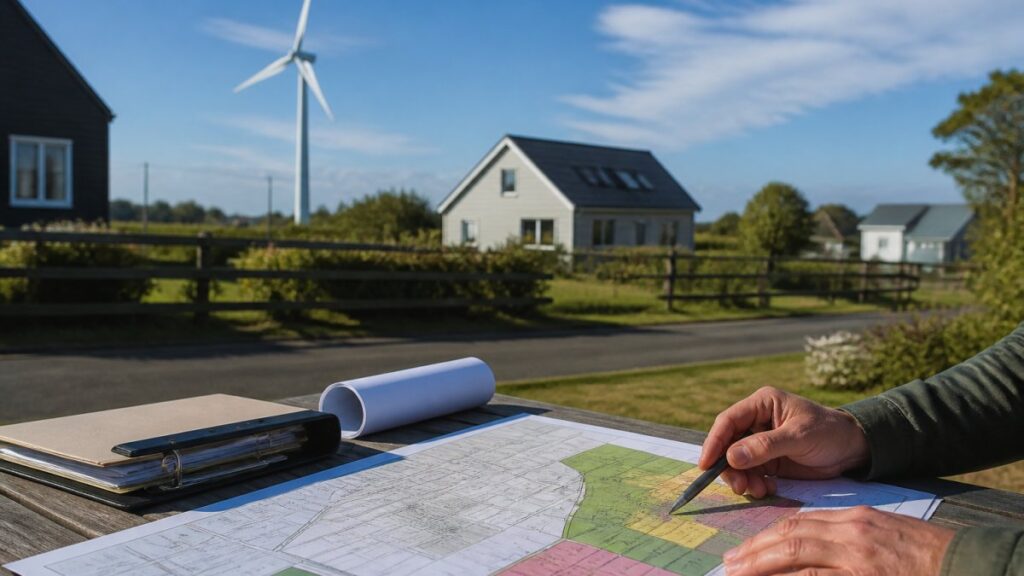
Verifying local zoning rules starts with your council’s online planning map, which shows the zone for your address. From there, match the zone to the relevant planning code and read the turbine provisions line by line.
Interpreting planning maps takes a little practice. Look for:
- The zone code (for example, a residential, rural, or special purpose zone)
- Overlays that add extra controls, such as bushfire or flood
- Heritage or environmental layers that can restrict structures
If the map is ambiguous, request a planning certificate from your council. It confirms the zoning and any restrictions in writing, which is useful evidence if your application is questioned.
Ground-Mounted vs Building-Mounted Turbines: Which Zoning Path Applies
Ground-mounted and building-mounted turbines often fall under different planning provisions, even on the same block. A ground-mounted turbine is a standalone structure, assessed against height, setback, and noise rules for a mast.
The practical difference comes down to visibility and reach. A ground-mounted mast is more visible and its noise travels further, so councils tend to apply the stricter test.
Match the mounting type to your zone’s rules before you choose a model, not after.
Conclusion: Turning Zoning Rules Into a Workable Approval Plan
The challenge with residential wind energy is not the technology but the planning framework around it. Rules differ by zone, council, and mounting type, and a single overlooked threshold can stall your project.
Solazone Australia can help you work through the practical side of your energy plan, from solar power systems and battery back-up to solar ventilators and pool heating, all backed by more than 40 years of technical expertise and a focus on Australian-made systems.
Get started with Solazone Australia and build an energy plan that fits your property and your budget.
Frequently Asked Questions
Do I need planning approval to install a residential wind turbine?
It depends on your council area, the turbine’s height, and whether it is ground-mounted or building-mounted. Some smaller building-mounted systems fall under exempt or complying development provisions, while ground-mounted turbines above certain heights typically require a development application. Always check your local planning scheme and confirm with your council before ordering equipment, because wind turbine zoning rules vary significantly between councils.
How far must a wind turbine be from a property boundary?
Wind turbine setback requirements are set by individual councils and usually relate to the turbine’s height and rotor diameter. A common approach is a setback equal to the hub height or a specified minimum distance from the property boundary and any sensitive land use such as a dwelling. Because there is no single national figure, you must confirm the exact separation distance in your council’s planning scheme before finalising a site layout.
Are there height limits for residential wind turbines?
Yes, most councils apply a height limit for domestic wind turbines, often measured from ground level to the top of the rotor. The specific limit varies by zone and by whether the turbine is ground-mounted or building-mounted. Exceeding the height limit usually pushes your project from a simple approval pathway into a full development application, so check the height threshold in your planning scheme early.
What should I include in a wind turbine planning application checklist?
A typical wind turbine planning application checklist includes a site plan showing the turbine position and property boundary, elevation drawings with height and setback measurements, manufacturer specifications for rated capacity and noise output, a statement addressing noise impact and visual impact on neighbouring residents, and written consent or notification details for affected neighbours. Some councils also require a shadow flicker assessment and evidence of compliance with relevant Australian Standards.
Do wind turbine planning rules vary between local councils?
They vary considerably. Each council’s planning scheme sets its own permitted use, prohibited use, and conditional use categories for wind energy facilities, along with height limits, setbacks, and noise limits. A turbine that is complying development in one council area may need a full development application in the next. This is why a jurisdiction-by-jurisdiction comparison and a direct check of your council’s planning maps is essential before you commit to a turbine size.
Can noise or shadow flicker affect approval for a home wind turbine?
Yes. Noise impact and shadow flicker are two of the most common reasons a residential wind turbine application is refused or conditioned. Councils often require a noise assessment against their planning code limits and may impose operating restrictions. Shadow flicker, where rotating blades cast moving shadows on neighbouring windows, is assessed by distance and orientation. Siting the turbine further from sensitive land use reduces both risks.