
Table of Contents
- Why Solar Energy System Maintenance Matters
- Solar Panel Maintenance Checklist Australia: What to Inspect
- How Often to Clean Solar Panels Australia: Seasonal Variations
- DIY Solar Panel Maintenance Australia: Safety Equipment and Steps
- Solar Panel Cleaning Cost Australia: Professional vs. DIY Options
- Inverter Health and Electrical Component Inspection
- Signs Your Solar System Needs Professional Servicing
- How Maintenance Protects Your Warranty and Energy Yield
Solar Energy System Maintenance Guide: Keep Your System Running Efficiently
Last Updated: July 26, 2026
A solar energy system maintenance guide is essential for anyone who’s invested in renewable energy. Understanding how to maintain your system properly determines the difference between consistent savings and underperformance. At Solazone Australia, we’ve spent over 40 years helping homeowners and businesses protect their solar investments through proper upkeep and monitoring. Below, we’ll show you exactly how to maintain your solar panels, inverter, and electrical components so your system stays efficient and your warranty stays valid.
Why Solar Energy System Maintenance Matters
A poorly maintained system loses efficiency gradually. The real problem isn’t catastrophic failure; it’s slow degradation when dust, debris, bird droppings, and corrosion accumulate on panels and electrical components. Most homeowners don’t realize their panels are underperforming until they compare actual output to what the system should produce. Pollen, salt spray, and debris reduce light reaching solar cells. Meanwhile, your inverter, the device converting DC power to usable AC electricity, can develop faults that go unnoticed for months.
A system degrading at just 1% per year sounds minor, but over ten years that’s a 10% loss in total energy yield. For a $10,000 system, that’s $1,000 in lost savings. Proper maintenance prevents this slide.
Maintenance protects your warranty. Most solar warranties include specific maintenance requirements. If you skip professional inspections or fail to keep documentation, manufacturers can deny warranty claims. Electrical components, cables, isolators, and connection points, are vulnerable to corrosion and weathering. An accredited installer or licenced electrician can spot these issues before they become safety hazards.
Solar Panel Maintenance Checklist Australia: What to Inspect
Your solar panel maintenance checklist should address both visible surfaces and the mounting structure. Start with a visual inspection every three months, looking for damage, discolouration, or debris accumulation. Check the mounting structure for rust, loose bolts, or movement. The frame and rails should be secure with no visible corrosion.
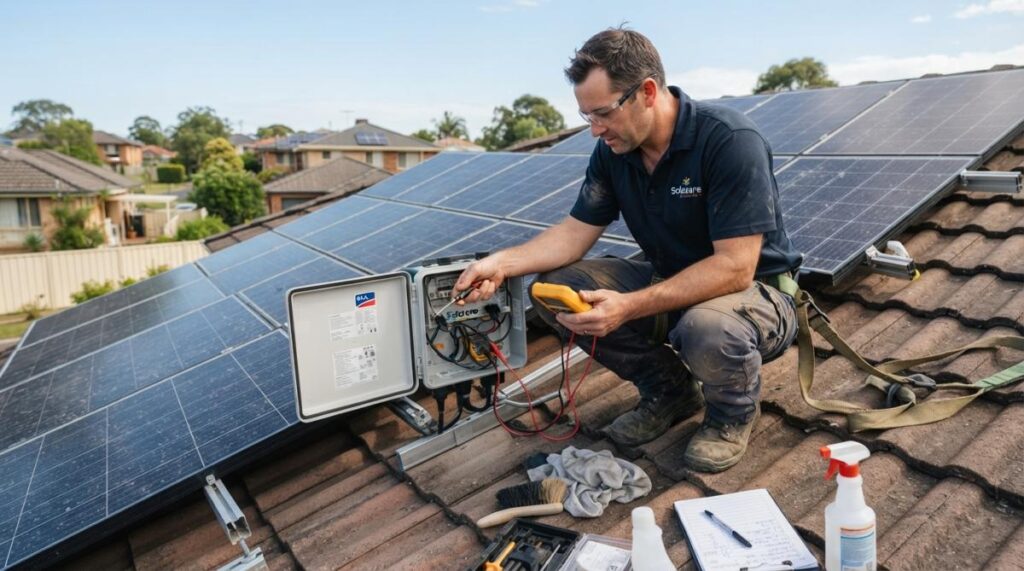
Examine the cables running from your panels to the inverter for cracks in insulation, exposed wiring, or animal damage. The isolator switch should be clearly visible and functioning smoothly. Check voltage readings if your monitoring system displays them; most systems show 300-500V depending on configuration. Significant deviations indicate wiring problems.
Corrosion assessment focuses on the mounting structure, especially near the coast. Salt spray accelerates corrosion on metal components. Look for white, green, or reddish discolouration on bolts, rails, or the frame. If you spot significant corrosion, call a licenced electrician to assess whether replacement is needed.
| Inspection Item | Frequency | What to Look For | Action if Found |
|---|---|---|---|
| Panel surface | Monthly | Dirt, bird droppings, leaves, cracks | Schedule cleaning or professional service |
| Mounting bolts | Quarterly | Rust, looseness, movement | Tighten or replace if corroded |
| Cables and isolator | Quarterly | Cracks, exposed wires, stiff switches | Contact licenced electrician |
| Inverter display | Weekly | Error codes, abnormal status messages | Document and contact installer |
| Corrosion on frame | Quarterly | White, green, or red discolouration | Professional inspection required |
Take photos during each inspection. Over time, these photos create a maintenance history that proves you’ve cared for the system, valuable if a warranty claim arises.
How Often to Clean Solar Panels Australia: Seasonal Variations
The frequency you clean your solar panels depends on your location and local conditions. In Australia, seasonal variations matter significantly. Spring brings pollen accumulation that can reduce output by 5-10%. Summer brings dust and bird activity. Autumn brings leaves and debris. Winter can bring salt spray near coastal areas.
Coastal properties need more frequent cleaning due to salt spray and bird droppings, monthly cleaning is common. Inland areas with lower humidity might need cleaning every 2-3 months. Desert regions experience dust storms requiring post-storm cleaning. Tropical areas with high pollen counts need more frequent attention during flowering seasons.
Monitor your system output to detect cleaning needs. If output drops 15-20% on a clear day compared to the same day last week, cleaning is needed. The general rule for most Australian homes: clean every 3-6 months, with more frequent cleaning during high-debris seasons. Coastal properties should clean monthly. Properties near trees or with high bird activity need quarterly cleaning minimum.
DIY Solar Panel Maintenance Australia: Safety Equipment and Steps
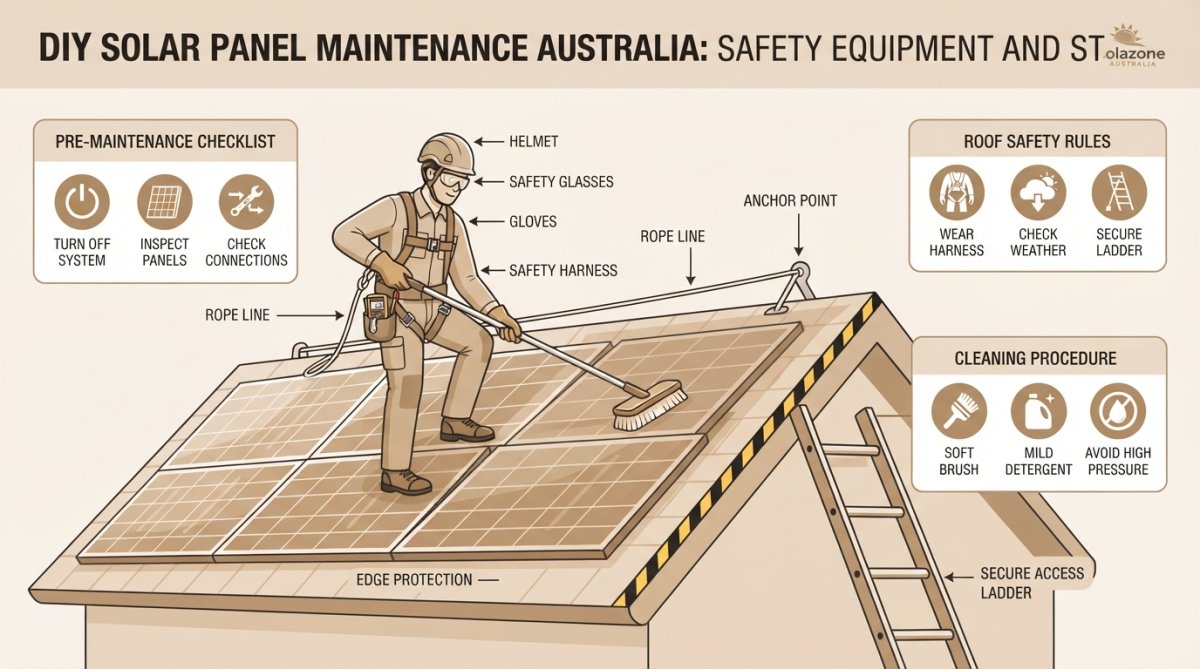
Before climbing onto your roof, understand the risks. Falls from height are serious. Electrical hazards exist even on DC systems. If you’re uncomfortable with heights or your roof pitch is steep, hire a professional.
Essential safety gear includes a fall arrest harness rated for roof work, non-slip footwear, and eye protection. Wear gloves to protect against sharp edges. Use a safety rope anchored to a secure point; never work alone. A harness is essential if your roof pitch exceeds 10 degrees.
Check weather conditions before starting; never work on a wet or icy roof. Inform someone you’re working at height. Use stable ladders with three-point contact. Never step directly on solar panels.
Step-by-step cleaning and inspection:
-
Turn off your system. Switch off the isolator and confirm the inverter has powered down. Wait 5 minutes for electrical charge to dissipate.
-
Inspect for damage before cleaning. Look for cracks, discolouration, or loose connections. If you spot damage, stop and contact a professional.
-
Use soft materials only. Never use abrasive brushes, pressure washers, or harsh chemicals. Soft-bristle brushes and deionised water are ideal.
-
Clean from bottom to top. Start at the lower edge and work upward to prevent dirty water running over cleaned sections.
-
Apply gentle pressure. Let the brush do the work; scrubbing hard risks damaging the anti-reflective coating.
-
Rinse thoroughly. Use clean deionised water for the final rinse to prevent mineral deposits.
-
Dry with soft cloth. Microfibre cloths prevent water spots.
-
Visual inspection while cleaning. Check for cracks, loose mounting bolts, or cable damage.
-
Document the work. Take photos and note the date, weather conditions, and any issues found.
-
Turn the system back on. Switch on the isolator and verify the inverter starts normally.
Never use pressure washers on solar panels. The force can crack the glass and damage seals. Water jets can force moisture into junction boxes and inverter connections, causing electrical faults.
Solar Panel Cleaning Cost Australia: Professional vs. DIY Options
Professional solar panel cleaning typically costs between $150 and $400 per visit, depending on system size and location. For a typical 5-6 kW residential system, expect around $250-$350 per cleaning.
Hire a licenced electrician or accredited installer for electrical component inspection, corrosion assessment, or any work involving the isolator, cables, or inverter. For routine cleaning, a general cleaning service works fine.
The hidden cost of DIY cleaning is your time and injury risk. If you spend 3 hours cleaning quarterly, that’s 12 hours per year. Professional cleaning becomes cost-effective when you factor in time and safety risks.
Professional cleaning every 6 months plus DIY visual inspections monthly creates the best balance of safety, cost, and system health. This approach costs roughly $500-700 annually but protects a system worth $8,000-15,000.
For coastal properties or high-debris areas, professional quarterly cleaning is worth the investment.
Inverter Health and Electrical Component Inspection
Your inverter converts DC power from the panels into AC power your home uses. When the inverter fails, your system stops producing energy entirely. Inverter lifespan typically ranges from 10-15 years, though some premium models last 20+ years.
Reading error codes helps you catch problems early. Common codes include grid connection errors, isolation faults, temperature warnings, and input voltage errors. When you see an error code, document it and contact your installer.
Voltage monitoring shows whether your panels produce the correct electrical potential. Most systems should show DC voltage between 300-500V. Significantly lower voltage suggests shading or panel degradation. Higher than normal voltage indicates possible wiring problems.
The isolator must operate smoothly and be clearly labelled. If it’s stiff, won’t switch, or shows corrosion around terminals, contact a licenced electrician. Cables should have intact insulation with no cracks or exposed wiring. Check where cables enter the inverter and connect to the isolator, these connection points are vulnerable to moisture and corrosion.
Signs Your Solar System Needs Professional Servicing
Performance degradation is the most obvious sign. If your system produces 20% less energy than it should on a clear day, something’s wrong. This could be panel dirt, shading from new tree growth, inverter problems, or wiring issues.
System health warnings appear as reduced efficiency, frequent disconnections, error codes, constant inverter fan running, or unusual clicking sounds. Any of these warrant professional inspection.
Physical damage is always a red flag. Cracked panels, loose mounting bolts, visible corrosion, or roof damage around the installation suggest problems requiring immediate professional assessment.
Strange noises from the inverter, such as grinding or loud humming, indicate mechanical problems. Inverters should be nearly silent. Loud fans running constantly suggest overheating.
Monitoring app disconnections or missing data suggest communication problems. Frequent disconnections can indicate inverter problems.
How Maintenance Protects Your Warranty and Energy Yield
Documentation is the foundation of warranty protection. Keep records of every inspection, cleaning, and service visit. Photograph your system quarterly, noting the date and observations. Save your monitoring app data. If a component fails, manufacturers will ask for proof of proper maintenance.
Your warranty claim protection depends on demonstrating proper maintenance. Documented quarterly inspections, cleaning records, and professional servicing history strengthen your position.
A well-maintained system produces 5-10% more energy annually than a neglected one. Over 25 years, that’s significant savings. Solazone Australia’s experience shows customers who maintain their systems see consistent energy production, while those who neglect maintenance experience gradual output decline.
Always use accredited installers or licenced electricians for repairs or component replacements. If you hire an unqualified person and something goes wrong, the warranty is void.
Maintaining your solar energy system isn’t complicated, but it requires consistency. Monthly visual inspections, quarterly professional cleaning, and annual electrical component checks keep your system running at peak efficiency. Solazone Australia recommends documenting every service visit and maintaining detailed records, this protects your warranty and proves proper maintenance. Start with a professional inspection from an accredited installer, establish a maintenance schedule suited to your location and climate, and stick to it. Your system will reward you with decades of reliable energy production and the savings you invested in it to achieve.
Frequently Asked Questions
How often should I perform solar energy system maintenance in Australia?
Most solar systems benefit from professional inspection annually, with visual checks every 3-6 months. Cleaning frequency depends on your location's dust, pollen, and bird activity, coastal areas and rural regions may need more frequent cleaning. Monitor your system's energy yield through your monitoring system; a significant drop often signals that maintenance is needed.
What does a solar panel maintenance checklist in Australia typically include?
A comprehensive maintenance checklist covers visual panel inspection for debris and damage, cleaning of panel surfaces, electrical component checks (cables, isolator, voltage), inverter health monitoring, mounting structure assessment for corrosion, and performance monitoring via your system's monitoring software. Professional servicing by an accredited installer or licenced electrician ensures electrical safety compliance.
Can I clean my solar panels myself, and what safety equipment do I need?
DIY cleaning is possible, but roof safety is critical. You'll need a safety harness, non-slip footwear, soft brushes, and deionised water. Never use high-pressure hoses, which can damage seals. However, electrical component inspection should only be performed by a licenced electrician to avoid safety risks and warranty voidance. Many homeowners find professional cleaning more cost-effective and safer.
How does regular maintenance improve my solar panel efficiency and protect my warranty?
Regular servicing prevents system degradation caused by dirt, pollen, bird droppings, and corrosion, all of which reduce energy yield. Most manufacturers require documented maintenance to honour warranty claims. By maintaining inspection records and addressing issues promptly, you protect your warranty coverage and ensure your renewable energy system performs at peak output for its full lifespan.
What are the signs that my solar system needs professional servicing?
Watch for a noticeable drop in energy output on your monitoring system, error codes or warning lights on your inverter, visible damage or corrosion on panels or mounting structures, and performance that doesn't match seasonal expectations. If cleaning doesn't restore output or you notice electrical issues, contact an accredited installer or licenced electrician immediately to prevent further system degradation.
Should I hire a professional or do DIY maintenance for my solar panels?
DIY visual inspection and cleaning are safe for homeowners, but electrical servicing must be done by a licenced electrician to maintain safety and warranty compliance. Professional annual inspections by an accredited installer catch issues early, corrosion, wiring problems, or inverter faults, saving money on repairs. Pricing depends on your system size and location; get a quote for professional servicing to compare against DIY costs.
This article was written using GrandRanker