
Table of Contents
- How to Get a Quote for Solar Installation
- Understanding Solar Panel Cost and Installation Pricing
- Finding Solar Installation Near Me: Local Installer Selection
- Solar Financing Options: Making Your Investment Affordable
- Solar Incentives and Tax Credits: Maximizing Your ROI
- Comparing Multiple Solar Quotes: Your Evaluation Checklist
- Why Choose Solazone Australia for Your Solar Quote
- Conclusion
Last Updated: July 19, 2026
When you’re ready to get a quote for solar installation, understanding the process can save you thousands of dollars and months of frustration. This guide walks you through every step of requesting and evaluating solar quotes, with specific attention to spotting red flags, comparing quotes accurately, and understanding what drives your costs.
The solar installation market has changed dramatically in the past two years. More providers exist than ever before, but quality varies wildly. According to Clean Energy Council Australia, customer satisfaction depends heavily on how well homeowners understand their quotes before signing.
How to Get a Quote for Solar Installation
Getting a solar installation quote involves three phases: preparation, submission, and assessment.
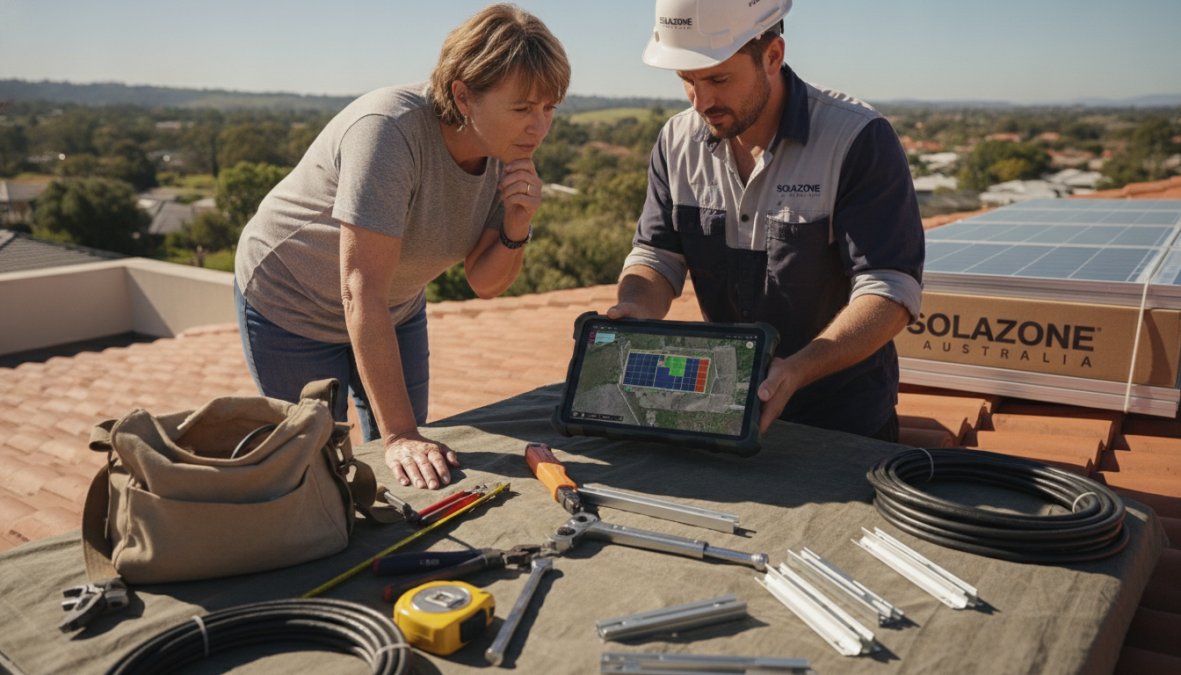
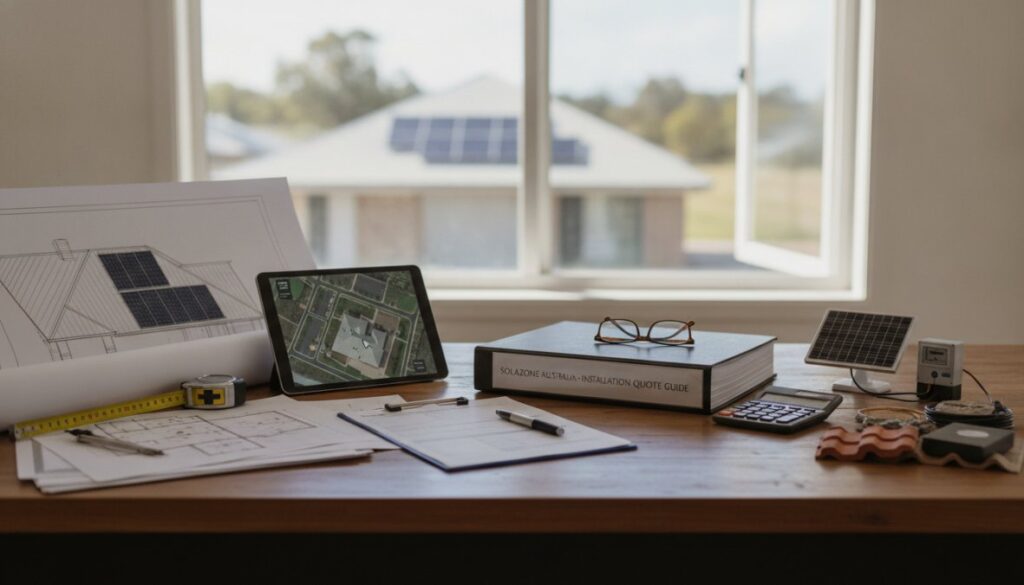
Start by gathering your energy data. Pull your last 12 months of electricity bills to show how your usage varies seasonally, which directly affects system sizing. Next, document your roof condition by noting shade, trees, neighboring buildings, and taking photos from different angles. This matters because shading can reduce system output by 20-40%.
When you contact installers, ask for a binding quote that includes exact system size (in kW), component specifications, labor costs, timeline, and warranty terms. Ballpark estimates are useless for comparison.
Request quotes from at least three installers before deciding. Variation between quotes for the same roof is often 15-25%.
Understanding Solar Panel Cost and Installation Pricing
Your solar installation quote breaks down into distinct cost categories.
What Affects Your System Sizing and Cost
System size drives everything else in your quote. A 5 kW system costs significantly less than an 8 kW system, but if your home uses 10 kW worth of energy daily, the smaller system won’t deliver good returns. Size your system to match actual energy consumption, adjusted for future changes like electric vehicles or heat pumps.
Roof condition is the second major cost driver. A simple roof with good southern exposure costs less than a complex roof with multiple angles or dormers. A flat, unobstructed roof might take 2-3 days to install; a complex roof can take 5-7 days.
Local factors matter too. Installation costs vary by region based on labor availability, permitting complexity, and local electricity prices.
Installation Cost Breakdown
A typical solar installation quote includes:
- Equipment (panels, inverter, mounting hardware): 40-50% of total cost.
- Labor and installation: 25-35% of total cost.
- Permits and inspections: 5-10% of total cost.
- Financing or incentive processing: 2-5% of total cost.
- Warranty and monitoring: included or 1-3% of total cost.
Ask your installer to provide this breakdown in writing. Vague pricing is a red flag.
Finding Solar Installation Near Me: Local Installer Selection
Not all solar installers are equal, and choosing the wrong one can cost you thousands.
What to Look for in Certified Installers
Start with credentials. Look for installers who are Clean Energy Council accredited or hold equivalent certifications. These require ongoing training and adherence to quality standards.
Experience matters significantly. An installer with 10+ years of experience has encountered most roof types and electrical configurations. Ask specifically how many systems they’ve installed in your area.
Check references carefully by calling previous customers and asking about timeliness, promised energy production, responsiveness, and warranty claim handling.
Review insurance and bonding. A reputable installer carries general liability insurance (at least $1 million) and workers’ compensation insurance, and should be bonded.
Examine their system design approach. A good installer optimizes placement for your specific usage patterns, roof orientation, and shading rather than using a one-size-fits-all approach.
Installers who pressure you to sign immediately or won’t provide written quotes are red flags. Legitimate installers expect you to compare options.
Red Flags in Solar Quotes
Vague pricing. If the quote doesn’t itemize equipment, labor, permits, and incentives separately, ask for clarification.
Unrealistic energy production claims. Real estimates account for shading, seasonal variation, and equipment losses.
Pressure to use their financing. Compare their financing against bank loans and third-party solar loans.
No warranty documentation. Reputable installers provide written warranty terms covering panels, inverter, labor, and workmanship.
Dismissing your roof concerns. Issues like leaks, structural problems, or tree shading directly affect system performance.
Unwillingness to discuss maintenance costs. Inverters need replacement around year 10-15 (cost: $2,000-$4,000). An installer who won’t discuss future costs is hiding information.
Solar Financing Options: Making Your Investment Affordable
Several financing models make solar accessible regardless of your cash position.
Loan vs. Cash vs. Lease: Pros and Cons
Cash purchase. Paying cash offers the best long-term economics. You own the system outright, claim all tax credits and rebates, and keep 100% of energy savings for 25+ years. Payback is typically 5-8 years. The downside: it ties up capital.
Solar loan. This is the most popular option. You borrow money, then use tax credits and rebates to pay down the loan. Monthly payments are typically lower than your current electricity bill, so you see savings immediately. You own the system and claim incentives. The downside: you’re carrying debt, and if you sell your home, the loan transfers to the buyer.
Lease or Power Purchase Agreement (PPA). You don’t own the system. You pay a fixed monthly fee (lease) or per kilowatt-hour produced (PPA). This requires no upfront cost and shifts maintenance to the owner. The downside: you don’t own the system, can’t claim tax credits or rebates, and your savings are limited to the difference between the lease payment and your current rate.
For most homeowners, a solar loan strikes the best balance: immediate savings, system ownership, and incentive claims without tying up large amounts of cash.
Solar Incentives and Tax Credits: Maximizing Your ROI
Government incentives can reduce your net cost by 25-40%.
Federal and State Rebates
The Australian Government’s Small-scale Renewable Energy Scheme (SRES) provides Small-scale Technology Certificates (STCs) for residential solar systems. The number of STCs depends on system size, location, and installation date. These certificates have market value and typically reduce upfront cost by $2,000-$5,000. Your installer usually handles STC claims.
Some states offer additional rebates. Check with your state’s energy department for current programs, as these change frequently.
Net Metering Benefits
Net metering allows you to send excess solar energy back to the grid and receive credits on your electricity bill. When your system produces more power than you use, the excess flows to the grid and your meter runs backward. This dramatically improves your return on investment.
Net metering terms vary by state and utility company. Some utilities offer full retail credits; others offer reduced rates for exported power. Ask your installer what terms apply in your area.
Comparing Multiple Solar Quotes: Your Evaluation Checklist
Use this framework to evaluate quotes side by side:
| Evaluation Criteria | What to Check | Why It Matters |
|---|---|---|
| System Size (kW) | Does it match your annual energy consumption? | Undersized systems don’t save money; oversized systems waste capital |
| Equipment Brands | Are panels and inverter from reputable manufacturers? | Cheap equipment fails sooner |
| Warranty Terms | 25-year panel warranty? 10-year inverter warranty? | Poor warranties leave you paying for repairs |
| Total Cost | Is it itemized (equipment, labor, permits, incentives)? | Vague pricing hides markups |
| Timeline | How long from contract to activation? | Delays cost money |
| STC/Rebate Handling | Does the quote reflect STCs and state rebates? | Some installers undervalue incentives |
| Monitoring System | Is real-time monitoring included? | Helps you spot problems early |
| Post-Installation Support | What’s the process for warranty claims? | Good support matters when something goes wrong |
Look for consistency across quotes. Real cost differences between installers usually fall in the 10-20% range for equivalent systems.
Impact of Roof Condition on Your Quote
Your roof’s age and condition directly affect quote pricing and system longevity.
If your roof is older than 15 years, most installers will recommend replacing it before installing solar. A new roof costs $10,000-$20,000 but extends system lifespan by ensuring the roof won’t leak and damage equipment.
Roof material affects installation complexity and cost. Tile roofs require special flashing and take longer. Metal roofs are fastest. Asphalt shingle roofs fall in between.
Some installers offer roof inspection as part of the quote process. A detailed assessment prevents surprises during installation.
Why Choose Solazone Australia for Your Solar Quote
With more than 40 years of technical expertise in solar energy systems, Solazone Australia brings deep experience to every project. Our team has trained more than 200 staff members and installed systems across thousands of Australian homes and businesses.
What sets Solazone Australia apart is our commitment to personalized customer service. Rather than pushing a one-size-fits-all approach, we conduct thorough home energy audits and design custom solar solutions matching your specific roof, usage patterns, and financial situation.
We handle the entire solar journey: from initial quote through STC claims, permitting, installation, and post-installation support. When you get a quote for solar installation with Solazone Australia, you’re getting a binding quote backed by our 40-year track record, not a ballpark estimate that changes at the site visit.
Getting a quote for solar installation is the critical first step toward energy independence and lower electricity costs. Real savings come from understanding what drives costs, spotting red flags in quotes, and choosing an installer with genuine expertise rather than just aggressive marketing.
Solazone Australia’s 40+ years of experience and commitment to personalized design means your quote reflects your actual situation. Our team has solved thousands of roof challenges and designed systems that deliver the energy savings customers expect. Start with Solazone Australia and get a detailed, binding quote that accounts for your roof condition, energy patterns, and local incentives.
Frequently Asked Questions
What information do I need to provide to get an accurate solar installation quote?
To receive a custom quote for solar installation, provide your recent utility bills (showing monthly energy usage in kWh), your roof's age and condition, roof orientation and shading patterns, and your address for satellite data analysis. Most installers use satellite imagery and on-site assessments to determine system sizing. Having this information ready helps certified installers deliver accurate, no-obligation quotes faster and identify whether your home is suitable for a grid-tied or off-grid photovoltaic system.
How long does it take to get a solar installation quote?
A ballpark estimate can be provided within 24-48 hours after submitting your information online. However, a detailed custom quote typically requires an on-site assessment by a certified installer, which may take 1-2 weeks depending on local solar marketplace demand. This assessment evaluates roof condition, shading, structural requirements, and electrical integration, all critical for accurate system sizing and installation cost breakdown. Rush quotes are available but may sacrifice accuracy.
What are the main cost factors in a solar installation quote?
Solar panel cost depends on system size (measured in kW), panel efficiency, inverter type, and installation labor. Additional factors include roof condition repairs, electrical upgrades, permits, and labor complexity. Australian-made systems and premium equipment may cost more upfront but often deliver better long-term ROI. Battery backup, if included, significantly increases costs. Financing options and available tax credits can offset these expenses. Always request an itemized installation cost breakdown to compare quotes fairly.
How do I know if a solar quote is competitive and fair?
Compare at least 3 quotes from vetted installers using a standardized checklist: system size (kW), panel efficiency ratings, warranty terms, installation timeline, and price per watt. Red flags include vague pricing, pressure to sign immediately, unrealistic energy savings claims, or refusal to provide itemized breakdowns. Check if the quote accounts for roof condition, shading analysis, and net metering eligibility. Verify installer certifications and ask about post-installation maintenance costs. Legitimate installers provide binding quotes with clear terms.
This article was written using GrandRanker