
Table of Contents
- Why Roof Heat Buildup Matters for Your Home
- Assess Your Roof Heat Buildup Problem
- Install or Upgrade Roof Ventilation in Australia
- Add or Improve Roof Insulation in Australia
- Apply Reflective Coatings and Radiant Barriers
- Government Rebates and Incentives for Roof Insulation in Australia
- Common Mistakes When Fixing Roof Heat Buildup
- Long-Term ROI: Calculating Your Payback Period
Last Updated: August 2, 2026
Why Roof Heat Buildup Matters for Your Home
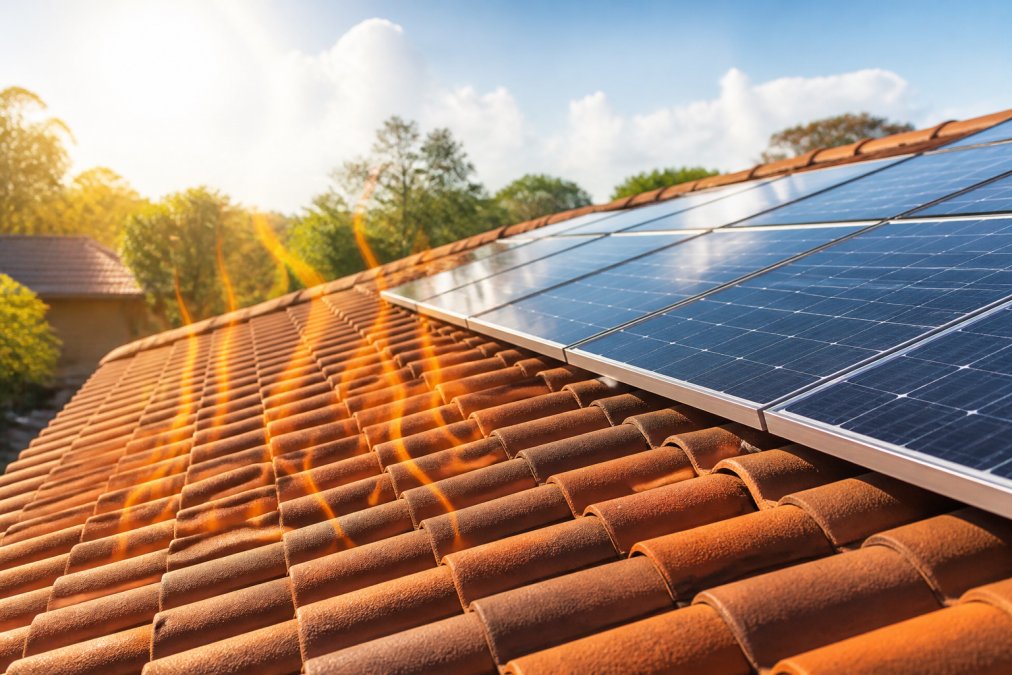
Roof heat buildup is one of the most overlooked energy problems in Australian homes. When your roof absorbs solar radiation without proper ventilation or insulation, attic temperatures can soar to 60°C or higher on summer days, forcing your air conditioning system to work overtime. Homes that address this issue typically see energy bills drop by 15-25%, while comfort levels improve dramatically.
Excessive roof heat damages roof materials, shortens air conditioning system lifespan, and creates uncomfortable living spaces even with active cooling running. This guide walks you through seven proven methods to fix the issue, from passive ventilation strategies to reflective coatings that reject solar energy before it enters your home.
The most cost-effective fix combines three elements: improved ventilation to allow heat to escape, adequate insulation to slow heat transfer, and reflective surfaces to reject solar energy before it enters the roof cavity. Start with the assessment section below to identify which approach suits your specific situation.
Assess Your Roof Heat Buildup Problem
Before investing in solutions, you need to understand the severity of your roof heat buildup. A proper assessment prevents wasted money on unnecessary upgrades.
Signs of Excessive Roof Heat
Upper floors feel significantly warmer than lower levels, even with air conditioning running. Certain rooms stay hot long after sunset, suggesting heat is trapped in the roof cavity and radiating downward through the ceiling.
Look for physical damage as well. Premature roof material deterioration, particularly on north-facing slopes, often signals excessive heat exposure. Shingles or tiles may appear faded or cracked faster than expected. Inside the attic, check for warped timber framing or peeling paint on roof trusses. If your roof cowls or whirlybirds aren’t spinning freely, or if you see moisture staining near ridge vents, airflow circulation is compromised.
Another telling sign: your air conditioning system runs constantly during summer without adequately cooling the upper level.
Measuring Attic Temperature and Airflow
Quantifying the problem gives you a baseline for improvement. Purchase a simple digital thermometer and measure attic temperature at three times: early morning (6am), midday (12pm), and early evening (6pm). Record outdoor temperature at the same times. If your attic is more than 15°C warmer than the outside air during midday, you have significant roof heat buildup.
For airflow assessment, hold a lit incense stick near soffit vents and ridge vents. Smoke should move steadily outward through ridge vents and inward through soffits, indicating proper convection currents. If smoke hangs still or moves weakly, ventilation is inadequate.
If you lack attic access, many solar ventilation specialists offer free assessments that measure actual conditions with professional equipment and identify thermal bridging points, gaps in insulation, and ventilation blockages.
Install or Upgrade Roof Ventilation in Australia
Roof ventilation is the foundation of any heat buildup solution. Without proper airflow, heat accumulates in the roof cavity regardless of insulation or coatings. Ventilation works by creating convection currents: cooler air enters through soffit vents along the eaves, absorbs heat from the roof structure and insulation, and exits through ridge vents or roof cowls at the peak.
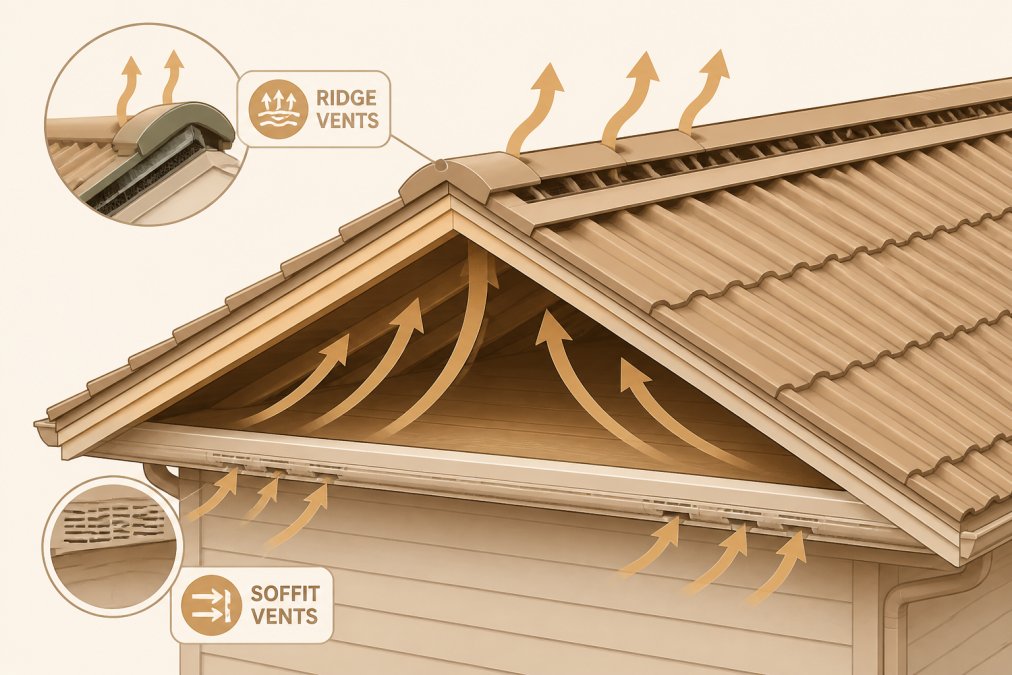
Ridge Vents and Soffit Vents
Ridge vents run along the peak of your roof and allow hot air to escape naturally. Soffit vents, located under the eaves, draw in cooler outside air to replace the escaping hot air. Together, they create a complete airflow path that reduces roof surface temperature and lowers the thermal load on your home.
Installing ridge vents requires removing a section of roofing material along the peak and fitting a continuous vent strip. This is a job for professionals, as improper installation can create water leaks. Soffit vents are easier to retrofit; they’re simply drilled or cut into the soffit panels and fitted with vent covers.
The key metric is ventilation area. Building codes typically specify that total vent area should equal at least 1/150th of the attic floor area (or 1/300th if you have a balanced 50/50 ridge-to-soffit ratio). A 200 square metre attic should have roughly 1.3 square metres of total vent opening. Many older Australian homes fall short of this standard, which is why retrofitting additional vents often produces dramatic improvements.
Never block soffit vents with insulation. A common mistake is pushing insulation right up to the eaves, which stops airflow circulation and defeats the entire ventilation system. Maintain at least 50mm of clear air space between insulation and soffit vents.
Whirlybirds and Roof Cowls
Whirlybirds (also called turbine vents) and roof cowls are active ventilation devices that spin in the wind, actively pulling hot air out of the roof cavity. Unlike passive ridge vents, they work even on still days because wind-driven rotation creates negative pressure that draws air upward. They’re particularly effective in Australian climates where summer heat often arrives with calm, stagnant air.
A typical whirlybird can extract around 300-500 cubic metres per hour on a breezy day. For a typical residential attic, installing two to four whirlybirds combined with ridge and soffit vents creates redundancy; if wind drops, the passive vents still function.
Installation involves cutting a hole through the roof, fitting a flashing collar to prevent water ingress, and securing the whirlybird base. The internal duct should connect cleanly to the attic space with minimal bends. Poorly installed whirlybirds become sources of water leaks and actually reduce airflow if ducts are kinked or undersized.
Add or Improve Roof Insulation in Australia
Insulation slows the rate at which heat transfers from the roof into the living space below. While ventilation removes heat that has already accumulated, insulation prevents that heat from entering your home in the first place. The two work together: ventilation handles the heat that does build up, while insulation reduces how much heat needs to be removed.
Insulation R-values and Types
R-value measures thermal resistance; higher numbers mean better insulation. Australian building standards recommend different R-values depending on climate zone. Melbourne is in zone 6, requiring minimum R2.5 for ceilings; the Sunshine Coast (zone 2) requires R1.5. However, these are minimums. For effective heat buildup reduction, aim for R3.5 to R4.0 in warm climates.
Common insulation types include bulk insulation (batts, blankets, rigid boards) and reflective foils. Bulk insulation works by trapping air in small pockets that slow heat transfer. Reflective foils reduce radiant heat transfer by reflecting thermal radiation back toward the heat source. They’re most effective when facing an air gap (at least 25mm). Many modern insulation products combine bulk insulation backing with reflective foils, giving you both conduction and radiant heat reduction in a single product.
The thermal bridging effect matters more than most homeowners realise. Timber roof trusses conduct heat directly from the roof to the interior. To address this, some installers add a thin reflective layer over the trusses before laying bulk insulation, or use spray foam that seals around the timber structure entirely.
Installation Best Practices
Proper installation makes the difference between effective insulation and wasted money. Batts must be laid flat without compression, as squashing insulation reduces its R-value significantly. They should fit snugly between trusses with no gaps or voids where heat can bypass the insulation entirely.
Ensure insulation doesn’t block soffit vents. Leave at least 50mm of clear space between the insulation and the soffit vent opening so air can flow freely. Some installers use baffle boards to hold insulation back from the eaves while maintaining the air channel.
For attics with existing insulation, adding a second layer perpendicular to the first covers more of the thermal bridging and creates a more uniform thermal envelope. This "cross-layer" installation is worth the extra cost if your current insulation is below R3.0.
Moisture control is critical in Australian climates. Install a vapour barrier on the warm side of the insulation (the interior side in your attic). This prevents moisture from the living space below from diffusing into the insulation, which would reduce its effectiveness and encourage mould growth.
Apply Reflective Coatings and Radiant Barriers
Reflective coatings and radiant barriers work by reflecting solar radiation away from your roof before it can be absorbed and converted to heat. These methods address the problem at the source, preventing heat gain rather than just managing heat that’s already accumulated.
How Reflective Paint Reduces Solar Reflectance
Reflective roof coatings contain special pigments and binders that reflect visible and infrared solar radiation. A standard dark roof absorbs 80-90% of incident solar energy; a reflective coating can reduce that to 30-40%, depending on the product’s solar reflectance index (SRI). This dramatic reduction in heat absorption means less thermal load on your entire cooling system.
The coating is applied directly to the existing roof surface with no removal required. It’s typically water-based acrylic or polyurethane, making it environmentally friendly and easy to apply. A roof coated with high-SRI reflective paint can be 20-30°C cooler than an uncoated dark roof on the same day. This translates directly to lower attic temperatures and reduced HVAC load.
Emissivity is equally important as reflectance. A good reflective coating should have high reflectance (70%+) and high emissivity (80%+). Together, these properties mean the roof reflects most incoming heat and releases any absorbed heat quickly, keeping the roof surface temperature low.
Reflective coatings are most cost-effective when applied to new roofs or during roof replacement, but retrofitting existing roofs is also viable. The [payback period](/calculate-solar-payback-period-guide/) is typically 3-5 years through reduced air conditioning costs.
Radiant Barrier Installation Under the Roof
A radiant barrier is a thin reflective foil layer installed under the roof structure, typically between the roof and the insulation below. It reflects radiant heat from the hot roof back upward rather than allowing it to radiate downward into the attic.
Radiant barriers are most effective in hot climates where radiant heat is a significant component of the total heat load. They work best with an air gap on at least one side, ideally 25mm or more. Without an air gap, the reflective benefit is reduced because the barrier can’t effectively reflect heat if it’s in direct contact with other materials.
Installation involves stapling or adhering the foil layer to the underside of roof trusses or rafters, creating a reflective surface that faces the attic space. The effectiveness depends on the foil’s reflectivity (should be 95%+) and the size of the air gap. Foil that’s in contact with insulation or other materials loses much of its radiant benefit.
Government Rebates and Incentives for Roof Insulation in Australia
Australian federal and state governments offer rebates and incentives to encourage home energy improvements, including roof insulation and ventilation upgrades. Understanding what’s available in your state can significantly reduce your out-of-pocket costs.
The federal Small-scale Renewable Energy Scheme (SRES) provides rebates for solar panels and some ventilation systems. State-based programs vary considerably. Victoria’s Energy Efficiency Rebate offers discounts on insulation improvements for eligible households. New South Wales has the Energy Savings Scheme, which includes insulation retrofits. Queensland’s Sustainable Homes Rebate covers energy efficiency upgrades including roof insulation.
Eligibility typically depends on your income level, home ownership status, and the age of your home. Many programs prioritize older homes with poor insulation. To check current availability, visit your state’s energy regulator website or contact your local council.
Some rebates require work to be completed by accredited installers, which is why choosing a professional with proper credentials matters. Solazone Australia’s experienced installation teams are familiar with rebate requirements across Australian states and can guide you through the application process, ensuring your work qualifies for available incentives.
Common Mistakes When Fixing Roof Heat Buildup
Understanding what doesn’t work helps you avoid wasting money on ineffective solutions. The most common mistake is installing ventilation without addressing insulation gaps. A well-ventilated attic that lacks proper insulation still allows significant heat transfer into the home. Ventilation and insulation must work together.
Another frequent error is blocking soffit vents with insulation. This destroys the convection current that makes passive ventilation work. Always maintain clear air channels from soffit to ridge.
Over-relying on reflective coatings without addressing ventilation is another trap. A reflective roof reduces heat absorption, but if your attic lacks ventilation, whatever heat does build up will stay trapped. Reflective coatings are most effective as part of a comprehensive strategy.
Undersizing ventilation is surprisingly common. Calculate the required vent area based on your attic size, not guesswork. Improper installation of radiant barriers, placing them in direct contact with insulation or without adequate air gaps, renders them nearly useless.
Finally, many homeowners neglect moisture control. In humid climates, failing to install vapour barriers or maintain adequate ventilation leads to condensation in the insulation, which reduces R-value and promotes mould growth.
Long-Term ROI: Calculating Your Payback Period
Investing in roof heat buildup fixes makes financial sense when you understand the return on investment. The payback period depends on your current energy costs, the severity of the problem, and which solutions you implement.
Start by calculating your baseline. Record your summer air conditioning costs for a typical month (January or February in Australia). If your cooling bill is significantly higher than winter heating bills, roof heat buildup is likely a major factor. Roof heat contributes 15-25% of summer cooling costs in poorly ventilated, uninsulated attics.
Reflective coatings typically cost $2,000-$4,000 for a typical home and can reduce cooling costs by 10-15%. At average Australian electricity rates, this translates to savings of $200-$400 per year, giving a payback period of 5-10 years. The coating also extends roof life by reducing thermal stress.
Insulation retrofits range from $1,500-$3,500 depending on current R-value and target R-value. Savings are typically 15-20% of cooling costs, or $300-$500 annually. Payback is 3-7 years, and many state rebates reduce upfront costs by 20-30%, cutting the payback period significantly.
Ventilation upgrades (ridge vents, soffit vents, whirlybirds) cost $800-$2,000 installed. These are the most cost-effective option, reducing cooling costs by 10-15% and offering payback in 2-4 years. Combined with insulation and reflective coatings, a comprehensive approach typically pays for itself in 4-6 years.
| Solution | Typical Cost | Annual Savings | Payback Period | Additional Benefits |
|---|---|---|---|---|
| Reflective coating | $2,500-$4,000 | $250-$400 | 6-10 years | Extended roof life, reduced UV damage |
| Insulation upgrade | $1,500-$3,500 | $300-$500 | 3-7 years | Winter heating savings, moisture control |
| Ventilation upgrade | $800-$2,000 | $200-$350 | 3-5 years | Faster heat dissipation, lower HVAC load |
| Comprehensive approach | $5,000-$9,000 | $750-$1,200 | 4-6 years | Maximum comfort and efficiency gains |
Beyond direct energy savings, consider non-financial benefits. Reduced HVAC runtime extends air conditioning system life by 3-5 years, saving replacement costs of $5,000-$8,000. Improved thermal comfort increases home value and makes summer living more pleasant.
Government rebates and incentives can reduce payback periods by 20-30%. Check your state’s energy efficiency programs for current rebate availability. Many programs cover 20-40% of insulation costs, which accelerates payback significantly.
Roof heat buildup doesn’t have to be a permanent problem. By combining proper ventilation, adequate insulation, and reflective surfaces, you can reduce attic temperatures by 15-25°C and cut cooling costs substantially. The key is starting with an honest assessment of your current situation, then implementing solutions that address both heat accumulation and heat transfer. At Solazone Australia, our experienced teams help homeowners across Melbourne and the Sunshine Coast design comprehensive solutions tailored to their specific roof conditions. Contact us today for a free evaluation and discover how much you can save this summer.
Frequently Asked Questions
How do you stop heat from building up in the roof cavity in Australia?
The most effective approach combines three methods: improve attic ventilation using ridge vents, soffit vents, or whirlybirds to create airflow circulation; add or upgrade insulation to R-values appropriate for your climate zone; and apply reflective roof coatings or install radiant barriers to reduce solar reflectance. In Melbourne, R-values of 4.0-5.0 are typical; on the Sunshine Coast, 5.0-6.0 is more suitable. Each method addresses a different aspect of heat gain, so combining them delivers the best results for thermal comfort and HVAC load reduction.
Are whirlybirds effective for reducing roof heat in Australia?
Whirlybirds (roof cowls) are effective when used as part of a complete ventilation strategy. They work by creating passive airflow circulation through convection currents, expelling hot air from the attic cavity. However, they work best when paired with adequate soffit vents to allow cool air intake. A single whirlybird typically handles 1,000-1,500 cubic metres per hour of airflow. For maximum effectiveness, ensure your roof cavity has balanced intake and exhaust vents, and that the whirlybird is properly installed to prevent moisture ingress or condensation issues.
Does roof insulation help with heat buildup?
Yes, thermal insulation reduces heat gain by slowing radiant heat transfer from the roof surface into the attic and living spaces below. Higher R-values provide better thermal resistance. However, insulation alone cannot eliminate heat buildup if ventilation is poor. The combination of insulation (to slow heat transfer) and ventilation (to remove heat that does enter the attic) is what delivers lasting relief from roof heat buildup. Building code compliance in Australia requires both adequate insulation and ventilation for energy efficiency.
What is the payback period for fixing roof heat buildup?
Payback periods vary based on your climate, current energy bills, and which solutions you choose. Ventilation upgrades like whirlybirds or ridge vents typically cost less upfront and may show energy savings within 2-4 years. Reflective roof coatings and radiant barriers offer payback periods of 3-7 years depending on roof size and local electricity costs. Insulation upgrades have longer payback periods (5-10 years) but deliver the most consistent long-term savings. Contact Solazone Australia for a personalised ROI calculation based on your specific situation, roof condition, and energy usage patterns.
This article was written using GrandRanker