
Table of Contents
- The Scale of Solar Panel Waste in Australia
- Environmental Impact of Solar Panel Landfill Disposal
- Solar Panel Waste Management: How Recycling Works
- Material Recovery and the Circular Economy
- Solar Panel Disposal Costs and Your Options
- Regulatory Framework and Current Collection Infrastructure
- What Homeowners and Installers Can Do Now
- Frequently Asked Questions
Last Updated: September 17, 2026
The Scale of Solar Panel Waste in Australia
Solar panel installations have grown exponentially across Australia, and as these systems age, a critical challenge emerges: what happens to the panels when they reach end-of-life? Solar panels typically have a functional lifespan of 25-30 years, meaning the first wave of large-scale decommissioning is beginning now (Recycling Wind Turbines, Solar Panels and Batteries: Fact Sheet).
Early-generation systems installed in the mid-1990s are now reaching retirement age. Without coordinated recycling infrastructure, many panels will end up in landfill, representing a significant loss of valuable materials. Understanding solar panel recycling is essential for anyone with an aging system or responsibility for commercial solar infrastructure.
Environmental Impact of Solar Panel Landfill Disposal
Solar panels contain hazardous materials including lead and cadmium sealed within glass and aluminium frames. Chemical leaching can occur in landfill, particularly in high-moisture environments, potentially contaminating soil and groundwater.
A single panel contains roughly 10 kilograms of glass, several kilograms of aluminium, and smaller quantities of copper and silicon, all requiring substantial energy to produce. Landfill disposal offers no recovery pathway for these materials.
Manufacturing a replacement panel generates greenhouse gas emissions equivalent to roughly 3-4 years of the panel’s operational carbon offset. Recycling recovers 85-95% of a panel’s material value and eliminates hazardous waste risk, while landfill disposal provides neither environmental nor economic benefit.
Solar Panel Waste Management: How Recycling Works
Solar panel recycling is a multi-stage process that separates materials into recoverable streams.
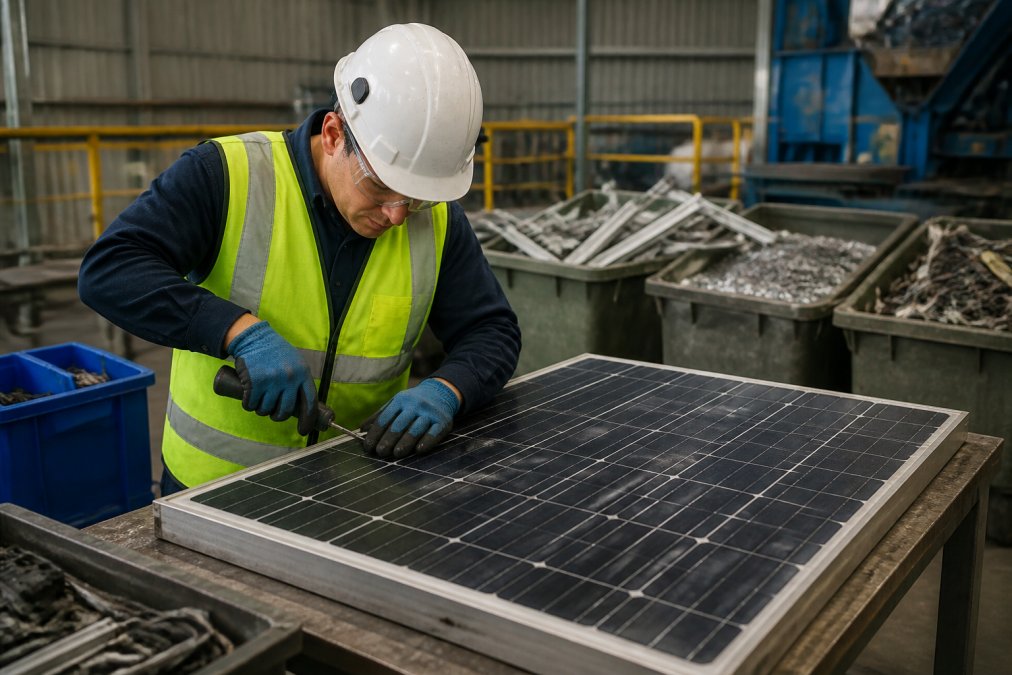
Decommissioning involves safely removing panels from roofs or ground-mount systems using trained technicians. Panels are then transported to a recycling facility for processing.
At the facility, panels are sorted by type and condition. Serviceable panels may be refurbished and resold, extending their useful life. Panels beyond repair enter the material recovery stream.
The mechanical separation process removes the aluminium frame (infinitely recyclable), then separates glass and silicon layers through thermal or mechanical treatment. Silicon recovered from panels can be reused in new panel manufacturing or other electronics applications.
Junction boxes and electrical components are processed separately, with copper and metals recovered. Hazardous materials like lead are contained and managed according to strict environmental standards, preventing chemical leaching.
Recovered materials feed into secondary manufacturing: recycled silicon into new panels, recycled glass into panels or construction materials, and aluminium into the broader recycling stream. This closes the loop, reducing virgin resource extraction.
Material Recovery and the Circular Economy
The circular economy principle treats end-of-life panels as a resource bank rather than waste. When recycling infrastructure functions effectively, panels become a source of materials.
Material recovery rates are substantial: glass achieves 95% recovery, crystalline silicon systems recover 85% or more, aluminium frames are nearly 100% recoverable, and copper and conductive materials are recovered at high rates.
As virgin material costs rise and recycling technology improves, recovered materials become increasingly competitive with newly extracted resources, creating incentives for manufacturers to design panels with end-of-life recycling in mind.
For Australia, developing strong material recovery infrastructure means reducing reliance on imported materials and building a domestic supply chain. Several pilot programmes are underway, testing collection logistics, material sorting efficiency, and remanufacturing pathways.
Recycling infrastructure requires upfront investment and regulatory support to become cost-competitive with landfill disposal. Without coordinated policy and collection systems, many panels end up in landfill despite their material value.
Solar Panel Disposal Costs and Your Options
When your solar panel system reaches end-of-life, costs depend on the number of panels, location, system condition, and disposal pathway. Solar panel disposal costs are not yet standardised across the country, so understanding your options requires research.
Recycling Costs and Material Value
Dedicated solar panel recycling facilities typically charge a fee per panel. Many recyclers recover material value, aluminium, glass, silicon, and copper, which can offset costs. Recovered material value can reduce the net cost, or occasionally result in a small credit.
Material recovery value fluctuates with commodity prices. Aluminium, comprising roughly 10-15% of a panel’s weight, is the most valuable recovered material. Contact local recyclers directly for realistic figures based on current commodity prices.
Transport costs are a hidden variable in regional areas. Courier or freight to a facility more than 100 kilometres away may add $200-$500. Some recyclers offer collection services for larger commercial systems.
Refurbishment and Second-Life Pathways
If panels still function but have degraded output, refurbishment may be the lowest-cost option. Refurbished panels can sell for a percentage of new panel prices, potentially recovering value for a residential array.
Second-life applications are expanding: off-grid systems, caravan and RV installations, agricultural water pumping, and remote telecommunications towers accept panels with 70-85% of original output. Contacting second-hand solar retailers or off-grid installers can unlock value.
Landfill Disposal: True Cost vs. Apparent Savings
Landfill disposal appears cheapest upfront. However, improper disposal of hazardous materials under the Environment Protection and Biodiversity Conservation Act 1999 (EPBC Act) and state waste legislation can trigger significant penalties.
For commercial operators, landfill disposal risks reputational damage and liability. Insurance policies increasingly exclude coverage for improper hazardous waste disposal, meaning you bear full remediation costs.
Decision Framework: Choosing Your Pathway
To make an informed choice: (1) Assess panel condition, if producing 80%+ of original capacity, refurbishment or second-life sale is viable. (2) Get quotes from local recyclers within 200 km, asking for processing fees, material credits, and collection options. (3) Check second-hand market value with off-grid installers and caravan retailers. (4) Calculate net cost including transport, subtract material credits, and compare to second-hand sale value. (5) Plan ahead, discuss end-of-life options with your installer, as some offer take-back schemes that lock in better rates.
Regional Variation and Emerging Schemes
Collection infrastructure is developing unevenly. Major population centres have multiple recycling options, whilst regional and rural areas often have limited capacity. If you’re in a region with limited infrastructure, establish a relationship with your installer now to secure a take-back arrangement or identify the nearest viable recycler.
Some solar retailers and installers offer extended producer responsibility (EPR) schemes voluntarily, accepting panels they’ve sold or installed for recycling at reduced or no cost. If your installer offers such a scheme, it’s often the simplest and most cost-effective disposal pathway.
Regulatory Framework and Current Collection Infrastructure
Solar panel recycling in Australia exists in a regulatory grey zone. Unlike batteries or e-waste, panels are not yet subject to a mandatory national recycling scheme. This means collection infrastructure is fragmented and inconsistent across states.
National Policy Landscape
The Australian Government’s National Waste Policy 2018 identifies solar panel waste as an emerging priority, but implementation remains at the state level. The Department of Climate Change, Energy, Environment and Water (DCCEEW) is monitoring international best practices, particularly from the European Union, which has mandated PV recycling since 2014. However, no national mandatory scheme has been legislated as of 2026.
Extended Producer Responsibility (EPR) is under active consideration. EPR places responsibility on manufacturers and importers to fund end-of-life management. If adopted, it would likely establish a national collection and recycling scheme funded by a small levy on new panel sales, similar to the model for televisions and computers under the Product Stewardship Act 2011.
State-Based Regulations and Schemes
Whilst national regulation is pending, individual states have begun to act:
- New South Wales: The EPA has issued guidance on solar panel disposal. Panels are classified as hazardous waste if they contain lead or cadmium above threshold levels. The EPA maintains a list of licensed waste facilities accepting solar panels, though capacity is limited.
- Victoria: The Victorian Government is developing a solar panel recycling scheme. Several dedicated recycling facilities operate in Victoria.
- Queensland: Queensland has no dedicated mandate, but the Department of Environment and Science recognises solar waste as a priority. A handful of recyclers operate in Brisbane and the Gold Coast.
- Western Australia: The Department of Water and Environmental Regulation has issued guidance but has not mandated recycling. Collection infrastructure is concentrated in Perth.
- South Australia: Zero Waste SA provides information on solar panel recycling options and supports pilot collection schemes.
Current Collection Infrastructure: Where Recyclers Operate
Dedicated solar panel recycling facilities operate nationally, concentrated in major population centres. Regional areas have minimal capacity.
Some general e-waste and metal recycling facilities accept solar panels, though they may not recover materials as efficiently as specialised facilities. Homeowners in major cities have reasonable access to quality recycling, whilst those in regional or remote areas face significant logistical barriers.
Installer Take-Back Schemes
The most accessible collection pathway for many homeowners is through their original installer or a local solar retailer. Several major installers and retailers now offer take-back schemes, accepting panels they’ve sold or installed for recycling or refurbishment. Take-back schemes offer advantages: the installer knows the system’s history, can assess refurbishment viability, and can arrange transport efficiently. For customers, this often means lower or no disposal cost.
How to Find Your Local Recycler: A Practical Guide
Emerging Infrastructure and Future Outlook
What Homeowners and Installers Can Do Now
Document your system: record the panel model, installation date, manufacturer, and performance history. This information is essential when assessing whether panels are suitable for refurbishment, recycling, or other pathways.
Frequently Asked Questions
What percentage of solar panels are recycled in Australia?
Recycling rates remain low, with the majority of end-of-life photovoltaic modules still entering landfill rather than dedicated recycling streams. As solar installations accelerate, the proportion of panels being diverted from waste-to-landfill pathways is increasing, but formal collection infrastructure is still developing. Most recycling currently occurs through specialist e-waste operators rather than mainstream waste management.
How do I dispose of old solar panels responsibly?
Contact your installer first, many offer decommissioning services or can recommend certified recyclers. Alternatively, search for e-waste or photovoltaic recycling facilities in your region. Never dispose of panels in general household waste, as they contain hazardous materials including lead solder and cadmium. Responsible disposal protects groundwater and recovers valuable materials like silicon, silver, and aluminium frame components.
What is the environmental impact of solar panel landfill disposal?
Panels in landfill risk chemical leaching into soil and groundwater, particularly from junction box materials and solder. The silicon, silver, and other materials are lost permanently, requiring new resource extraction elsewhere. Landfill diversion through recycling reduces this environmental footprint significantly and supports renewable energy infrastructure sustainability by closing the material loop.
Are there government-backed solar recycling initiatives in Australia?
Yes. The Australian government and state regulators are developing frameworks to improve solar panel waste management and circular economy outcomes. Various state-based regulatory policies are emerging to support collection logistics and material recovery infrastructure. Contact your state environmental authority for current programs and incentives in your area.