
Table of Contents
- How Long Do Solar Panels Actually Last in Australia?
- Solar Panel Degradation Rates: What the Data Shows
- Key Factors That Affect Solar Panel Durability
- Solar Panel Maintenance Tips for Long-Term Performance
- Why Clean Energy Council Approved Solar Panels Matter
- Inverter vs. Panel Lifespan: The Synchronisation Problem
- Warranties, End-of-Life Recycling, and What to Ignore
- Frequently Asked Questions
Last Updated: September 28, 2026
How Long Do Solar Panels Actually Last in Australia?
Most quality solar panels are designed to keep producing for 25 to 30 years, and many continue working well beyond that. But the long term durability of australian solar panels depends far less on the brochure figure than on how they handle heat, salt air, hail and the slow chemistry of degradation. At Solazone Australia, we have spent more than 40 years installing and servicing systems.
The number that matters is the degradation rate: the percentage of output a panel loses each year.
A panel losing 0.5% per year still produces roughly 85% of its original output after 30 years. A cheaper panel losing 1% per year is down to about 70% over the same period, and that gap shows up directly on your electricity bill. The long term durability of australian solar panels, in other words, is a financial question as much as a technical one.
Below, we break down what actually drives panel lifespan, how to read a warranty properly, and why your inverter will probably fail long before your panels do.
Solar Panel Degradation Rates: What the Data Shows
Solar panel degradation rate is the annual percentage decline in a panel’s power output, and it is the single best predictor of long-term value. Manufacturers typically warrant two different figures: one for the first year, and a lower one for every year after.
Understanding the 20% Rule and Linear Performance Warranties
A linear performance warranty guarantees a minimum output percentage at each year of the panel’s life. The 20% rule is the common floor: the panel must still produce at least 80% of its rated output at the end of the warranty term, usually 25 or 30 years.
Two things separate a strong warranty from a weak one:
- The first-year cap. Better panels limit year-one degradation to around 2%, then drop to a steady annual rate.
- The annual rate after year one. Look for 0.5% per year or lower. Anything above 0.7% compounds badly.
The warranty is only as good as the company behind it. A 30-year performance warranty from a manufacturer that may not exist in a decade is worth less than a 25-year warranty from an established brand with local support. Ask who honours the claim and where the replacement comes from.
Key Factors That Affect Solar Panel Durability
Durability comes down to four stressors: heat, moisture, mechanical impact and electrical stress. How well a panel is built to resist each one decides whether it meets its warranty or falls short. The sections below go past the generic ‘weather’ explanation and look at the specific mechanisms that shorten panel life in local conditions.
Micro-Cracking and Hail Impact: The Hidden Threat
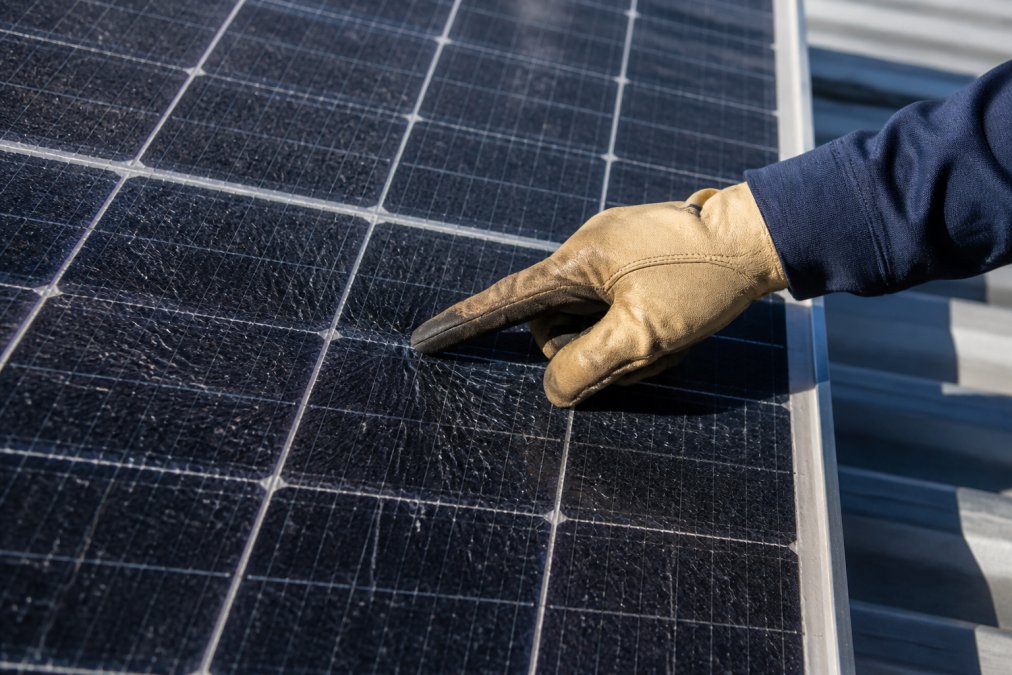
Micro-cracks are hairline fractures in the silicon wafer that are often invisible to the eye but permanently reduce a panel’s output. They usually start during manufacturing, transport or installation, then spread through thermal cycling as the panel heats and cools each day. A crack that begins as a few millimetres across a cell can, over several summers, propagate across the busbar and isolate part of the cell entirely.
What matters for real-world resilience:
- Glass thickness and tempering. Tempered, low-iron glass resists impact far better than thinner or untempered alternatives.
- Frame rigidity and clamping. Panels mounted with uneven clamping pressure flex more under impact and are far more vulnerable to cell cracking.
- Cell size and layout. Larger cells and half-cut or shingled designs change how stress propagates through the module.
Coastal Salt-Mist Corrosion and Thermal Cycling
Salt-mist corrosion attacks the frame, mounting hardware and junction box on properties near the coast. Over years, it can compromise backsheet integrity and let moisture reach the cells. The mechanism is straightforward: airborne chloride deposits settle on surfaces, moisture activates them, and the resulting electrochemical reaction eats into aluminium frames, steel fasteners and the thin metallic layers inside the junction box.
- Anodised or marine-grade aluminium frames rather than bare or thinly coated ones.
- Stainless-steel mounting hardware (typically 304 or 316 grade) rather than galvanised or coated steel.
- Junction boxes and connectors rated for high-humidity, high-chloride environments, with proper IP ratings.
- Regular freshwater rinsing of frames and hardware to remove salt deposits before they activate.
Two failure modes are frequently misdiagnosed as “bad panels”: PID (Potential Induced Degradation) and LID (Light Induced Degradation). PID is an electrical voltage-driven loss that can be reversed in some systems; LID is a one-time early loss that stabilises. Neither is a reason to scrap a system, but both need a proper diagnosis before anyone replaces panels.
Solar Panel Maintenance Tips for Long-Term Performance
A simple maintenance schedule keeps output close to nameplate for decades. None of it is complicated, but skipping it is the most common reason systems underperform.
- Clean the panels two to four times a year, more often if you are near the coast or under trees. Grime and bird droppings create hot spots.
- Inspect after every major storm for cracked glass, loose clamps or debris.
- Check the inverter display monthly for error codes or a drop in daily yield.
- Trim shading sources before they grow into a problem. Even partial shading drags down a whole string.
- Book a professional inspection every two to three years, including thermal imaging to catch micro-cracks and hot spots early.
Why Clean Energy Council Approved Solar Panels Matter
Clean Energy Council approved solar panels are panels that meet the standards required to be eligible for government rebates and to be installed by accredited professionals. Choosing approved products is not just about compliance; it is a filter for quality.
Inverter vs. Panel Lifespan: The Synchronisation Problem
Here is the part most guides skip: your inverter will almost certainly fail before your panels do. Panels are passive and rugged; inverters are active electronics with capacitors, fans and power-conversion stages that wear out. A typical string inverter lasts around 10 to 15 years, while panels run 25 to 30. That mismatch creates a synchronisation problem, and it is the most common reason a system’s real-world payback falls short of the quote.
The fix is planning, not luck:
| Component | Typical Lifespan | Replacement Reality |
|---|---|---|
| Solar panels | 25-30 years | Rarely replaced under warranty |
| String inverter | 10-15 years | Expect one replacement, possibly two |
| Micro-inverters | 15-25 years | Matched closer to panel life |
| Battery storage | 10-15 years | Degrades with cycle count |
Why the Mismatch Costs More Than It Looks
The economics are simple once you frame them correctly. A string inverter is a meaningful fraction of the original system cost, and replacing it is not just the hardware: there is labour, possibly new mounting and wiring, and the downtime while the system is offline. If you replace the inverter once over a 30-year panel life, the maths usually still works.
How to Plan for the Replacement
- Ask what happens at year 12. A good installer will have a clear answer, not a shrug.
- Check the inverter warranty separately from the panel warranty. Inverter warranties commonly run 5 to 10 years, extendable in some cases. A 5-year inverter warranty on a 30-year panel is a mismatch worth questioning.
- Consider micro-inverters or DC optimisers if you want the electronics lifespan to sit closer to the panel lifespan. They cost more upfront but reduce the single-point-of-failure risk of one central inverter.
- Budget for the replacement from day one. Treat the first inverter replacement as a scheduled cost, not a surprise.
- Factor battery storage into the same calculation. Batteries typically last 10 to 15 years and degrade with cycle count, so a system with panels, an inverter and a battery has three different lifespans to reconcile.
When comparing quotes, ask what happens at year 12. A system with a cheap inverter and a 30-year panel warranty can cost more over its life than a system with a matched, longer-life inverter. Factor the replacement into your payback maths from day one.
Warranties, End-of-Life Recycling, and What to Ignore
Two warranties cover a panel, and they do different jobs. The product warranty covers manufacturing defects, typically for 10 to 15 years. The linear performance warranty covers output, typically for 25 to 30 years. Read both, because a strong performance warranty with a weak product warranty leaves you exposed on hardware faults.
Frequently Asked Questions
What is the average lifespan of solar panels in Australia?
Most quality solar panels have a design life of 25 to 30 years, though many continue producing usable power beyond that. The average lifespan depends on the degradation rate, which is typically 0.5% to 0.8% per year for modern panels. After 25 years, a panel may still operate at 80% of its original capacity. Inverter lifespan is shorter, usually 10 to 15 years, so you may need to replace it once during the system’s life.
What is the 20% rule for solar panels?
The 20% rule refers to the performance warranty threshold: most manufacturers guarantee that after 25 years, panels will still produce at least 80% of their original rated output. This means a 400W panel would still deliver at least 320W. The rule helps homeowners compare linear performance warranties. It is not a hard cutoff, panels can keep working below that, but the warranty typically covers replacement if output falls short.
How does extreme weather affect solar panel durability?
Hail, cyclones, and extreme heat are the main threats. Hail can cause micro-cracking that is invisible but reduces output over time. High temperatures accelerate degradation and thermal cycling, which stresses solder joints and backsheets. Coastal areas add salt-mist corrosion to the mix. Panels tested to AS/NZS standards and installed with proper clearance handle these stresses better. Regular inspections after severe weather help catch damage early.
What is the difference between a performance warranty and a product warranty?
A product warranty covers manufacturing defects and physical failures, typically lasting 10 to 15 years. A linear performance warranty guarantees a minimum power output over time, often 25 to 30 years. For example, a 25-year performance warranty might promise 84% output at year 25. Both matter: the product warranty protects against premature failure, while the performance warranty protects your investment if degradation is faster than expected.