
Table of Contents
- What Makes a Solar Battery Storage Solution Worth Buying
- The Best Solar Battery Storage Solutions in 2026
- How to Size a Solar Battery for Your Home
- Solar Battery Cost Comparison: What Drives the Price
- Solar Battery Lifespan and Warranty: What to Expect
- Integration with EV Charging and Smart Energy Management
- Frequently Asked Questions
Last Updated: September 21, 2026
What Makes a Solar Battery Storage Solution Worth Buying
A solar battery storage solution is a rechargeable home battery system that stores excess energy from your solar panels so you can use it at night or during a power cut. Choosing the best solar battery storage solutions starts with understanding three core specs: depth of discharge, round-trip efficiency, and usable capacity.
Depth of Discharge and Round-Trip Efficiency
Depth of discharge (DoD) is the percentage of a battery’s total capacity you can safely use before recharging. A battery with 10 kWh total capacity and 90% DoD gives you 9 kWh of usable energy.
Clean Energy Council battery storage guide
Battery Capacity and Power Ratings
Capacity (measured in kilowatt-hours) tells you how much energy the battery holds. Power rating (measured in kilowatts) tells you how fast it can deliver that energy.
The Best Solar Battery Storage Solutions in 2026
The best solar battery storage solutions balance usable capacity, power output, warranty length, and how well they integrate with your existing system. Here are some leading options.
Solazone Australia
Solazone Australia provides expert guidance for homeowners, from system sizing to installation and after-sales support. With over 40 years of technical expertise and a focus on Australian-made systems, our team is committed to personalised customer service.
Pros:
- More than 40 years of technical expertise
- Promotion of Australian-made solar systems
- Experienced installation teams
- Personalized customer service
- Reliable solar power for on-grid and off-grid applications
Cons:
- Pricing depends on your specific system requirements, so you’ll need a consultation for an accurate quote
Tesla Powerwall 3
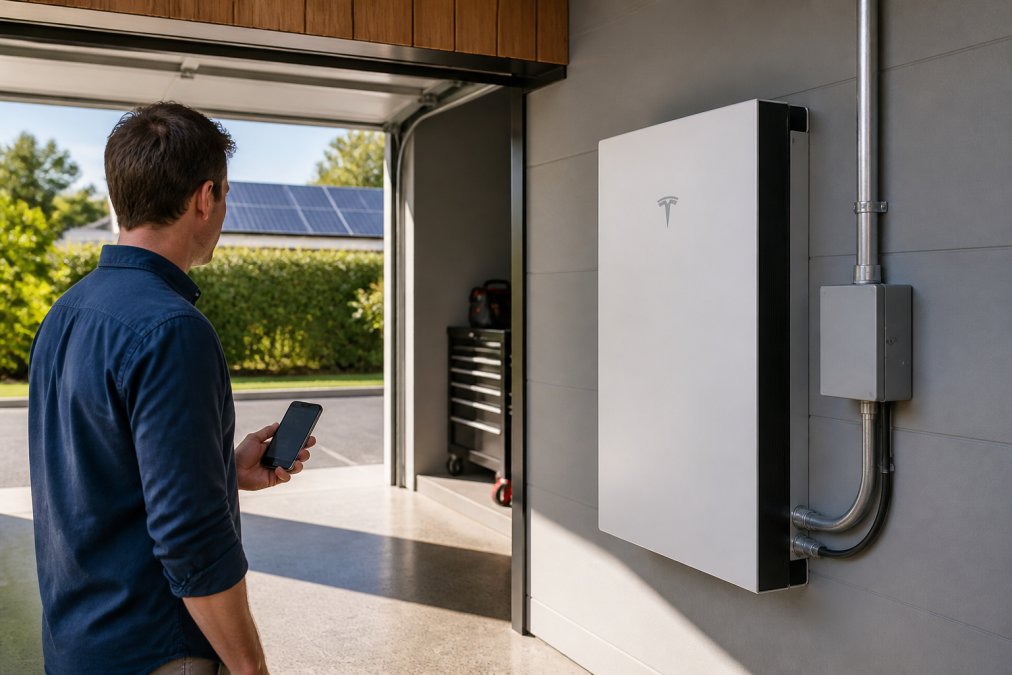
The Powerwall 3 packs a 13.5 kWh capacity with an integrated solar inverter and high continuous power output. It’s a strong all-in-one option for households wanting seamless backup.
Best for: Households seeking a high-performance, all-in-one backup solution.
Pros: High reliability and brand reputation; excellent software integration.
Cons: High demand can lead to installation wait times.
Enphase IQ Battery
The Enphase IQ Battery uses a modular AC-coupled design with safe lithium iron phosphate (LFP) chemistry. You can start small and add modules as your needs grow.
Pros: Highly scalable; safe battery chemistry.
Cons: Requires Enphase ecosystem components.
SolarEdge Home Battery
This DC-coupled battery is designed to maximise self-consumption for homes already running SolarEdge inverters. Round-trip efficiency is a highlight.
Pros: High round-trip efficiency; unified management platform.
Cons: Best suited for existing SolarEdge installations.
FranklinWH aPower
The aPower delivers exceptional peak power output for whole-home backup and scales up to 136 kWh. LFP chemistry keeps it safe for heavy cycling.
Pros: Exceptional power output; highly scalable.
Cons: Requires significant wall space.
| Battery | Usable Capacity | Chemistry | Best For |
|---|---|---|---|
| Solazone Australia | Tailored to your home | Depends on system | Custom whole-home solutions |
| Tesla Powerwall 3 | 13.5 kWh | Lithium-ion | All-in-one backup |
| Enphase IQ Battery | Modular | LFP | Scalable storage |
| SolarEdge Home Battery | Scalable | Lithium-ion | Existing SolarEdge systems |
| FranklinWH aPower | Up to 136 kWh | LFP | Large homes, heavy loads |
How to Size a Solar Battery for Your Home
Sizing a solar battery comes down to two numbers: your average nightly energy use and your backup priorities. Pull a recent electricity bill and look at your daily usage in kilowatt-hours.
To size correctly:
- Note your daily usage from your bill
- Estimate the share used after sunset
- Add your critical backup loads (fridge, lights, internet)
- Match that total to a battery’s usable capacity
Solar Battery Cost Comparison: What Drives the Price
Solar battery cost comparison isn’t about finding the cheapest unit. It’s about understanding what you’re paying for, how each component moves the total, and whether the payback period justifies it.
What actually sits inside the price
An installed battery quote bundles several distinct costs, and comparing two quotes without separating them is meaningless:
- Battery hardware, the cells, battery management system and enclosure. This is usually the largest single line item.
- Inverter or hybrid inverter, needed if your existing inverter isn’t battery-ready. DC-coupled systems often need a hybrid inverter; AC-coupled systems use a separate battery inverter.
- Installation labour, mounting, DC and AC wiring, commissioning and compliance paperwork.
- Switchboard and electrical upgrades, older switchboards may need upgrading to handle battery backup circuits, which can add a meaningful amount to the job.
- Monitoring and gateway hardware, some brands require a proprietary gateway or energy management device.
- Certificates and compliance, installer accreditation, grid connection approvals and safety certification.
AC-coupled vs DC-coupled: the cost trade-off
AC-coupled batteries are generally cheaper and simpler to retrofit because they work alongside your existing solar inverter. DC-coupled systems typically cost more upfront because they need a compatible hybrid inverter, but they avoid one energy conversion step, so more of your solar generation ends up stored rather than lost.
How payback is actually calculated
Payback isn’t a fixed number, it’s a function of your specific circumstances:
- Self-consumption rate, the share of your solar generation you use at home rather than export. Higher self-consumption means each stored kilowatt-hour displaces a retail tariff, not a much lower feed-in tariff.
- Time-of-use tariffs, if you’re on a peak/off-peak structure, discharging during the peak window delivers the biggest bill reduction per kilowatt-hour.
- Feed-in tariff, the lower your export credit, the stronger the case for storing rather than exporting.
- Rebates and incentives, the federal Small-scale Renewable Energy Scheme and state-based battery programs reduce the upfront cost and therefore shorten payback.
- Battery utilisation, a battery cycled daily pays back faster than one cycled a few times a week.
Ask your installer to model payback using your real half-hourly usage data and your actual tariff structure, not a state average. It changes the answer more than the battery brand does.
Why we don’t publish a single price
Installed battery costs vary widely by capacity, chemistry, inverter compatibility and whether your switchboard needs work. A quote that looks expensive per kilowatt-hour may include a hybrid inverter and switchboard upgrade that a cheaper quote omits entirely. The only meaningful comparison is a like-for-like quote built on your own usage data.
Clean Energy Council guidance on choosing an accredited installer
Australian Energy Regulator on solar and battery consumer protections
Solar Battery Lifespan and Warranty: What to Expect
Solar battery lifespan and warranty expectations vary by chemistry, depth of discharge and how hard the battery is cycled. Most modern lithium batteries are rated for 10 to 15 years of service, but the warranty terms matter far more than the headline number.
Cycle life vs calendar life
Battery life is limited by whichever comes first: cycle life or calendar life.
- Cycle life is the number of full charge-discharge cycles the battery can complete before its usable capacity falls to a defined threshold. LFP (lithium iron phosphate) chemistries typically offer longer cycle life than older nickel-manganese-cobalt lithium-ion chemistries.
- Calendar life is degradation over time regardless of use. Even a lightly cycled battery ages, and high ambient temperatures accelerate that ageing.
What warranties actually guarantee
Battery warranties are rarely a simple ’10 years’. Most combine several conditions:
- A time period, commonly 10 years, sometimes longer for LFP.
- A throughput or cycle limit, a total energy throughput cap or a maximum number of cycles, whichever is reached first.
- A minimum retained capacity, often expressed as a percentage of original usable capacity (commonly in the 60-70% range) that the manufacturer guarantees over the warranty term.
Read the fine print on:
- Whether the warranty covers the battery module only, or also the inverter and labour.
- Whether the retained-capacity guarantee is measured at the battery terminals or at the meter (system losses reduce the figure you actually see).
- Whether the warranty is transferable if you sell the home.
- What conditions void it, for example, using an unaccredited installer, exceeding the specified depth of discharge, or installing in an environment outside the rated temperature range.
Degradation in the real world
Manufacturer datasheets describe performance under controlled test conditions. In practice, degradation depends on how the battery is used:
- Shallow daily cycling generally slows capacity loss compared with deep cycling.
- High temperatures, a hot garage or an unshaded west-facing wall, accelerate degradation.
- Frequent full discharges to the depth-of-discharge limit shorten cycle life compared with partial cycling.
- Keeping the battery within its rated operating temperature range is one of the most effective things a homeowner can do to protect lifespan.
Your rights under Australian Consumer Law
Manufacturer warranties sit alongside, not instead of, your statutory rights under the Australian Consumer Law. Those rights apply regardless of the warranty document and cannot be excluded by fine print. If a battery fails to meet a consumer guarantee, for example, it fails to perform as described or is not fit for purpose, you may have a remedy against the supplier even if the manufacturer’s warranty has expired or its conditions aren’t met.
Skipping a licensed installer to save on labour can void your warranty and breach insurance conditions. Battery systems involve high voltage and thermal runaway risk, so compliance with certification standards isn’t optional.
Australian Competition and Consumer Commission on battery warranties
Clean Energy Council battery storage guide
Integration with EV Charging and Smart Energy Management
Modern batteries do more than store power. Integration with EV charging and smart home energy management systems (HEMS) is where the real savings now come from.
Australian Energy Regulator on solar and battery consumer protections
Frequently Asked Questions
What is the best solar battery storage system for residential use?
The right system depends on your backup needs, inverter compatibility, and budget. For whole-home backup, high-capacity options like the FranklinWH aPower or Tesla Powerwall 3 work well. If you want to start small and expand, the modular Enphase IQ Battery is a strong choice. For existing SolarEdge owners, the SolarEdge Home Battery offers seamless DC-coupled integration. Speak with an installer to match capacity to your actual usage.
How long will a 10kWh battery last?
A 10kWh battery typically covers evening peak usage for an average household, but actual runtime depends on your load. If you run air conditioning, an EV charger, or heavy appliances during a blackout, expect less. Most modern lithium iron phosphate (LFP) batteries are rated for 6,000 to 10,000 cycles, which translates to 10 to 15 years of daily use. Depth of discharge limits also affect how much usable capacity you get.
How do I determine the right battery capacity for my household energy needs?
Start with your electricity bills. Look at your evening and night usage in kilowatt-hours, since that is when the battery works hardest. A typical home uses 10 to 20kWh after sunset. Add backup loads you want to run during outages, such as fridge, lights, and internet. A qualified installer can model your usage and recommend a size that balances upfront cost with self-consumption savings.
Are there specific safety standards for solar battery installations?
Yes. In Australia, installations must comply with AS/NZS 5139 for battery systems and AS/NZS 4777 for grid connection. Lithium batteries must meet IEC 62619 for safety and pass thermal runaway testing. A certified installer will also ensure ventilation, fire separation, and signage meet local requirements. Always ask for proof of certification and check that your insurer covers the installed system.