
Last Updated: November 2, 2026
Quick Summary
Solar panel recovery dismantles end-of-life photovoltaic modules and extracts the glass, aluminium, silicon, copper and silver inside so those materials re-enter the supply chain instead of landfill. The process moves from mechanical separation of frames and glass to thermal decomposition and chemical leaching for silver and high-purity silicon.
- A solar panel is roughly 80% glass and aluminium by weight, both highly recoverable.
- Dismantling removes the junction box and aluminium frame first because it is the highest-value, lowest-effort recovery.
- Mechanical separation recovers most of the glass and metal but leaves encapsulant and silicon bonded as a laminate fraction.
- Thermal decomposition heats the laminate in an oxygen-limited atmosphere to burn off the EVA encapsulant and back-sheet.
- Chemical leaching carries the highest reagent cost but recovers silver and high-purity silicon, so it only stacks up at scale.
Table of Contents
- Why Solar Panel Recovery Matters More Than Ever
- Inside a Solar Panel: What Can Actually Be Recovered
- The Solar Panel Component Recovery Process, Step by Step
- Mechanical vs Thermal vs Chemical Recycling: How the Methods Compare
- The Value of Recovered Solar Materials
- Solar Panel Recycling Regulations and What They Require
- Photovoltaic Waste Management: Where the Infrastructure Falls Short
- Upcycling vs Recycling: Which Path Fits Your Old Panels
- Frequently Asked Questions
Why Solar Panel Recovery Matters More Than Ever
Solar panel recovery is the process of dismantling end-of-life photovoltaic modules and extracting the glass, aluminium, silicon, copper and silver inside them so those materials re-enter the supply chain instead of landfill.
Here is the part most people miss: a solar panel is roughly 80% glass and aluminium by weight, both highly recoverable. The valuable, harder-to-extract materials sit in the remaining fraction, and the gap between what is technically recoverable and what actually gets recovered is the whole story of this industry.
Below, we break down the recovery process step by step, compare the three main recycling methods, and explain what the solar panel recycling and sustainability guide adds for anyone who wants the broader picture.
Inside a Solar Panel: What Can Actually Be Recovered
A photovoltaic module is a layered sandwich, and each layer has a different recovery path. Understanding module composition is the key to understanding why recycling is complicated.
The Six Core Components of a Photovoltaic Module
- Aluminium frame – structural, easy to remove, high scrap value
- Tempered glass – the top cover, the largest single fraction by weight
- Encapsulant – usually EVA film, bonds the layers together and is the main obstacle to separation
- Silicon wafer – the semiconductor cells that generate current
- Back-sheet – protective rear layer, often a polymer composite
- Junction box and copper wiring – carries the current out of the module
Material Recovery Rates by Component
Recovery rates vary sharply by material. Aluminium and glass are routinely recovered at high rates because mechanical separation handles them well. Silver, copper and high-purity silicon are where the economics get interesting, and where most recycling processes still lose value.
| Component | Typical Share of Module Weight | Recovery Difficulty | Main Method |
|---|---|---|---|
| Aluminium frame | Moderate | Low | Mechanical |
| Glass | Largest fraction | Low to moderate | Mechanical |
| Copper wiring | Small | Low | Mechanical |
| Silicon wafer | Small | High | Thermal or chemical |
| Silver contacts | Very small | High | Chemical leaching |
| Encapsulant | Small | High | Thermal decomposition |
The Solar Panel Component Recovery Process, Step by Step
The recovery process moves from the simple to the difficult: pull off what comes apart easily, then apply heat or chemistry to what does not.
Step 1: Collection, Testing and Dismantling
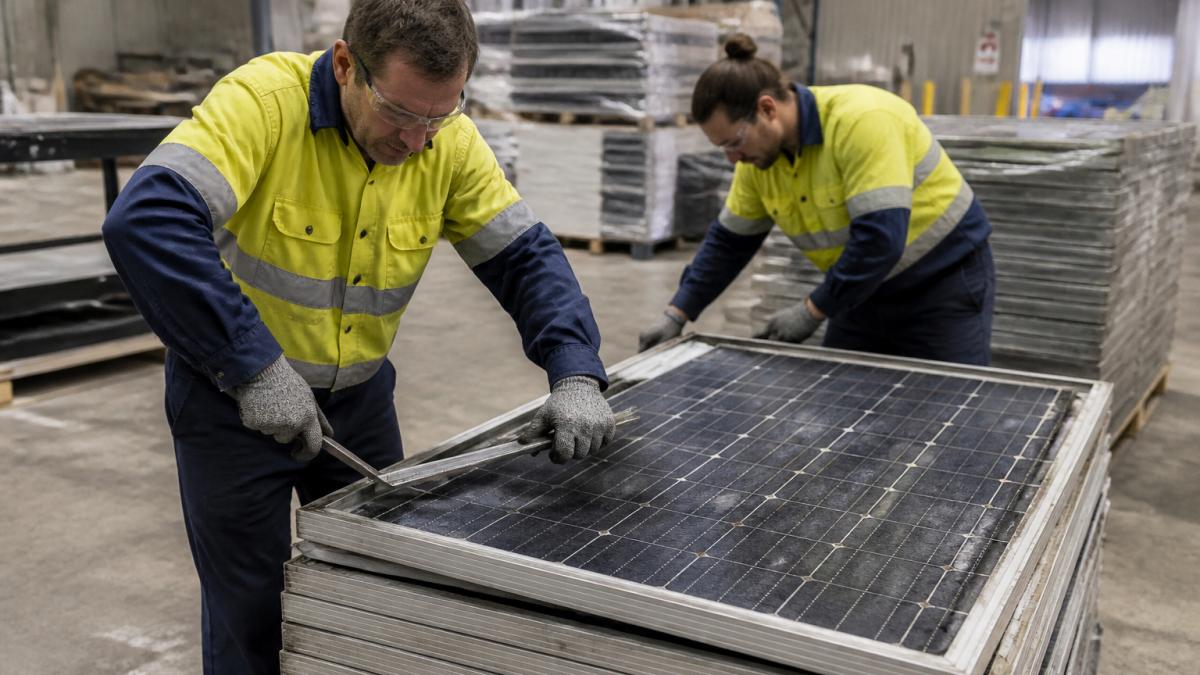
Panels arrive from decommissioned arrays, warranty replacements and installer stock. Each unit is tested first with an open-circuit voltage and current check, because a panel with useful output left may be better suited to reuse than recycling. Dismantling then removes the junction box and aluminium frame by hand or with simple tooling. The frame is the highest-value, lowest-effort recovery, which is why it comes off first.
This stage is labour-heavy and sets the quality of everything downstream: a cracked module loses glass yield in the shredder, and an attached junction box can short or jam equipment.
Step 2: Mechanical Separation and Shredding
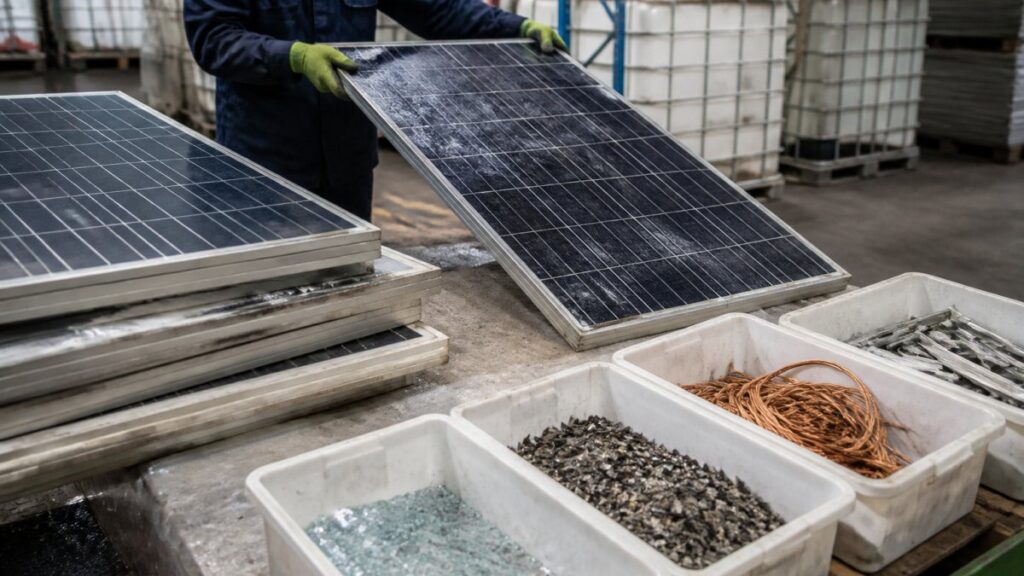
Frames removed, modules go into shredders and hammer mills that break the glass and liberate the layers. Mechanical separation then sorts by size, density and magnetic properties: eddy-current separators lift out aluminium and copper, magnetic separators catch steel fasteners, and screening classifies the glass cullet by particle size.
This stage recovers the bulk of the mass, most of the glass and metal, but leaves the encapsulant and silicon bonded together as a laminate fraction. That laminate is the hard part, and it is what separates a basic mechanical facility from one that recovers the valuable materials; smaller facilities often stop here and ship the laminate onward to a specialist.
Step 3: Thermal Decomposition and Chemical Leaching
The remaining laminate is where the hard work happens. Thermal decomposition, also called pyrolysis, heats the laminate in a controlled, oxygen-limited atmosphere to burn off the EVA encapsulant and back-sheet without oxidising the silicon or driving off the silver.
Chemical leaching then dissolves out silver and other metals, and the leachate is processed through hydrometallurgy, selective precipitation, ion exchange or solvent extraction, to recover silver and copper in saleable form. Pyrometallurgy is the alternative route, smelting the fraction to recover metals in a slag-and-metal separation. Component purity determines whether recovered silicon is saleable or scrap: silicon that meets specification re-enters wafer manufacturing, while lower-grade silicon becomes feedstock for other industries.
Step 4: Finding a Facility That Actually Runs These Stages
Most installers never see the inside of a recycling plant, so the practical question is how to find one that runs the full process rather than just shredding. A workable framework: confirm the facility holds current environmental authorisation for e-waste or regulated waste; ask which downstream stages it performs in-house and which it ships out; ask for the destination of the laminate fraction if it is shipped; and confirm it can issue documentation for the material trail. Ensuring the longevity of these materials begins with selecting high-quality equipment, which is why understanding the durability of the best solar panel brands remains a critical step in reducing the eventual burden on recycling infrastructure.
Mechanical vs Thermal vs Chemical Recycling: How the Methods Compare
No single method recovers everything well. Most facilities combine mechanical separation with one of the two downstream routes, and the choice shapes both cost and material purity.
| Method | What It Recovers | Strength | Limitation | Best Fit |
|---|---|---|---|---|
| Mechanical | Glass, aluminium, copper | Low cost, high throughput, simple equipment | Leaves laminate bonded; no silver or silicon recovery | High-volume, low-margin operations |
| Thermal | Encapsulant removal, silicon | Handles mixed laminate; prepares feed for leaching | Energy intensive; off-gas treatment required | Facilities with downstream chemical capacity |
| Chemical | Silver, high-purity silicon, copper | Highest material value per tonne | Reagent handling, cost and waste treatment | Specialist plants at scale |
What Each Method Actually Costs You
Mechanical separation is the cheapest per tonne because the equipment is simple and the throughput is high.
Thermal decomposition adds energy cost and emissions control. Pyrolysis needs a controlled atmosphere and off-gas treatment, which means capital equipment and ongoing operating cost.
Chemical leaching carries the highest reagent cost and the most complex waste handling, but it recovers the materials that actually carry value, silver and high-purity silicon. The economics only stack up at scale, which is why chemical routes concentrate in larger specialist plants rather than small regional facilities.
The Mistake Most Guides Make
A common mistake is assuming chemical leaching is always the best route because it recovers the most valuable materials. In practice, reagent cost and waste handling only stack up at scale, so smaller facilities lean on mechanical separation and ship the laminate fraction onward. The right method depends on what you are set up to handle downstream, not on which method recovers the most in theory.
Upcycling vs Recycling: A Parallel Decision
The same logic applies one level up. Before choosing a recycling method, decide whether the panel should be recycled at all. Upcycling versus recycling comes down to one question: does the panel still have useful output?
Judging that is where degradation data helps. The solar panel degradation rates guide explains how climate, panel type and warranties affect long-term performance, which tells you whether a panel has life left. And if the installer who sold you the system has since closed, the options when your solar installer goes out of business page covers where that leaves you.
The Value of Recovered Solar Materials
The value of recovered solar materials depends on purity and market timing, not volume. Clean aluminium and glass find steady buyers. Recovered silver commands attention because silver recovery from the cell contacts offers the highest per-kilogram return of any material in the module, even though the quantity is tiny. High-purity silicon is the swing factor: if it meets specification it re-enters manufacturing, and if it does not it becomes lower-grade feedstock.
Solar Panel Recycling Regulations and What They Require
Solar panel recycling regulations in Australia are still developing, and there is no single national scheme covering all end-of-life panels. Requirements can differ depending on where the system was installed and who is handling the material.
Watch out: assuming a panel can go in a standard skip bin is the mistake that catches installers out. End-of-life modules need to be directed to a facility equipped to process them, and the documentation trail matters.
Because the rules are moving, confirm current obligations with your state environmental regulator before any decommissioning job.
Photovoltaic Waste Management: Where the Infrastructure Falls Short
Photovoltaic waste management is constrained less by technology than by logistics. Collection networks are thin, transport distances are long, and the volume arriving at any one facility is often too low to justify the expensive thermal and chemical stages. That is why so much end-of-life material still moves through the mechanical route only.
The infrastructure gap is real, and it is closing slowly. For a closer look at the environmental impact of local solar manufacturing, including lower emissions, sustainable practices and panel recycling in Australia, see environmental impact of local solar manufacturing.
Upcycling vs Recycling: Which Path Fits Your Old Panels
Judging that is where degradation data helps. The solar panel degradation rates guide explains how climate, panel type and warranties affect long-term performance, which tells you whether a panel has life left. And if the installer who sold you the system has since closed, the options when your solar installer goes out of business page covers where that leaves you.
Frequently Asked Questions
What materials can be recovered from solar panels?
A standard photovoltaic module is mostly glass (around 70-75% by weight), aluminium frame (roughly 10-15%), and encapsulant plastics. The remaining fraction holds the silicon wafer, copper wiring, junction box components and a small amount of silver in the cell contacts. Recovery processes target all of these: aluminium and glass through mechanical separation, silicon through thermal or chemical treatment, and silver and copper through leaching. Component purity matters here, because mixed or contaminated glass has far fewer resale options than clean cullet.
Is there a mandatory solar panel recycling scheme in Australia?
There is no national mandatory product stewardship scheme for solar panels in force. Panels are managed under state and territory waste and environmental regulations, and In practice, most end-of-life modules are handled through voluntary take-back programs and dedicated recyclers rather than a single legislated scheme. If you are replacing a system, ask your installer in writing where the old panels will go and who holds the relevant waste transport approvals.
How are silicon and silver recovered from solar modules?
After the frame, junction box and glass are removed, the remaining laminate goes through shredding and separation. Thermal decomposition burns off the encapsulant and back-sheet at controlled temperatures, leaving the silicon wafers and metal contacts. Silver and copper are then recovered through chemical leaching, a hydrometallurgical step that dissolves the metals into solution for later extraction. Pyrometallurgy, which uses high-temperature smelting, is an alternative route. Both approaches work; the choice usually comes down to facility scale and what purity the buyer needs.
Are solar panel recycling services available for residential systems?
Yes, though access varies by location and volume.
The real challenge with solar panel recovery is not knowing the process. It is knowing what to do with a specific array at the end of its life, and getting it handled properly. Solazone Australia has more than 40 years of technical expertise, experienced installation teams and a long-standing focus on Australian-made systems, so we can advise on decommissioning and replacement as well as installation. Get started with Solazone Australia and give your old system a responsible next step.
