
Table of Contents
- Do Solar Panels Overheat in Australian Summers?
- Impact of High Temperatures on Photovoltaic Efficiency
- Solar Panel Temperature Coefficient Explained
- Can Extreme Heat Cause Permanent Damage or Shutdowns?
- Solar Inverter Overheating Symptoms and Solutions
- How to Maintain Solar Panels in Summer
- Crystalline vs. Thin-Film: Which Handles Heat Better?
- Conclusion: Protecting Your Solar Investment
- Frequently Asked Questions
Last Updated: September 16, 2026
Do Solar Panels Overheat in Australian Summers?
Yes, solar panels get hot, but how local solar panels handle extreme heat is more reassuring than most homeowners expect. Panels are built to keep producing in high temperatures; they simply produce less efficiently. At Solazone Australia, we’ve spent more than 40 years installing and servicing systems through heatwaves, and the pattern is consistent: output dips on the hottest afternoons, then recovers as the roof cools.
The key insight most guides bury when explaining how local solar panels handle extreme heat is this: heat reduces production, it rarely destroys the panel. According to the Clean Energy Council’s consumer resources on solar system performance, quality panels are tested and rated for operation well beyond typical summer conditions. What actually matters is the temperature coefficient, airflow under the panels, and whether your inverter copes. Below, we’ll show you exactly how each of those plays out, and what you can do about it.
Impact of High Temperatures on Photovoltaic Efficiency
High temperatures reduce photovoltaic efficiency because solar cells convert sunlight less effectively as they warm up. A panel rated at 25°C at the factory will deliver noticeably less power on a 40°C roof. This is normal physics, not a fault.
The effect compounds in summer for three reasons:
- Solar irradiance peaks in the middle of the day, heating the panels further
- Ambient temperature stays elevated into the late afternoon
- Roof surfaces radiate stored heat back into the panel frame
A hot panel is not a broken panel. Expect a modest output dip on extreme days and near-normal production in the cooler morning and evening hours.
Solar Panel Temperature Coefficient Explained
The solar panel temperature coefficient explained simply: it’s the rate at which a panel’s power output falls for every degree its cell temperature rises above 25°C. It’s expressed as a negative percentage per degree Celsius, and it’s printed on every panel datasheet.
A coefficient of -0.35%/°C means the panel loses about 0.35% of its rated output for each degree above 25°C. On a 45°C day with cells running 20°C hotter than standard test conditions, that adds up.
| Panel Type | Typical Coefficient | Behaviour in Heat |
|---|---|---|
| Monocrystalline silicon | Around -0.30% to -0.40%/°C | Strong output, moderate heat loss |
| Polycrystalline silicon | Around -0.35% to -0.45%/°C | Slightly more heat-sensitive |
| Thin-film technology | Around -0.20% to -0.25%/°C | Least heat-sensitive, lower peak output |
Lower absolute numbers (closer to zero) mean better heat tolerance. If you’re comparing quotes, this single figure tells you more about summer performance than panel wattage alone.
Can Extreme Heat Cause Permanent Damage or Shutdowns?
Extreme heat rarely causes permanent damage to quality panels, but it can trigger inverter shutdowns and accelerate long-term thermal degradation. The distinction matters, because a shutdown is temporary and a damaged cell is not.
What actually happens on a 42°C day:
- Panel surface temperature climbs well above ambient, triggering thermal expansion in the frame and glass
- The inverter may derate (reduce output deliberately) to protect itself
- In rare cases, an overheated inverter shuts down entirely until it cools
Persistent thermal stress over many years is the real risk. Poorly ventilated roof installations run hotter and age faster, which is why mounting gap and airflow matter more than most buyers realise. The Australian Renewable Energy Agency’s guidance on solar performance notes that system design and installation quality heavily influence long-term output.
Panels mounted flush against the roof with no airflow gap can run several degrees hotter than properly raised arrays. Over a decade, that heat shortens component life and quietly erodes your kilowatt-hour yield.
Solar Inverter Overheating Symptoms and Solutions
Solar inverter overheating symptoms show up before a full failure, and catching them early saves you a service call. Watch for these signs during a heatwave:
- Output dropping sharply in the early afternoon, then recovering by evening
- A red or amber fault light on the inverter display
- Audible fan noise that’s louder than usual
- Error codes referencing temperature or “derating”
- The unit feeling hot to the touch on a shaded wall
Why inverters derate before they fail
An inverter converts the direct current from your panels into the alternating current your home uses, and that conversion generates its own heat on top of the ambient temperature. Most units are designed to begin derating, deliberately reducing output, once internal temperatures climb past a threshold the manufacturer sets, often somewhere in the 45-60°C internal range. Derating is a protective behaviour, not a fault. The inverter is trading a small amount of production now to avoid a thermal shutdown or a shortened service life later.
A full shutdown is the next step up. When internal temperature keeps climbing despite derating, the inverter cuts output entirely and waits for the heatsink to cool. On a still, 42°C afternoon with the unit in direct sun, that can mean a dead system for an hour or more, exactly when your panels would otherwise be producing at their daily peak.
The system-level angle most guides miss
The choice of inverter architecture changes how heat stress plays out across your whole array, and this is where a panel-only explanation falls short.
String inverters wire every panel into one central unit. If that single inverter derates or shuts down, the entire array stops producing, no matter how cool the panels themselves are. A string inverter mounted on a west-facing brick wall that bakes all afternoon is a common failure point in hot climates.
Micro-inverters sit under each panel and convert power at the source. There is no single choke point: if one unit runs hot, the others keep working. They also spread the heat load across many small enclosures rather than concentrating it in one box. The trade-offs are real, higher upfront cost, more components that can fail, and harder access for servicing, but for roofs with partial shade, complex angles, or extreme afternoon heat, the resilience is often worth it.
DC optimisers are a middle path. They sit under each panel like micro-inverters but still feed a central string inverter, so you get per-panel optimisation without multiplying the number of grid-interactive units. They don’t eliminate the central inverter’s heat exposure, but they reduce the impact of one hot panel dragging down its neighbours.
Practical fixes
The fix depends on the cause. Shade the inverter from direct sun with a purpose-made cover or a simple awning, clear dust from vents, and confirm it isn’t boxed in a closed garage or cupboard. Mount it on a shaded southern wall where possible, and leave clearance around the unit for air to move. If symptoms persist after those steps, the unit may be undersized for your array or genuinely faulty, and a licensed installer should test it.
Never enclose an inverter in a sealed cabinet to “protect” it from heat. Trapped air heats faster than moving air, and you’ll accelerate the exact derating you’re trying to avoid.
How to Maintain Solar Panels in Summer
Maintaining solar panels in summer comes down to airflow, cleanliness, and timing. None of it is complicated, and most of it you can do yourself, but knowing where DIY stops and professional servicing starts is what separates a system that survives a heatwave from one that quietly loses output for years.
The DIY routine that actually matters
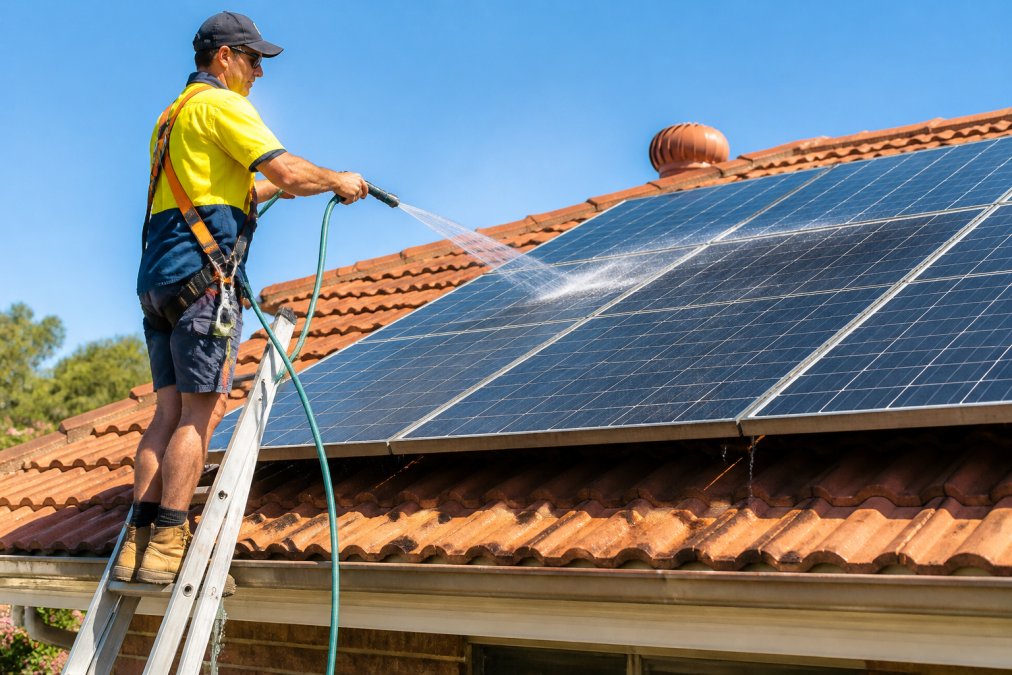
Clean your panels in the early morning, never at midday. Cold water on hot glass risks thermal shock, and you’ll also be working in the worst heat of the day.
Where DIY stops and professional servicing starts
Professional servicing earns its place in three situations:
- Annual or biennial inspection, a licensed installer can check torque on mounting bolts, inspect DC isolators and cabling for heat damage, and confirm the inverter is operating within spec. These are the failure points that heat accelerates and that a hose-down will never reveal.
- Output drift, if your daily reading has fallen noticeably and cleaning hasn’t fixed it, the cause is likely electrical, not dirt. A technician can test string voltages and isolate a failing panel or connection.
- Post-heatwave check, after an extended run of 40°C-plus days, a professional inspection catches thermal stress before it becomes a warranty dispute.
The financial angle: what heat actually costs you
Most guides stop at “you’ll lose some efficiency.” The more useful question is how much, and whether it’s worth acting on.
Crystalline vs. Thin-Film: Which Handles Heat Better?
Thin-film technology handles heat better than crystalline silicon on a per-degree basis, but crystalline panels usually win on overall power output.
Conclusion: Protecting Your Solar Investment
Heat is part of the deal when you install solar, but it’s manageable.
Frequently Asked Questions
What is the 20% rule for solar panels?
The 20% rule is a general guideline suggesting that solar panel output decreases by about 20% when operating at high temperatures compared to their rated capacity. This is a simplified way to account for temperature-related losses. The actual reduction depends on the panel’s temperature coefficient, ambient temperature, and installation quality. For a precise estimate of your system’s performance in local conditions, consult a professional installer like Solazone Australia.
How hot is too hot for a solar panel?
Most solar panels are tested to operate safely up to 85°C, but performance drops well before that. On a 35°C day, panel surface temperatures can reach 65°C or more. While this won’t usually cause permanent damage, it reduces output. High-quality panels with good heat dissipation and proper mounting gaps handle these temperatures better. If surface temperatures consistently exceed 80°C, it’s worth checking airflow and considering professional advice.
How does extreme heat affect solar panel lifespan?
Sustained high temperatures accelerate thermal degradation of solar panels, potentially shortening their lifespan. Heat stress can degrade the encapsulant and backsheet materials over time. However, modern panels are designed to withstand decades of exposure. Proper installation with adequate airflow and regular maintenance, such as cleaning and checking for hot spots, helps mitigate heat-related wear and preserve system longevity.
Can heatwaves cause solar panels to shut down?
Solar panels themselves rarely shut down from heat alone; they simply produce less power. However, inverters are more sensitive and may derate or shut down if they overheat. This is a protective measure. Ensuring your inverter is installed in a shaded, well-ventilated location and keeping vents clear can prevent heat-related shutdowns. If your system shuts down during heatwaves, have a professional inspect the inverter and overall system.