
Table of Contents
- Solar Installation vs Wind Power for Homes: Quick Comparison
- Cost Comparison: Installation Expenses and Maintenance Costs
- Energy Efficiency and Output: Solar Irradiance vs Wind Speed
- Small-Scale Wind Turbine Feasibility for Residential Properties
- Solar Battery Storage Benefits and Hybrid System Options
- Renewable Energy Government Rebates and Incentives
- Reliability, Intermittency and Zoning Considerations
- Return on Investment: Payback Period and ROI Framework
- Frequently Asked Questions
Last Updated: September 11, 2026
Solar Installation vs Wind Power for Homes: Quick Comparison
The choice between solar installation vs wind power for homes comes down to one practical reality: solar suits most residential properties, while small wind only makes sense on large, exposed sites. Four decades of installing renewable systems has taught us that solar delivers predictable output on a typical suburban block, whereas a wind turbine needs consistent wind speed and space that few homes have.
Solar photovoltaic panels convert sunlight directly into electricity with no moving parts. Wind turbines capture kinetic energy from moving air and spin a generator to produce power. That mechanical difference drives everything else: cost, maintenance, reliability and where each system works.
| Factor | Solar PV | Small Wind |
|---|---|---|
| Best site | Most roofs, good solar irradiance | Large, exposed rural blocks |
| Moving parts | None | Rotor, bearings, gearbox |
| Output pattern | Daylight hours | Whenever wind blows |
| Maintenance | Low | Higher, mechanical |
| Noise | Silent | Audible at close range |
| Typical use | Grid-tied or off-grid | Off-grid, rural |
How the Two Systems Actually Work
A solar array generates direct current when photons strike the photovoltaic cells; an inverter converts that to household alternating current. Output rises and falls with solar irradiance across the day. A wind turbine instead relies on wind speed: below a cut-in threshold it produces nothing, and above a rated speed it must shed excess load to avoid damage. This intermittency profile is the single biggest factor in system reliability.
Cost Comparison: Installation Expenses and Maintenance Costs
Solar generally costs less upfront and far less over its life, because it has no moving parts. Pricing depends on system size, roof complexity and battery choice, so we quote each property individually rather than publish a flat figure. For a tailored figure, request a quote from Solazone Australia.
Upfront Costs and What Drives Them
Installation expenses for solar scale with array size, roof height and pitch, switchboard condition and whether you add energy storage. Wind adds a tower, foundation, guy wires and often a planning permit, which pushes residential-scale costs up sharply. For a tailored figure, request a quote from Solazone Australia.
Ongoing Maintenance and System Longevity
Solar panels typically need little more than occasional cleaning and an inverter check every few years. A wind turbine requires scheduled servicing of bearings, blades and the yaw mechanism, and storm damage is a real risk. System longevity favours solar: fewer mechanical parts means fewer failures over a 25-year horizon.
Energy Efficiency and Output: Solar Irradiance vs Wind Speed
Solar efficiency depends on solar irradiance, orientation and shading; wind output depends entirely on wind speed at hub height. A rooftop array on a well-oriented roof produces a predictable average daily output you can model before installation. A small turbine’s output is far harder to forecast, because wind is gusty and site-specific, and doubling wind speed roughly multiplies available power several times over, which cuts both ways: a good site is excellent, a mediocre one is nearly useless.
Small-Scale Wind Turbine Feasibility for Residential Properties
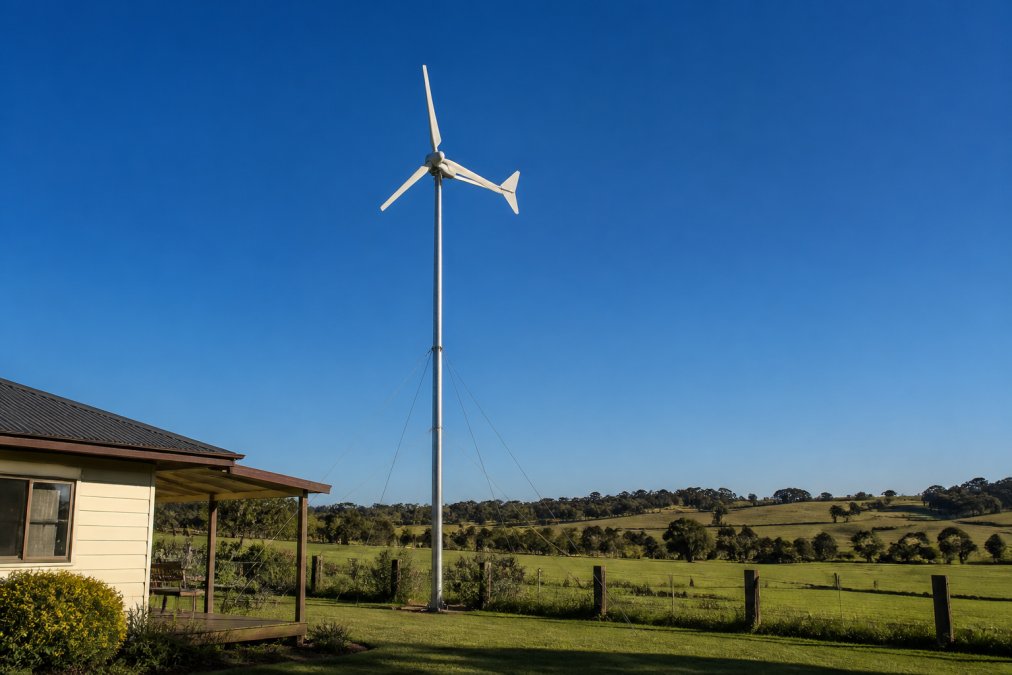
Most suburban homes are not viable for wind, and the reason is physics rather than preference. Small-scale wind turbine feasibility depends on average wind speed, turbulence intensity and the height of the turbine relative to every obstacle around it. Trees, neighbouring buildings and rooflines create turbulence that both reduces output and fatigues the turbine’s bearings, blades and yaw mechanism. If your block is small and sheltered, wind is likely a poor fit; if you have acreage and a clear prevailing wind, it can supplement solar.
The Wind Speed Threshold That Actually Matters
Available wind power scales with the cube of wind speed, so a site averaging 6 m/s at hub height produces roughly eight times the energy of a site averaging 3 m/s on the same turbine (energy.gov). That non-linearity is why a mediocre site is nearly useless and a good site is excellent. As a practical guide, most small turbines need a cut-in speed around 3-4 m/s to start generating, reach rated output near 10-12 m/s, and must furl or stall above roughly 20-25 m/s to avoid damage (energy.gov). A site that only occasionally reaches cut-in will spend most of its life idle.
Site Assessment: What Your Property Needs
A proper site assessment reviews average wind speed at proposed hub height, turbulence intensity, tower height, setbacks and noise distance to the nearest dwelling. As a rule, a turbine needs to sit at least 9-10 metres above anything within 100 metres of it to catch clean airflow, the taller the tower, the smoother the wind and the lower the turbulence. On coastal or open rural sites, this is achievable; in dense suburban streets it rarely is. solar panel maintenance.
Useful free starting points are the wind resource maps published by the Bureau of Meteorology and the wind-speed data in the National Construction Code’s climate zone annexes, but these are regional averages, they cannot replace an on-site anemometer study. A common pattern is to log wind speed at the proposed hub height for at least three months before committing, because a single stormy week can flatter a site that is calm for the rest of the year.
Why Small Wind Rarely Stacks Up Against Solar in Suburbia
Three mechanisms explain the gap:
- Height penalty. A rooftop solar array sits on the highest, most unobstructed surface most homes own. A turbine needs a tower taller than the roof to beat the same turbulence, and that tower needs a foundation, guy wires and often a planning permit.
- Capacity factor. Rooftop solar in most populated areas achieves a capacity factor in the mid-teens to low twenties per cent. Small wind in a suburban setting often sits in single digits, because the wind is gusty and the turbine is below the clean-air layer.
- Maintenance exposure. Every moving part is a failure point. Bearings, blades, slip rings and the yaw mechanism all need scheduled servicing, and storm damage is a real risk that solar simply does not carry.
If your site cannot demonstrate a sustained average wind speed above roughly 5 m/s at the proposed hub height, wind will almost always lose to solar on both output and payback. Measure before you buy.
Solar Battery Storage Benefits and Hybrid System Options
Solar battery storage benefits centre on energy independence: you store daytime generation and use it at night or during outages. For grid-tied homes, a battery bank also lets you draw less from the grid during peak tariffs. Hybrid systems pair a solar array with a small turbine and battery storage, so wind tops up the battery when the sun is low.
A hybrid setup works best when solar carries the daytime load and wind covers winter evenings. Size the battery bank to your nightly consumption, not your daily total, or you pay for capacity you rarely cycle.
We design battery backup for both on-grid and off-grid applications, so you can start grid-tied and add storage later.
Renewable Energy Government Rebates and Incentives
Renewable energy government rebates reduce the upfront cost of solar and, in some cases, battery storage. Eligibility, amounts and thresholds change regularly, so always confirm current figures with the official source before budgeting. The Clean Energy Regulator’s small-scale renewable energy scheme sets out how small-scale technology certificates work for eligible systems.
State and territory programs vary too, so check the scheme that applies where you live. Available incentives are factored into every quote rather than quoting a headline price that ignores them.
Reliability, Intermittency and Zoning Considerations
Reliability is where solar wins for most homes. Panels have no moving parts and degrade slowly, while turbines depend on wind that may not blow when you need power. Intermittency affects both, but solar’s daily pattern is predictable and easy to offset with storage.
Zoning Laws, Permitting and Noise Ordinances
Zoning laws, permitting and noise ordinances often decide whether a turbine is even allowed. Many councils require a planning permit for a tower and set minimum setbacks and noise limits at neighbouring boundaries. Solar panels usually need far less approval. Check your local council’s planning rules before committing to wind.
Installing a turbine without a planning permit where one is required can force you to remove it at your own cost. Confirm zoning and noise limits before you buy, not after.
Return on Investment: Payback Period and ROI Framework
Payback period is the time it takes for energy savings to cover your upfront cost. Solar typically pays back faster than wind because it costs less and produces more predictable output, but “typically” is not a number you can bank. This section gives you a repeatable framework so you can compare the two systems on your own property, using your own tariff and your own site data, rather than relying on a generic rule of thumb.
The Core Formula
For each system, calculate:
Annual savings = annual output (kWh) × effective tariff ($/kWh)
Net installed cost = gross cost − rebates and certificates
Simple payback (years) = net installed cost ÷ annual savings
Then adjust for the two effects most homeowners forget:
- Panel and turbine degradation. Solar output typically falls by around 0.5% per year, so a 25-year average is lower than year-one output. Small wind degrades less predictably because it depends on mechanical wear.
- Tariff shape. If you are on a time-of-use tariff, solar output is worth more per kWh than a flat rate suggests, because it lands in the daytime peak. Wind output is spread across the clock, so its value per kWh is usually lower unless you have storage to shift it.
Worked Example Structure
Rather than a single number, build a small table with one column per system and one row per input:
| Input | Solar PV | Small Wind |
|---|---|---|
| Site-specific annual output (kWh) | From irradiance model | From anemometer study |
| Effective tariff ($/kWh) | Your retailer’s rate | Your retailer’s rate |
| Gross installed cost | Quote | Quote |
| Rebates and certificates | STCs, state schemes | Usually none |
| Net cost | Gross − rebates | Gross − rebates |
| Annual maintenance | Low | Higher, mechanical |
| Simple payback (years) | Net cost ÷ annual savings | Net cost ÷ annual savings |
Where the Framework Bites
Three adjustments separate a realistic payback from an optimistic one:
- Add maintenance to the wind side. Over a 10-year horizon, scheduled servicing of bearings, blades and the yaw mechanism can materially extend payback. Solar’s maintenance is close to negligible by comparison.
- Discount output for shading and soiling. A solar model that ignores winter shading or dust will overstate savings. A wind model that ignores turbulence will do the same.
- Test sensitivity. Re-run the calculation at ±20% of your assumed wind speed or irradiance. If the project only works at the optimistic end, it is not a robust investment.
A Note on Hybrid Systems
If you are considering a hybrid solar-plus-wind setup, do not simply add the two paybacks. Wind and solar outputs are imperfectly correlated, wind often peaks in winter evenings when solar is weak, so the combined system can deliver a higher capacity factor than either alone. That said, the wind side usually carries most of the capital cost and most of the maintenance, so the marginal payback on adding wind to an existing solar array is often longer than the payback on the solar array itself. Model the hybrid as a single system with a blended output profile, not as two separate projects.
Run the numbers with real site data before you commit. A payback calculated from a regional average wind speed or a generic irradiance figure is a marketing number, not a financial one.
For a system sized to your usage and modelled on your actual site conditions, get a quote.
Frequently Asked Questions
Which is better for my home, a wind turbine or solar panels?
For most Australian homes, solar panels are the more practical choice. Photovoltaic systems work in almost any location with adequate roof space, need minimal maintenance, and benefit from established rebate schemes. Wind turbines can outperform solar in rural areas with consistent wind speeds above 4-5 metres per second, but they require more space, regular servicing, and often face stricter council approval. A hybrid system combining both can work well on larger properties.
Is it worth having a small-scale wind turbine at home?
Small-scale wind turbine feasibility depends heavily on your site. You need average wind speeds of at least 4-5 metres per second, a tower height well above nearby obstructions, and a property large enough to avoid noise complaints. In built-up suburban areas, turbulence from surrounding buildings reduces output significantly. For rural or coastal properties with steady wind, a turbine can supplement solar generation, particularly during winter evenings when solar output drops.
What are the disadvantages of solar and wind power?
Solar panels only generate during daylight hours, so without battery storage you rely on the grid at night. Output also drops on heavily overcast days. Wind turbines depend entirely on wind speed, which is unpredictable, and they need more maintenance because of moving parts. Both face intermittency challenges. Zoning laws and permitting requirements vary by council, and wind installations often face stricter noise ordinances than solar.
Do I need planning permission for a residential wind turbine?
In most Australian jurisdictions, small wind turbines require council approval, and rules differ between states and local government areas. Many councils impose height limits, setback distances from property boundaries, and noise restrictions. Solar panels are generally exempt from planning permission when installed on an existing dwelling roof, though heritage-listed properties may need consent. Always check with your local council before committing to either system.
How do battery storage and rebates affect the payback period?
Battery storage lets you use solar-generated power at night, which reduces reliance on grid electricity and shortens the payback period on your overall system. Government rebates for renewable energy reduce upfront installation expenses, and additional state-based incentives may apply. Calculating your payback period means dividing the net system cost after rebates by your annual energy bill savings. A qualified installer can model this using your actual consumption data.
Choosing between solar and wind is really a question of your site, not the technology. For most homes, solar installation backed by battery storage delivers the fastest payback and the least maintenance. Solazone Australia brings over 40 years of technical expertise, Australian-made systems and personalised service to every project, from grid-tied solar to off-grid battery backup. Get started with Solazone Australia and turn your roof into reliable, low-maintenance power.