
Table of Contents
- Solar Lease vs Purchase: The Core Trade-Off
- How Solar Leasing Works and What It Costs
- How Buying a Solar System Works
- Solar Panel Payback Period: What You Need to Know
- Using a Solar Lease vs Buy Calculator
- Solar Battery Payback Period and Storage Considerations
- Solar Lease Transfer When Selling a House
- Conclusion: Which Option Fits Your Situation
- Frequently Asked Questions
Last Updated: October 6, 2026
Solar Lease vs Purchase: The Core Trade-Off
Evaluating solar for your home or business comes down to ownership. A solar lease vs purchase payback comparison reveals two financial paths: owning the system outright and capturing long-term savings, or paying a third party a fixed monthly fee while they retain ownership.
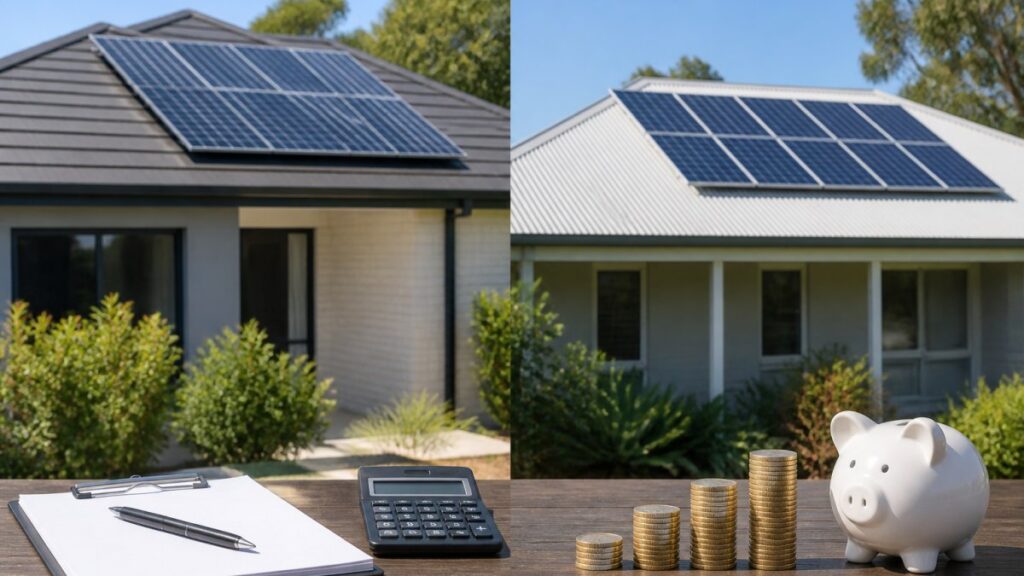
Leasing requires little or no upfront capital and shifts maintenance to the provider. Buying demands significant initial investment but unlocks decades of savings and tax incentives. At Solazone Australia, we break down the real numbers, not the marketing claims.
What matters most is your payback period and long-term wealth. A lease keeps payments predictable but caps returns; a purchase front-loads costs but compounds savings over 25+ years.
Leases avoid upfront cost but provide no ownership equity or long-term savings once the contract ends.
How Solar Leasing Works and What It Costs
A solar lease is straightforward: a third-party company installs, owns, and maintains the panels. You pay a fixed monthly fee and benefit from the electricity generated. The provider covers repairs, replacements, and performance guarantees.
The appeal is obvious: no upfront cost, no maintenance headaches, and predictable monthly payments that rise by a small annual percentage (the lease escalator).
Most leases run 20 to 25 years. At the end you can renew at a new rate, buy the system at residual value, or have it removed.
Lease transfers add complexity when selling: the new owner must qualify for lease assumption, which isn’t guaranteed.
Lease escalators compound over time. Factor the full escalated cost into your payback comparison, not just the starting rate.
How Buying a Solar System Works
Purchasing solar means you own the equipment outright. You pay the full cost upfront or finance it through a loan, keep every kilowatt-hour the panels produce, and handle maintenance, repairs, and insurance.
The financial advantage is cumulative. Once paid off, electricity costs drop to near zero (minus minor maintenance), decades of free power over a 25-year lifespan.
Ownership means flexibility: upgrade the system, add battery storage, or modify it as needs change.
The trade-off is capital intensity. Upfront costs are substantial, though home loans, green loans, or vendor financing can spread payments over 5 to 10 years.
Solar Panel Payback Period: What You Need to Know
The payback period is how long your system’s electricity savings take to equal its total cost. This is where a solar lease vs purchase payback comparison becomes concrete, so here is the arithmetic laid out.
A like-for-like worked example
Assume a 6.6 kW system in a location with good sun exposure, and a household consuming 6,000 kWh a year with 40% of that drawn from the grid during daylight hours. Assume a grid electricity rate of 30c/kWh and an export tariff of 5c/kWh for surplus power sent back.
- Self-consumed solar: roughly 2,400 kWh at 30c/kWh avoided = $720 a year
- Exported surplus: roughly 4,000 kWh at 5c/kWh = $200 a year
- Gross annual benefit: about $920
- Simple payback: $6,500 ÷ $920 ≈ 7.1 years
That figure moves the moment any assumption changes. Drop the grid rate to 24c/kWh and payback stretches past nine years; lift self-consumption to 60% by shifting loads to daytime and it compresses toward six. A single headline number is misleading, the inputs do the work.
The break-even point between lease and purchase
A lease has no payback in the ownership sense, since you never recoup a capital outlay. The useful comparison is the break-even point: the year cumulative ownership savings overtake cumulative lease savings.
Take a lease with an annual escalator: over 25 years the escalated total can be substantial. The purchased system delivers escalating savings as retail rates rise. If rates climb, cumulative ownership benefit can overtake cumulative lease cost.
That crossover year, not the headline payback, is the number that should drive the decision for anyone weighing a lease against a purchase.
Why the assumptions matter more than the answer
Four inputs swing the result more than anything else:
- Electricity price trajectory. A 2% versus 4% annual rise changes the break-even year by several years.
- Self-consumption ratio. Every kWh used on site is worth the full retail rate; every kWh exported is worth a fraction.
- System degradation. Panels lose a small fraction of output yearly, so year-20 savings are lower than year-1.
- Finance cost. If you borrow to buy, interest is part of the payback maths.
Model three scenarios rather than one: conservative (low usage growth, higher maintenance, modest rate rises), base case (current trends), and optimistic (high usage growth, minimal degradation). The spread between them is more honest than any single payback figure.
What a lease actually costs over its term
Because a lease has no payback, the only fair comparison is total cost. Against that, the purchase case is upfront costs plus financing charges, offset by decades of bill reductions. Ownership wins on long-term wealth, but only if you stay past the break-even year to capture compounding savings.
Using a Solar Lease vs Buy Calculator
Most online calculators default to national averages that ignore your local rates, roof orientation, and shading. Rather than trust a black box, run the comparison yourself with a spreadsheet and a handful of inputs.
The inputs you need
- Your current annual electricity bill, or better, your annual consumption in kilowatt-hours
- Your local electricity rate and your best estimate of annual increases
- Your export tariff for surplus power sent to the grid
- Proposed system size and total installed cost, net of SRES credits
- Financing terms if you are borrowing: interest rate and loan term
- Lease payment, escalator rate, and contract length
- An assumed annual degradation figure for panel output
The calculation, step by step
- Estimate annual generation from the system size and your location’s sun hours.
- Split that generation into self-consumed kWh (valued at the retail rate) and exported kWh (valued at the export tariff).
- Multiply each by its rate to get gross annual benefit.
- Subtract any annual maintenance or insurance cost to get net annual benefit.
- Apply degradation to reduce generation slightly each year.
- Escalate the retail rate each year to reflect rising electricity prices.
- Cumulate net benefit year by year until it equals the net system cost, that is your payback year.
- For the lease, cumulate the escalating monthly payments over the same period and compare the two cumulative lines.
Sensitivity analysis: the part most calculators skip
A single payback figure hides the range of realistic outcomes. Run the same model across a grid of assumptions:
- Electricity price growth: 2%, 3%, and 4% a year
- Export tariff: low, mid, and high values, since export rates are volatile
- Self-consumption: 30%, 45%, and 60%, reflecting daytime load shifting
- System size: a smaller system may pay back faster per dollar even if it saves less overall
- Lease escalator: 0%, 2.5%, and 4% a year
A pattern usually emerges: payback is most sensitive to the retail electricity rate and self-consumption ratio, and least sensitive to early-year degradation. Focus your effort on shifting loads to daytime and confirming your actual tariff, not on panel spec sheets.
Calculators that quote a single payback number without showing the electricity price assumption, the export tariff, and the self-consumption ratio are not giving you an answer, they are giving you a guess dressed as one. Ask for the assumptions before you trust the output.
Where a calculator still falls short
No spreadsheet knows your roof. Shading, roof age and structural condition, and installation complexity all change real-world performance and cost, and none appear in a generic tool. Use the calculator to understand the mechanics and sensitivity, then get a site-specific assessment to confirm the numbers. The calculator tells you which levers matter; the site assessment tells you where they sit for your property.
Solar Battery Payback Period and Storage Considerations
Adding battery storage changes the payback equation significantly. A battery stores excess solar for peak rates or grid outages, increasing the value of every kilowatt-hour your panels produce.
Battery payback is longer than solar-only payback because batteries cost more per unit of energy stored.
Batteries deliver real value in two scenarios: frequent power cuts where you value energy independence, or utility export compensation for excess solar fed to the grid.
Most lease agreements don’t allow battery additions, a critical limitation if energy independence or load-shifting matters to you.
Battery payback improves each year as costs fall and rates rise.
Solar Lease Transfer When Selling a House
One of the most overlooked complications in a solar lease vs purchase payback comparison is what happens when you sell your home.
If you own your system, the sale is straightforward. The new owner inherits a functioning system with years of warranty remaining, and it typically adds resale value since buyers recognize it as an asset that reduces electricity costs.
If you lease, the situation is more complex.
A buyout means paying the remaining lease balance, which can be substantial depending on years left on the contract.
Some providers allow lease transfer for a fee, but qualification requirements remain. The uncertainty creates friction in negotiations and can deter buyers who don’t want an unfamiliar contract.
This is a major reason ownership wins for homeowners staying 10+ years: the system becomes part of the property, with no transfer complications or buyout costs.
Conclusion: Which Option Fits Your Situation
The choice between a solar lease vs purchase payback depends on four factors: time horizon, upfront capital, appetite for maintenance, and long-term savings goals.
Choose a lease if: you plan to move within 5 to 7 years, have limited upfront capital, prefer predictable payments, or want to avoid maintenance.
Choose to buy if: you plan to stay 10+ years, can finance the upfront cost, want to maximize long-term savings, or value energy independence. Ownership requires more capital and responsibility upfront but compounds significant returns over decades.
At Solazone Australia, we’ve guided thousands of customers through this decision with payback analysis tailored to their electricity usage, roof conditions, and local rates.
Frequently Asked Questions
Is it cheaper to lease or buy solar panels?
Leasing typically costs less upfront and involves no installation fees, making it attractive for homeowners with limited capital. However, buying a solar system usually delivers greater long-term savings because you own the system, benefit from government incentives, and avoid annual lease escalators. The break-even point depends on your electricity usage, local utility rates, system size, and how long you plan to stay in your home. A solar lease vs buy calculator tailored to your postcode and household consumption will show the true cost difference over 10, 15, and 25 years.
How long does it take for purchased solar panels to pay for themselves?
The solar panel payback period depends on system size, installation costs, electricity rates, and available incentives such as the Small-scale Renewable Energy Scheme (SRES). Homes with higher electricity consumption or facing rising utility rates see faster payback. After the payback period, the system generates free electricity for the remainder of its 25 to 30-year lifespan, resulting in substantial long-term savings. Your actual payback period will vary based on local conditions and your specific energy usage.
What happens to a solar lease when you sell your home?
When you sell your home, the solar lease transfer becomes the buyer’s responsibility. Most lease agreements allow transfer to the new owner, but the buyer must qualify and approve the terms. If the buyer declines to assume the lease, you may be required to pay a buyout fee or removal cost. This can complicate the sale and reduce your home’s appeal to buyers unfamiliar with solar leases. Owned systems, by contrast, transfer with the property without these complications and often increase home value. Always review your lease agreement for specific transfer terms and costs.
Is adding battery storage worth the cost?
Battery storage payback depends on your energy usage patterns, local electricity rates, and whether you experience frequent outages. The solar battery payback period is typically longer than the solar panel payback period because batteries are expensive. However, batteries provide backup power during blackouts, reduce reliance on the grid, and can optimise self-consumption of solar production. If you live in an area with unreliable grid supply or high peak-rate electricity, battery storage becomes more valuable. For grid-connected homes with stable power, batteries may not deliver financial payback within a reasonable timeframe, though they offer resilience benefits.
The decision between leasing and buying shapes your energy costs for decades. Get a detailed payback analysis from Solazone Australia that models your actual consumption, local rates, and long-term plans. With our personalised assessment and Australian-made system options, you’ll understand exactly when your system pays for itself, and how much you’ll save beyond that point.