

Table of Contents
- Is Battery Backup Worth It? The Real Financial Case
- How Solar Battery Payback Period Calculation Works
- How Long Does a Solar Battery Last During a Power Outage
- Whole-Home vs Essential Load Backup: Which Suits Your Needs
- The Impact of Feed-In Tariffs and Time-of-Use Rates
- Battery Backup Beyond Financial Returns
- Conclusion
Last Updated: August 12, 2026
Is Battery Backup Worth It? The Real Financial Case
Whether battery backup worth it depends entirely on your situation. For some households, it’s a worthwhile investment that delivers genuine financial returns and peace of mind. For others, it’s an unnecessary expense that won’t pay back within a reasonable timeframe.
The real question isn’t whether battery backup is worth it in theory, it’s whether it makes sense for your specific energy consumption, local electricity rates, and grid reliability. Battery backup systems have become more affordable and efficient, but they remain a significant upfront investment with payback periods typically ranging from 8 to 15 years depending on your location, energy usage patterns, and feed-in tariff rates.
The biggest mistake homeowners make is comparing battery backup costs to the cost of solar panels alone. Battery systems serve a different purpose, they’re about resilience and time-of-use optimisation, not just cost reduction. If your main goal is lower energy bills, solar panels alone may deliver better ROI. If you value backup power during outages or want to maximise self-consumption, battery backup becomes far more attractive.
How Solar Battery Payback Period Calculation Works
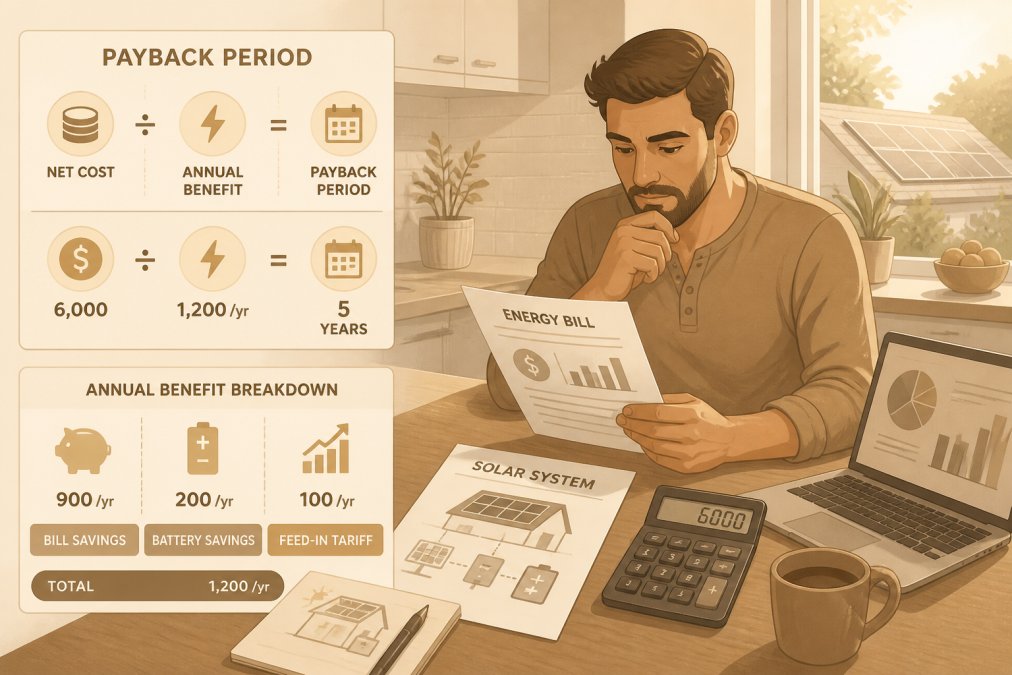
The payback period for battery backup is the number of years it takes for the system to generate enough savings to cover its installation cost. Your payback period depends on five interconnected factors: your electricity consumption, your feed-in tariff rate, time-of-use rates, your location’s solar irradiance, and your battery’s depth of discharge rating.
Key variables that affect your payback timeline
Your current electricity consumption determines how much you can save, a household using 30 kilowatt-hours per day has more opportunity for savings than one using 15 kilowatt-hours. Your feed-in tariff rate (what your retailer pays for surplus power) significantly affects whether battery backup is worth it. If your feed-in tariff is high, you may earn more by sending surplus electricity to the grid than by storing it.
Time-of-use rates matter enormously. If your retailer charges higher rates during peak evening hours and lower rates during the day, battery backup becomes more valuable because you can store cheap daytime solar energy and use it during expensive peak periods. Your location’s solar irradiance determines how much energy your panels generate, Sunshine Coast properties typically receive stronger solar potential than southern regions. Finally, your battery’s depth of discharge rating determines how much stored energy you can actually use; a battery with an 80% depth of discharge can only safely deliver 80% of its stated capacity.
Working out your personal ROI
Start by gathering your actual electricity bills from the past 12 months and calculating your average daily consumption in kilowatt-hours. Identify your peak usage periods and cross-reference them against your retailer’s time-of-use rate structure. Contact your electricity retailer directly to determine your current feed-in tariff rate, as these vary significantly between providers and regions.
Calculate how much you currently earn from surplus solar energy. If this figure is substantial, battery backup may not improve your financial position significantly. Then model a scenario where you add battery backup, assuming conservative storage efficiency (most modern lithium batteries achieve 85-95% round-trip efficiency). Calculate how much of your peak-period consumption could be met by stored solar energy rather than grid electricity. The difference between your peak-period rate and feed-in tariff multiplied by your daily peak usage gives you daily savings potential. Multiply this by 365 to estimate annual savings, then divide your system cost by annual savings to determine payback period.
Your payback period is only meaningful if you stay in your home long enough to realise the savings. If you’re planning to move within 8 years, battery backup is generally not worth it unless you value the backup power capability itself.
How Long Does a Solar Battery Last During a Power Outage
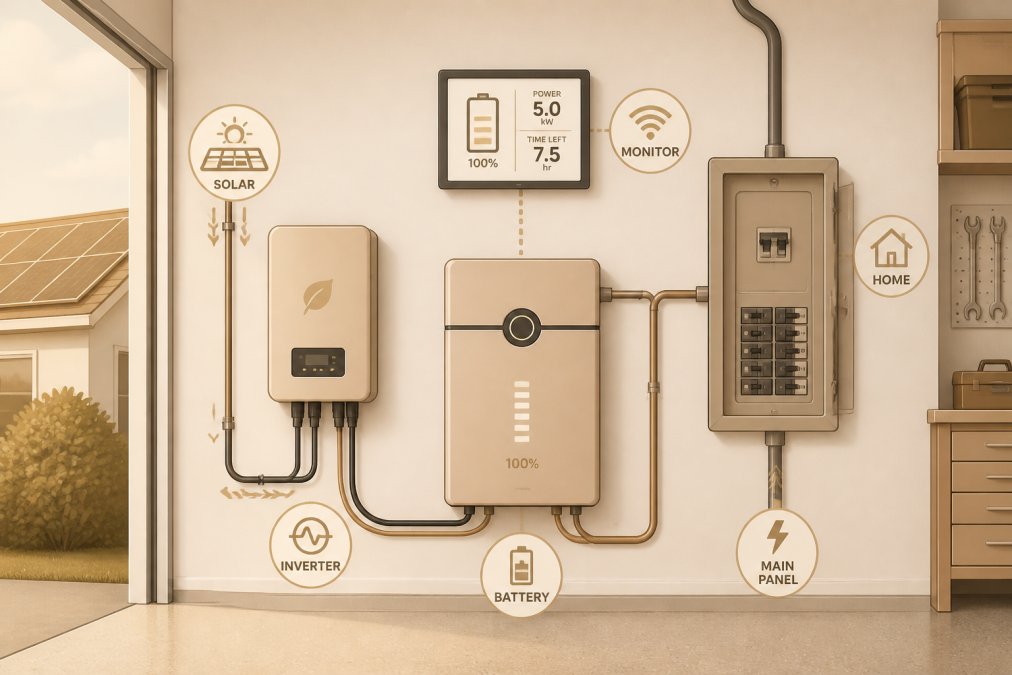
Battery backup capacity during a power outage depends on your system size, consumption patterns during the outage, and your battery’s depth of discharge. A typical residential battery system might provide anywhere from 4 to 24 hours of backup power.
Battery capacity and real-world usage
A 10 kilowatt-hour battery system with an 80% depth of discharge provides 8 kilowatt-hours of usable energy. If your household consumes 2 kilowatt-hours during an outage, that battery lasts 4 hours. If you’re running air conditioning or heating, consumption might spike to 4 kilowatt-hours per hour, reducing your backup duration to 2 hours.
Most households cannot run their entire home on battery power for extended periods. Instead, many systems are configured to power only essential circuits: refrigeration, lighting, phone charging, internet equipment, and water heating.
Depth of discharge and system efficiency
Depth of discharge is the percentage of a battery’s total capacity that can be safely used without damaging the battery or significantly reducing its lifespan. A battery rated at 10 kilowatt-hours with an 80% depth of discharge provides only 8 kilowatt-hours of usable energy. Manufacturers set conservative limits to protect battery longevity.
System efficiency also affects real-world backup duration. Energy is lost during conversion from DC (direct current) in the battery to AC (alternating current) that powers your home. Modern inverters achieve 95-98% efficiency, meaning 2-5% of stored energy is lost in conversion. Temperature also affects battery performance; cold weather reduces battery capacity and efficiency, meaning a system providing 24 hours of backup on a warm day might only provide 18 hours during winter.
Whole-Home vs Essential Load Backup: Which Suits Your Needs
The choice between whole-home backup and essential load backup is often the most important decision affecting whether battery backup is worth it.
Essential load backup for targeted protection
Essential load backup systems power only critical circuits: refrigeration, lighting, internet equipment, phone charging, and water heating. A typical essential load configuration uses 30-40% of your home’s total electrical capacity, allowing a smaller, less expensive battery system to provide meaningful backup duration.
For a household with essential loads consuming 1 kilowatt-hour per hour, a 10 kilowatt-hour battery system provides 10 hours of backup power. Essential load backup is worth it for most households because it balances protection against cost. Installation costs are lower because the electrician only needs to install dedicated circuits and a smaller transfer switch.
Whole-home backup for complete coverage
Whole-home backup systems are designed to power your entire home during a power outage, including air conditioning, heating, and pool pumps. This requires a significantly larger battery system, often 30-50 kilowatt-hours or more, and more complex electrical installation.
For most households, whole-home backup is not worth it financially due to prohibitive costs and extended payback periods. However, it may be worth it if you operate a home-based business that cannot tolerate power interruption, rely on medical equipment requiring continuous power, or live in an area with frequent extended outages.
Don’t assume whole-home backup means your battery will keep everything running indefinitely. Even a 50 kilowatt-hour system with a 5 kilowatt average load provides only 10 hours of backup. During extended outages lasting days, you’ll need to carefully manage consumption regardless of your system size.
The Impact of Feed-In Tariffs and Time-of-Use Rates
Your electricity retailer’s feed-in tariff and time-of-use rate structure are the primary financial drivers determining whether battery backup is worth it. Feed-in tariffs across Australia typically range from 8 to 15 cents per kilowatt-hour in 2026. If your feed-in tariff is high, you’re already being compensated well for surplus generation, which reduces the financial case for battery backup.
Time-of-use rates create the opposite incentive. If your retailer charges 35 cents per kilowatt-hour during peak evening hours and 18 cents during off-peak daytime hours, battery backup becomes financially attractive. The difference between peak and off-peak rates determines your daily savings potential.
Some retailers offer specialised programs that increase battery backup value. Virtual power plant schemes, where your battery system is connected to an aggregator network, can provide additional revenue by allowing your battery to discharge during grid stress periods. These programs typically add 5-15 cents per kilowatt-hour to your effective feed-in tariff, improving battery backup ROI significantly.
Contact your retailer directly for your exact time-of-use rate structure and current feed-in tariff, then recalculate your payback period using these actual figures rather than industry averages.
Battery Backup Beyond Financial Returns
Even if the financial case for battery backup is marginal, several non-financial benefits may make it worth it for your situation.
Energy independence and grid resilience
Power outages are becoming more frequent in some regions due to aging infrastructure, extreme weather events, and increased grid demand. For households in areas experiencing regular outages, battery backup provides genuine resilience. You maintain essential services while your neighbours are without power, avoiding spoiled food, lost productivity, and potential safety risks.
Environmental benefits of self-consumption
When you store solar energy in a battery for use during peak evening hours, you increase your self-consumption rate, the percentage of your solar generation you use directly rather than exporting to the grid. Higher self-consumption rates mean less energy imported from the grid, which typically comes from fossil fuel sources.
The carbon footprint of manufacturing a battery system is significant, and it takes several years of increased renewable self-consumption to offset this impact. However, after this payback period, the environmental benefit becomes meaningful as you displace grid electricity from coal or gas generation.
Whether battery backup worth it ultimately depends on your personal priorities. If your primary goal is reducing electricity costs, calculate your payback period carefully before committing. If your feed-in tariff is high and your time-of-use rate differential is small, battery backup may not deliver positive financial returns within a reasonable timeframe.
However, if you value backup power during outages, want to maximise self-consumption of your solar generation, or live in an area with frequent grid disruptions, battery backup is worth it even if the financial payback extends beyond 10 years. Contact Solazone Australia for a personalised assessment that shows whether battery backup is worth it for your home or business, backed by your actual energy data rather than industry averages.
Frequently Asked Questions
Is battery backup worth it for the average household?
It depends on your electricity consumption, local feed-in tariff rates, and exposure to grid outages. For homes with high peak-rate usage or frequent blackouts, battery backup typically delivers positive ROI within 8-12 years. However, if you have low consumption or stable grid supply, the financial case is weaker. Calculate your personal payback period using your actual energy bills, local tariff structure, and expected battery lifespan to determine whether battery backup makes sense for your situation.
What is the solar battery payback period calculation based on?
Payback period combines battery cost, installation fees, daily energy savings from self-consumption, and any government rebates or incentives you qualify for. The formula is: (Total system cost minus rebates) divided by (annual energy savings in dollars). Your savings depend on how much surplus solar electricity you store and use instead of buying from the grid, which varies by season, consumption patterns, and your local tariff rates. A professional energy audit will give you more accurate projections than generic estimates.
Does a solar battery work when the grid goes down?
Yes, a properly installed solar battery system provides backup power during grid outages, but only if the system includes an automatic switchover mechanism (called an inverter with islanding capability). Your battery will supply power to connected circuits until it depletes. However, if your solar panels are also grid-connected without a dedicated backup circuit, they will shut down during an outage for safety reasons. A hybrid system with battery storage and a backup-enabled inverter ensures both solar generation and battery storage function during blackouts.
This article was written using GrandRanker