
Table of Contents
- Solar Pool Heating Cost vs Efficiency: The Core Comparison
- How Solar Pool Heating Works and What Affects Thermal Efficiency
- Pool Heat Pump vs Solar Efficiency: Which Delivers Better Performance
- Solar Pool Heating Installation Cost Australia: Breakdown and Factors
- Operating Costs and Long-Term Savings: Running Cost Per Day
- Pool Cover Energy Efficiency Benefits and System Longevity
- ROI, Payback Period and Environmental Impact of Solar Pool Heating
- Conclusion
Last Updated: August 7, 2026
Solar Pool Heating Cost vs Efficiency: The Core Comparison
Solar pool heating cost vs efficiency represents one of the most critical decisions Australian homeowners face when extending their swimming season. The tension between upfront investment and long-term energy savings defines this choice entirely. At Solazone Australia, we’ve spent over 40 years helping thousands of pool owners navigate this exact trade-off, and the numbers tell a clear story: passive solar systems dominate on operating expenditure, while heat pumps win on year-round performance and thermal efficiency.
Here’s what separates a smart investment from money wasted: understanding that these aren’t competing technologies, they’re solutions for different priorities. A solar collector system costs less to run but depends entirely on sun exposure and seasonal availability. A heat pump delivers consistent temperature regulation and extended swimming months, but demands ongoing electricity consumption. The real question isn’t "which is better?" It’s "which aligns with your climate zone, pool volume, and comfort expectations?"
This guide breaks down the actual cost-benefit analysis, system efficiency metrics, and payback periods so you can calculate your specific ROI based on Melbourne or Sunshine Coast conditions. We’ll compare thermal efficiency ratings, installation complexity, and the environmental impact of each approach, factors most quotes conveniently skip over.
How Solar Pool Heating Works and What Affects Thermal Efficiency
Solar pool heating harnesses free thermal energy from the sun through a network of collectors mounted on your roof. Water circulates through these collectors, absorbs heat, and returns to your pool warmer than it arrived. The system requires no fuel, only sunshine, a pump, and a thermostat to control water flow.
Thermal efficiency depends on several interconnected factors. Collector surface area directly impacts kilowatt output; larger systems capture more solar radiation. Climate zone matters enormously: Sunshine Coast properties receive stronger, more consistent solar gain than Melbourne locations, meaning the same system produces different thermal output depending on latitude and seasonal cloud cover. Ambient temperature also affects performance, a collector working on a cold winter morning produces less heat than one running in summer. Pool volume determines how much thermal energy you need to raise temperature by one degree Celsius; a 50,000-litre pool requires significantly more energy than a 25,000-litre pool.
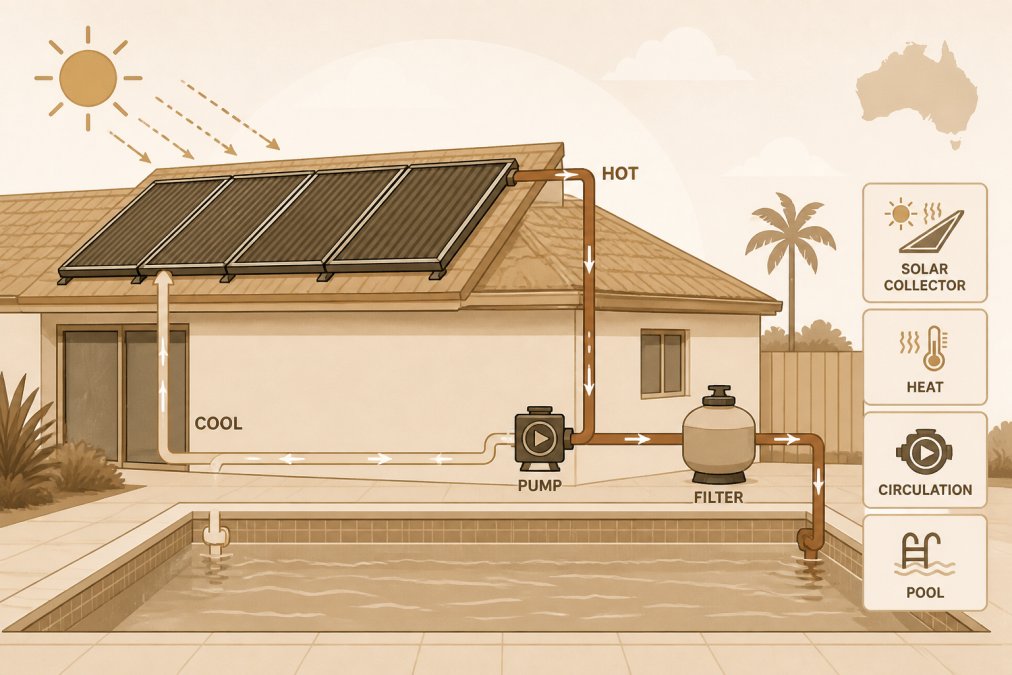
Heat retention systems multiply efficiency gains. A pool blanket prevents 70-80% of overnight heat loss through evaporation, one of the simplest upgrades to extend your swimming season. Wind exposure, shade from trees or structures, and the pool’s surface-to-volume ratio all influence how long heated water stays warm.
System durability affects long-term thermal performance. Polypropylene collectors degrade under UV exposure; quality manufacturers use virgin-grade material with carbon-black protection to extend lifespan.
Pool Heat Pump vs Solar Efficiency: Which Delivers Better Performance
This comparison reveals the fundamental trade-off between passive and active heating. A heat pump uses electricity to move thermal energy from ambient air into your pool water, delivering consistent temperature regardless of sun exposure. A solar collector captures free solar energy but only when the sun shines.
Heat pump efficiency is measured by Coefficient of Performance (COP), the ratio of heat output to electrical input. A COP of 20 means the system delivers 20 units of heat for every 1 unit of electricity consumed. This translates to lower operating expenditure compared to traditional electric resistance heating, though it still consumes grid electricity.
Solar collectors produce zero operating costs but depend entirely on weather patterns and seasonal variation. During peak summer, a well-sized solar system heats your pool to comfortable temperatures with minimal pump runtime. In winter or during extended cloud cover, thermal output drops dramatically, sometimes to negligible levels. This is where most homeowners discover the limitation: solar heating extends your season but doesn’t guarantee year-round swimming without supplementary heating.
Thermal efficiency ratings differ fundamentally between the two approaches. Solar system efficiency measures the percentage of incident solar radiation converted to usable pool heat, typically 70-85% for quality collectors. Heat pump efficiency measures electricity-to-heat conversion, where a COP of 20 represents exceptional performance. These aren’t directly comparable metrics, which confuses many buyers.
The performance difference becomes obvious in practice. A heat pump maintains your pool at 28°C consistently, whether it’s cloudy or sunny, summer or winter. A solar system might achieve 28°C in summer with zero running costs, but drop to 22°C during winter regardless of system size. For year-round swimming, heat pumps deliver superior performance. For seasonal swimming with cost minimisation, solar wins decisively.
Solazone Australia has installed both systems across Melbourne and Sunshine Coast properties. Heat pumps suit homes where extended swimming season justifies the operating expenditure. Solar collectors suit properties with excellent sun exposure and owners comfortable with seasonal temperature variation.
Solar Pool Heating Installation Cost Australia: Breakdown and Factors
Installation costs vary dramatically based on system type, pool size, and site complexity. A passive solar system typically requires less labour than a heat pump, but both involve structural assessment, plumbing integration, and electrical work.
Solar collector installation depends on roof condition, pitch, and orientation. A north-facing roof in good structural condition costs less to work with than a south-facing roof or one with structural quirks. Piping runs from roof to pool equipment also affect labour hours. A straightforward installation on a modern home with accessible roof space runs significantly cheaper than retrofitting an older property with complicated roof geometry.
Most homeowners benefit from professional installation to ensure proper water circulation, thermostat calibration, and system integration.
Heat pump installation requires a dedicated 25-amp circuit breaker, which may demand electrical upgrades on older homes. Concrete pad installation for the outdoor unit, plumbing connections, and thermostat integration add to labour costs.
Site-specific factors compound costs. Limited roof space might require a smaller solar system, increasing cost per kilowatt of thermal output. Existing pool equipment compatibility affects whether you need to replace pumps or controllers. Soil conditions determine concrete pad costs for heat pump installation.
Solazone Australia provides personalised quotes because no two installations are identical. Your specific roof orientation, pool volume, existing equipment, and desired temperature range determine the actual capital investment required. The team’s 40+ years of experience means they’ve solved unusual installations that standard quotes can’t address.
Operating Costs and Long-Term Savings: Running Cost Per Day
Operating expenditure separates these systems completely. Solar collectors produce zero running costs, the sun’s energy is free. Your only expense is the pump’s electricity consumption, typically 0.5-1.5 kilowatts depending on pool size and circulation rate. On an average sunny day, running costs for a solar system might reach $1-3 in electricity.
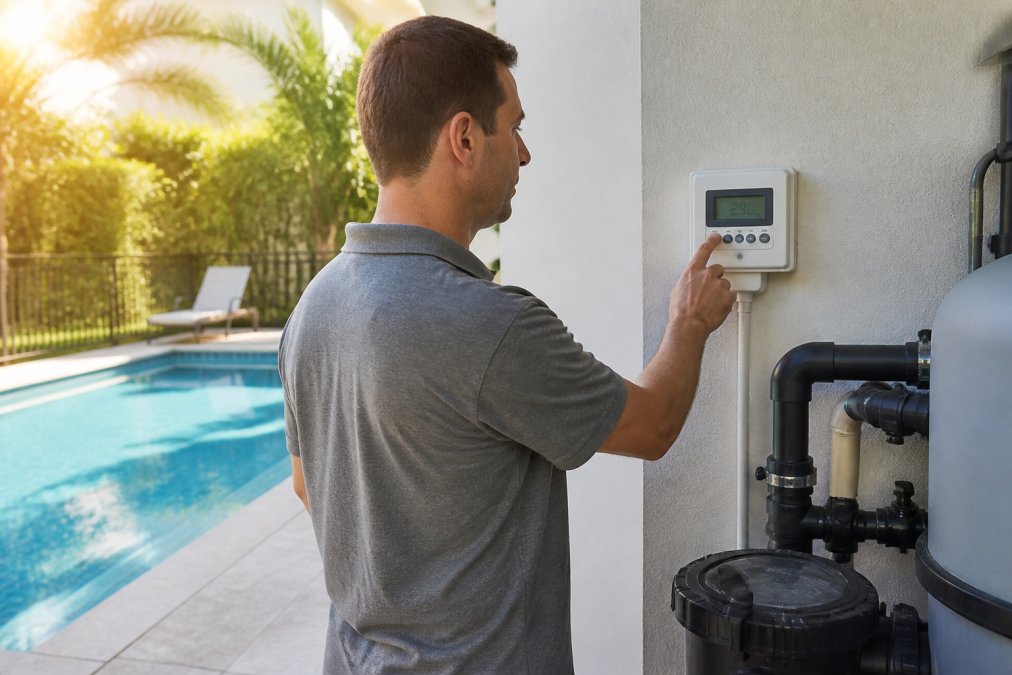
Heat pump operating costs depend on ambient temperature, desired pool temperature, and system efficiency. A heat pump with COP 20 consumes roughly 5 kilowatts of electricity to deliver 100 kilowatts of thermal energy. Running costs vary seasonally, winter operation costs more because ambient temperatures are lower, forcing the system to work harder. A heat pump might cost $5-12 per day during winter operation, compared to $1-3 for a solar system on sunny days.
Over a swimming season, the difference accumulates. A solar system heating a 50,000-litre pool through spring and autumn might cost $200-400 in electricity for the entire season. The same heat pump might cost $1,500-2,500 over the same period, depending on desired temperature and ambient conditions.
Long-term savings calculations must account for electricity price increases. Australian electricity costs have risen consistently; projecting 10-year operating expenses means assuming higher rates than today’s prices. A solar system’s running cost advantage compounds over time because it’s largely immune to electricity rate increases.
However, running cost tells only part of the story. A heat pump delivers consistent comfort that extends your swimming season by months. If that extended comfort has value to your household, more family time in the pool, health benefits, property appeal, the operating cost difference might be worth paying.
Pool Cover Energy Efficiency Benefits and System Longevity
A pool blanket or cover is the single highest-impact efficiency upgrade available, regardless of heating method. Evaporation causes 70-80% of heat loss from an uncovered pool. A thermal cover prevents this loss almost entirely, meaning your heating system works less to maintain temperature.
The energy efficiency benefits compound across time. A solar system paired with a cover operates more efficiently than the same system without one. A heat pump paired with a cover requires fewer operating hours to maintain desired temperature, directly reducing electricity consumption and running costs.
System longevity determines your total cost of ownership. A solar collector with proper maintenance lasts 25-35 years.
Heat pumps typically last 10-15 years before compressor degradation requires replacement. This means heat pump owners face a significant capital cost mid-lifecycle.
System durability also depends on maintenance. Solar collectors require occasional cleaning and inspection. Heat pumps need refrigerant checks and compressor servicing. Neglected systems degrade faster, reducing both efficiency and lifespan.
Solazone Australia’s commitment to Australian-made systems reflects this longevity principle. Systems designed and manufactured locally account for Australian climate conditions, reducing premature failure rates and extending functional lifespan.
ROI, Payback Period and Environmental Impact of Solar Pool Heating
Return on investment depends on your specific capital cost, running costs, and how long you plan to own the property. A solar system costing $3,000-5,000 with $300-500 annual operating costs achieves payback in 6-10 years, depending on electricity prices. After payback, you’re running your pool on essentially free energy for the remaining 20+ years of system life.
A heat pump costing $10,000+ with $2,000-3,000 annual operating costs achieves payback in 5-7 years if you value year-round swimming. However, the compressor replacement at year 10-12 resets your payback calculation, you’re investing another $3,000-5,000 in mid-lifecycle maintenance.
Payback period calculations must account for local electricity rates and your specific climate zone. Sunshine Coast properties with stronger solar exposure achieve faster payback on solar systems. Melbourne properties with more cloud cover might see heat pumps deliver better ROI due to more consistent operating conditions.
Environmental impact favours solar systems decisively. A passive solar collector produces zero emissions across its entire lifecycle, no ongoing electricity consumption, no grid demand. A heat pump reduces emissions compared to electric resistance heating, but still consumes grid electricity, which in Australia increasingly comes from renewable sources but still includes fossil fuel generation.
Over 25 years, a solar system prevents approximately 15-25 tonnes of CO2 emissions compared to electric resistance heating. A heat pump prevents 5-10 tonnes, depending on Australia’s electricity grid mix. For environmentally conscious homeowners, this difference matters.
Solazone Australia’s promotion of Australian-made systems reflects this environmental principle. Locally manufactured equipment reduces transportation emissions and supports Australian renewable energy infrastructure development.
Choosing between solar pool heating cost vs efficiency ultimately depends on your priority. If you want to minimise running costs and have excellent sun exposure, a solar system delivers superior long-term value with zero operating expenditure and exceptional durability. If you prioritise consistent year-round comfort and don’t mind higher electricity bills, a heat pump provides reliable temperature control regardless of weather.
Solazone Australia helps you calculate your specific ROI based on your pool volume, roof orientation, climate zone, and comfort expectations. With over 40 years of technical expertise and thousands of satisfied customers across Australia, the team provides personalised quotes that account for your unique site conditions. Get started with Solazone Australia and discover how solar pool heating can reduce your energy costs while extending your swimming season.
Frequently Asked Questions
How much does solar pool heating cost to install in Australia?
Installation costs depend on pool volume, system type, and roof configuration. Passive solar collectors typically range from $2,500 to $5,000 for a 50,000-litre pool, whilst heat pump systems start higher due to electrical requirements and compressor technology. Factors affecting cost include panel area needed, plumbing complexity, existing pool infrastructure, and local labour rates. Contact Solazone Australia for a personalised quote based on your specific pool size and location.
Is solar pool heating more efficient than a heat pump?
Solar pool heating and heat pumps measure efficiency differently. Solar systems capture free thermal energy from the sun with negligible running costs but depend on weather and season. Heat pumps (like the Supreme Heating VProPlus) achieve exceptional energy efficiency with a COP up to 20, meaning they deliver 20 units of heat for every 1 unit of electricity consumed. Heat pumps provide year-round heating and precise temperature control, whilst solar systems work best in warmer months and extend swimming season rather than enable winter swimming.
Does solar pool heating work on cloudy days?
Solar pool heating works on cloudy days but with reduced thermal gain. Solar collectors still capture diffuse radiation even without direct sunlight, though heat absorption drops significantly. Performance depends on cloud density and duration. In Australia's climate zones, particularly Melbourne and the Sunshine Coast, seasonal variation matters more than occasional cloud cover. Pairing solar heating with a pool cover maximises heat retention and compensates for lower thermal efficiency on overcast periods.
How long does a solar pool heating system last?
Quality solar collectors like Ecosun systems come with genuine 35-year manufacturer warranties, reflecting system durability. Most solar pool heating panels maintain 80% efficiency after 20 years of exposure. System lifespan depends on panel material (virgin polypropylene with carbon-black resists degradation), installation quality, and maintenance. Heat pump systems typically last 10-15 years before compressor replacement. Regular maintenance of pumps, controllers, and plumbing extends overall system longevity significantly.
What are the ongoing running costs of solar pool heating compared to gas?
Solar pool heating has negligible running costs once installed, primarily pump electricity (typically $5-15 per week depending on pump capacity and usage). Gas heating costs depend on gas prices and consumption but generally run $20-50+ weekly during heating season. Heat pumps operate at lower cost than gas due to high energy efficiency ratings, typically $10-25 weekly. Over a heating season, solar systems deliver the lowest operating expenditure, making them ideal for reducing utility bills in the long term.
This article was written using GrandRanker