

Table of Contents
- What Is Net Metering?
- How Does Net Metering Work Step by Step?
- Net Metering vs Solar Feed-in Tariffs in Australia
- How to Maximise Solar Self-Consumption at Home
- The Benefits of Solar Battery Storage for Net Metering
- Net Metering Policy Changes: What Homeowners Need to Know
- Troubleshooting Common Net Metering Billing Errors
- Frequently Asked Questions
Last Updated: September 12, 2026
What Is Net Metering?
Net metering is a billing mechanism that credits solar owners for excess electricity their system exports to the utility grid, offsetting the power they draw at night or on cloudy days. At Solazone Australia, we’ve explained this to thousands of homeowners, and the confusion almost always starts with the difference between what your panels produce and what your meter records. Understanding these metering nuances is the first step toward managing your energy consumption more effectively, which remains the most reliable way to lower high utility bills.
Your solar array generates electricity during daylight hours. Your home uses some immediately; whatever’s left flows out through a bi-directional meter, and your retailer credits that export against your consumption. The net outcome is a reduced bill, not a cash payment, net metering isn’t a subsidy or a feed-in tariff, but an accounting arrangement whose rules have shifted significantly in recent years.
The Billing Mechanism Behind Your Energy Credits
Think of net metering as a running ledger. Every kilowatt-hour your panels export earns a credit; every kilowatt-hour you import costs you. At the end of the billing cycle, the two columns are reconciled.
The critical detail is what rate applies to each side. Older arrangements credited exports at or near the retail rate, so a kWh sent to the grid was worth roughly the same as one bought back. Newer frameworks use avoided-cost rates, valuing exports at what the grid would have paid a large generator.
That change reshapes the maths for every solar owner, and explains why battery storage has moved from optional to essential for many households.
How Does Net Metering Work Step by Step?
Net metering works through a defined sequence: generation, self-consumption, export, metering, billing reconciliation, and, before any of that, an application and approval process with your distributor. Most guides skip the last part, which is where delays actually happen.
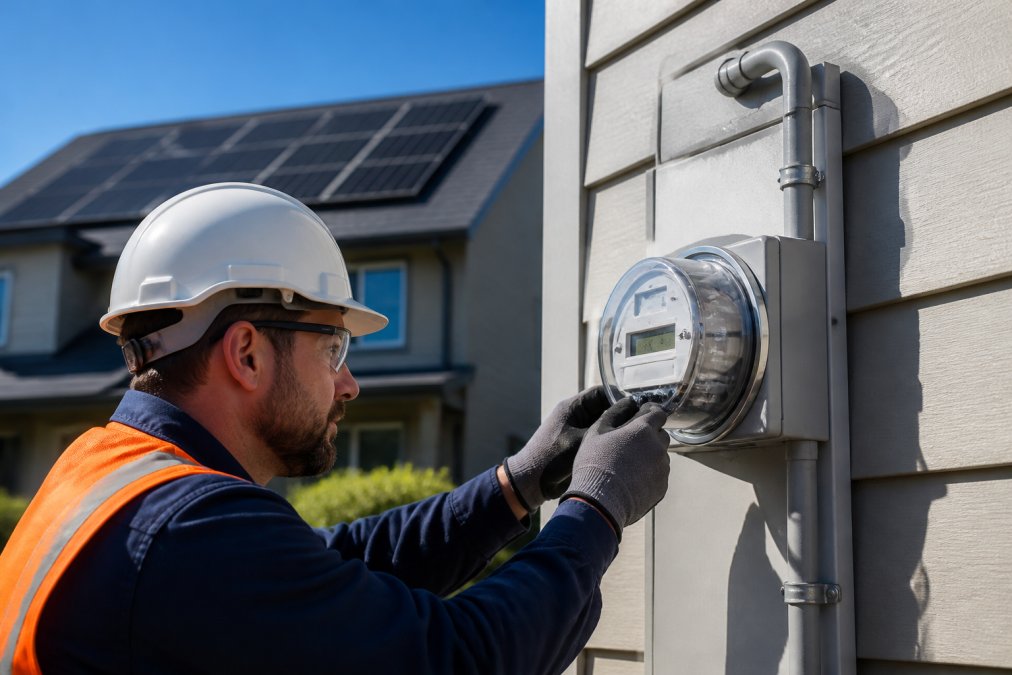
From Solar Array to Utility Grid: The Energy Flow
- Your solar array generates DC electricity from sunlight hitting the panels.
- An inverter converts it to AC at the voltage your home and the grid use.
- Your household loads draw power first. The fridge, hot water, and air conditioning consume whatever’s available in real time.
- Surplus flows through your bi-directional meter and out to the utility grid.
- Your distributor records interval data, typically in 30-minute blocks, showing how much was imported and exported, and when.
- Your retailer reconciles imports and exports at the end of the billing cycle, applying the credit rate in your offer.
The bi-directional meter is the piece most people never look at, yet it determines whether your credits are calculated correctly. Older accumulation meters can’t record direction, so an upgrade is usually part of the interconnection agreement.
The Application and Interconnection Process
Before your system can export, your distributor, which owns the poles and wires, not your retailer, must approve the connection:
- Your installer submits a connection application to the local distributor, usually via an online portal, including the inverter model, system size, and single-line diagram.
- The distributor assesses network capacity at your connection point. In high-penetration areas they may impose an export limit (often a kW cap) or require a smart inverter with volt-watt and volt-var response.
- Approval is issued, sometimes with conditions. Basic connections are often auto-approved; constrained ones take longer.
- The meter is exchanged for a bi-directional interval meter if you don’t have one. Your retailer arranges this, not your installer, and it can be the slowest step.
- Your retailer switches you to a solar-compatible offer and begins applying export credits.
A gap of several weeks between installation and the first credited bill is common, so keep your commissioning documents.
Check whether your meter records exports in 30-minute intervals or as a single daily total. Interval data lets you see exactly when you’re exporting, which is the only way to know whether a battery would actually pay for itself in your situation. Under time-varying export rates, a midday kWh and an evening kWh can be worth very different amounts.
How the Credit Is Actually Calculated
The arithmetic is simpler than the paperwork. If your meter records 20 kWh imported and 30 kWh exported, the retailer applies your import rate to the 20 kWh and your export credit rate to the 30 kWh, then nets the two. If exports exceed imports in value, the surplus may roll over as a credit, but rollover rules vary by retailer and state, and some offers cap or forfeit unused credits.
The critical variable is the rate on each side. Older arrangements credited exports at or near the retail rate; newer frameworks use an avoided-cost rate, typically a fraction of what you pay to import. That asymmetry makes self-consumption and storage economically important.
Approval, metering, and billing are three separate steps handled by three different parties, your installer, your distributor, and your retailer. Knowing which one to chase when something stalls saves weeks.
Net Metering vs Solar Feed-in Tariffs in Australia
Net metering and feed-in tariffs are not the same thing, though retailers often blur the language. Net metering offsets your consumption against exports within a billing period; a feed-in tariff is a payment rate applied to exported energy, credited against your bill or sometimes paid separately.
The practical difference is the rate applied. Feed-in tariffs in most jurisdictions have fallen well below the retail rate you pay for imported power, the single biggest reason payback periods have lengthened for new installations compared with a decade ago.
| Feature | Net Metering | Feed-in Tariff |
|---|---|---|
| What it offsets | Consumption within the billing cycle | Exported energy only |
| Typical rate basis | Retail or near-retail | Avoided-cost |
| Credit rollover | Varies by retailer and state | Usually limited or none |
| Best paired with | Self-consumption-first design | Export-heavy systems |
For current rates in your area, check your retailer’s published offer documents and the Australian Energy Regulator’s consumer resources, which explain how retail offers must be presented.
How to Maximise Solar Self-Consumption at Home
Maximising solar self-consumption means shifting household energy use into daylight hours, so you consume your own generation instead of exporting it cheaply and buying it back at full retail. Every kWh you use directly is worth considerably more than the same kWh exported.
The highest-impact changes are usually the least glamorous:
- Run heavy appliances during the day. Washing machines, dishwashers, and dryers should run on timers between mid-morning and mid-afternoon.
- Heat water with surplus solar. A timer or diverter on your hot water system absorbs generation that would otherwise be exported.
- Pre-cool or pre-heat your home. Reverse-cycle air conditioning run during peak generation reduces evening demand.
- Charge devices and vehicles in daylight. An EV charged from your own roof costs a fraction of one charged overnight.
A common mistake is sizing for total annual consumption rather than daytime load profile. Two households can use identical annual kilowatt-hours and get wildly different returns, purely because one runs its loads while the sun is up.
The Benefits of Solar Battery Storage for Net Metering
The benefits of solar battery storage under modern net metering rules come down to arbitrage: storing cheap daytime generation to avoid expensive evening imports. When export credits are worth a fraction of retail rates, every kWh you keep and use later is worth several times what you’d earn exporting it. Under time-of-use rates, evening power can cost substantially more per kWh than daytime power, and a battery discharging into that window cuts the most expensive part of your bill.
A second, less-noticed benefit is resilience. For households on the Sunshine Coast and in outer Melbourne where outages are a real concern, battery backup keeps essential circuits running when the grid drops. Grid-tied solar alone shuts down during an outage for safety reasons; a battery with backup capability doesn’t (cleanenergycouncil.org.au).
Adding a battery to an existing system isn’t always plug-and-play. Older inverters may not support battery integration, and some interconnection agreements require notification before storage is added. Confirm the requirements with your distributor before you buy.
Net Metering Policy Changes: What Homeowners Need to Know
Most articles describe net metering as a single, static scheme. In practice it has moved through distinct phases, and the shift that matters most is from 1:1 retail credit, where an exported kWh was worth roughly the same as an imported one, to avoided-cost export rates, where exports are valued at what the grid would otherwise have paid a large generator.
That change is not cosmetic. Under 1:1 netting, an export-heavy system performed well because every surplus kWh offset a full-retail kWh later. Under avoided-cost rates, the same system earns a fraction of that value on exports, while every kWh consumed on site still avoids a full-retail purchase. The economics flip from generate as much as possible to use as much as possible, when it’s worth most.
The Three Phases of the Framework
- Phase 1, Retail-rate netting. Exports credited at or near the retail rate, often with generous rollover. This is the arrangement many older articles still describe, and it no longer reflects most current offers.
- Phase 2, Reduced and time-varying export rates. Export credits separated from the retail rate and set at an avoided-cost benchmark. Some offers introduced time-of-use structures, paying more for exports during evening peak and less, sometimes nothing, during the midday solar surplus.
- Phase 3, Self-consumption and storage incentives. Policy attention shifted to rewarding households that store and shift their own generation, through battery programs, demand-response tariffs, and inverter standards that allow the network to manage exports.
The direction is consistent across jurisdictions: exports are worth less, self-consumption is worth more, and when you use power matters as much as how much you generate.
What This Means for System Design
For anyone considering solar now, the implication is direct: prioritise self-consumption and battery readiness over maximum panel count. A slightly smaller array with storage will often outperform a larger export-heavy system, because the marginal panel produces kWh that earn an avoided-cost credit rather than a retail-rate offset. Three practical design questions follow:
- What is your daytime load profile? A household that runs pool pumps, hot water, and air conditioning during the day captures more value per panel than one that doesn’t.
- What does your retailer pay for exports, and when? If the offer has a time-varying export rate, orienting generation toward the higher-value window changes the maths.
- Is the system battery-ready? Even if you don’t buy storage now, choosing a hybrid inverter and a battery-compatible design preserves the option without a full retrofit later.
The Battery Connection
Battery storage is the direct response to reduced export rates. When an exported kWh earns a fraction of the retail rate, every kWh you store and use later is worth several times what you’d earn exporting it. Under time-of-use import rates, a battery discharging into the evening peak avoids the most expensive part of the bill.
The trade-off is capital cost and round-trip efficiency. Storage isn’t free, and not every load profile justifies it. The households that benefit most have a large evening peak, a time-of-use tariff, and limited ability to shift daytime loads.
Adding a battery to an existing system isn’t always plug-and-play. Older inverters may not support battery integration, and some connection agreements require notification to the distributor before storage is added. Confirm the requirements before you buy.
The single most important shift: net metering now rewards when you use power, not just how much you generate. Design for the evening peak, not the midday export.
Troubleshooting Common Net Metering Billing Errors
Billing errors under net metering usually fall into four categories, and most are fixable with a phone call and a meter reading.
- Export credits missing entirely. Often a meter configuration issue. Your retailer can see whether export data is reaching them.
- Credits applied at the wrong rate. Check your offer document against the rate on your bill. Rates change, and old rates sometimes persist in billing systems.
- Meter reading estimated rather than actual. Estimated reads can produce wild swings. Request an actual read.
- Solar offset not reflected in the billing cycle. If your system was installed mid-cycle, the first bill often looks wrong. It usually corrects on the second.
Keep a record of your inverter’s generation figures. If your inverter reports substantially more generation than your bill shows as exported plus self-consumed, that discrepancy is your evidence. For guidance on your rights when a retailer gets it wrong, the Energy and Water Ombudsman scheme in your state handles disputes at no cost to the consumer.
Net metering rewards households that treat their solar system as an energy management problem, not just a generation asset. The rules have shifted toward self-consumption, and the best-performing systems are designed accordingly.
Solazone Australia has spent more than 40 years equipping homes and businesses with solar power systems, battery backup, and ventilation solutions built around how people actually use energy. Our installation teams handle the metering and interconnection details that trip up DIY approaches, and we specify Australian-made systems where reliability matters most.
Get started with Solazone Australia and design a system around the billing framework you’ll actually face, not the one that made headlines a decade ago.
Frequently Asked Questions
Is net metering available in Australia?
Net metering in the traditional sense, where you receive the full retail rate for every kilowatt-hour exported, is not widely available. Most states operate on a feed-in tariff model instead. This means your utility provider pays you a set rate, usually between 4c and 12c per kWh, for excess electricity sent to the grid. That rate is lower than what you pay to buy power, so self-consumption matters more than export credits for your solar payback period.
What happens to the electricity my solar panels produce but I don’t use?
Any excess electricity your solar array generates flows through your bi-directional meter and into the utility grid. Your utility provider then credits you at the agreed feed-in tariff rate on your next billing cycle. If you have battery storage, you can store that surplus instead and use it at night, which reduces your reliance on grid export rates and keeps more of your energy production working for you at peak demand times.
Do I need a special meter for solar export?
Yes. A standard accumulation meter cannot measure energy flowing in two directions. You need a bi-directional smart meter, sometimes called a net energy metering device, installed by your utility provider. This meter records both the electricity you draw from the grid and the excess you export. Your installer will usually arrange the meter upgrade as part of the interconnection agreement process, though timelines vary by distributor.
What is the difference between gross and net metering?
Gross metering pays you a feed-in tariff for every kilowatt-hour your solar array produces, regardless of whether you use it on site. Net metering only credits you for the excess electricity that flows to the grid after your home has consumed what it needs. Net metering encourages self-consumption because using your own solar power directly avoids buying electricity at the higher retail rate, while gross metering treats all generation equally.