
Table of Contents
- Why Maintenance Costs Matter to Your Solar Payback Period
- Solar Panel Maintenance Costs: What You’ll Actually Spend
- Creating a Solar Panel Maintenance Schedule That Protects ROI
- Using a Solar Payback Period Calculator With Maintenance Built In
- Solar Inverter Replacement Cost and System Lifespan
- Maintenance-Adjusted Payback: A Worked Example
- How Warranties and Service Inclusions Reduce Maintenance Risk
- Frequently Asked Questions
Last Updated: October 8, 2026
Why Maintenance Costs Matter to Your Solar Payback Period
When you invest in solar, the payback period, how long energy savings take to recover your upfront costs, is usually the deciding factor, yet understanding maintenance costs solar payback requires accounting for ongoing expenses most guides overlook. But most solar guides calculate payback without accounting for ongoing maintenance costs, a significant blind spot.
Maintenance costs affecting solar payback can shift your timeline by months or years. A system that looks like it pays for itself in 7 years might take 8 or 9 once you factor in cleaning, inspections, inverter servicing, and component replacements.
Australian electricity rates keep rising, making solar more attractive, but rising installation costs and longer system lifespans mean maintenance is a bigger slice of total ownership cost. If you’re comparing quotes, ignoring maintenance costs is like ignoring a major line item on your electricity bill.
Solar Panel Maintenance Costs: What You’ll Actually Spend
Your solar panels don’t require expensive upkeep, but they do need attention. The main costs are cleaning, inspections, inverter servicing, and component replacements.
Routine cleaning is the most frequent expense. Dust, pollen, bird droppings, and grime reduce efficiency, many systems lose 15-25% output when dirty. Professional cleaning costs depend on system size and roof accessibility.
Annual inspections by a qualified electrician or solar technician catch problems early.
Inverter servicing is where costs can spike. Your inverter converts DC power into AC power your home uses. Inverters typically last 10-15 years, and replacement costs are substantial.
Battery replacement, if you have storage, is a major cost. Batteries degrade with each charge cycle and may need replacing every 10-15 years, a significant investment.
The key insight: maintenance costs are baked into long-term ownership. The question isn’t whether you’ll pay them, but whether you’ve accounted for them in your payback calculation.
Creating a Solar Panel Maintenance Schedule That Protects ROI
A structured maintenance schedule keeps costs predictable and prevents expensive emergency repairs, the difference between regular oil changes and an engine rebuild.
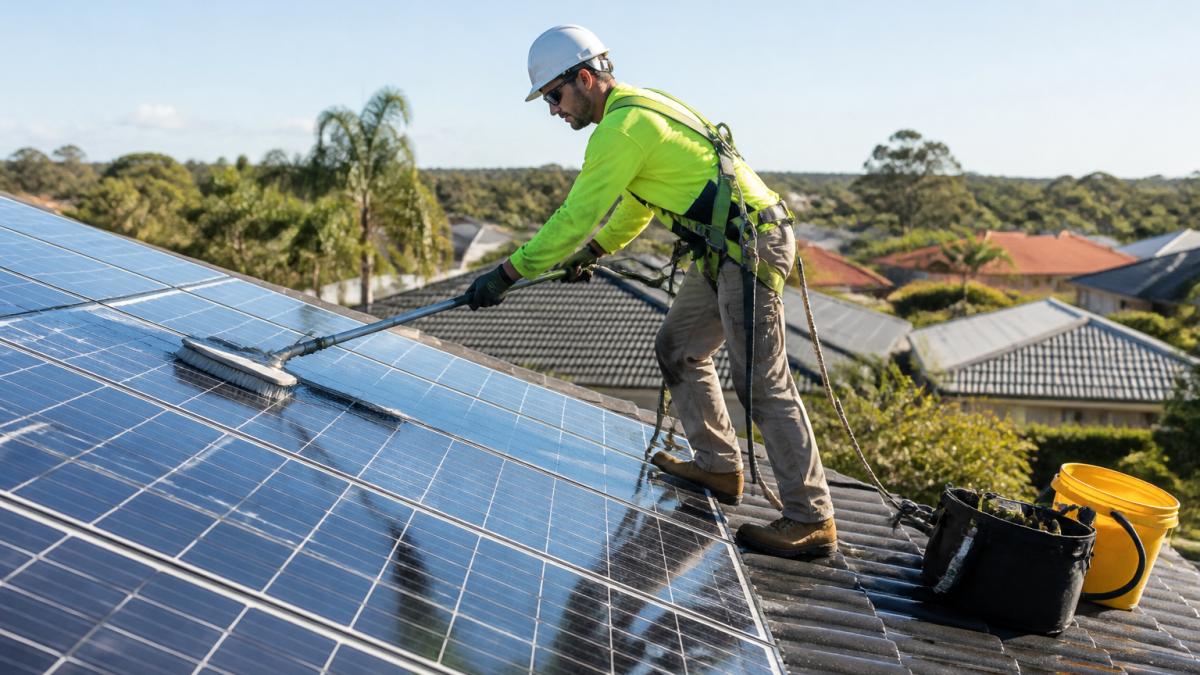
Start with quarterly cleaning if you live in a dusty area or near the coast, where salt spray accelerates corrosion and reduces output faster than inland dust. Inland with moderate dust, twice yearly often suffices.
Annual professional inspections should happen every 12 months. A qualified technician checks:
- Electrical connections and junction boxes
- Mounting hardware and roof penetrations
- Inverter cooling fans and internal components
- Battery terminals and charge controller settings (if applicable)
- Ground continuity and safety switches
Inverter servicing depends on type: string inverters often need attention every 5-7 years, while microinverters and power optimizers need less frequent service. Check your warranty documentation for manufacturer recommendations.
Battery checks (if you have storage) should happen annually. A technician monitors voltage, temperature, and charge/discharge cycles to predict remaining lifespan.
The maintenance costs solar payback calculation: take annual energy savings, subtract average annual maintenance costs, then divide total system cost by net savings.
Using a Solar Payback Period Calculator With Maintenance Built In
A proper payback calculator must account for three variables: system cost, annual electricity savings, and maintenance costs. Many online calculators skip maintenance, understating your true payback period.
Here’s a practical framework:
Step 1: Determine your system cost. This includes panels, inverter, wiring, mounting, and labour. Get quotes from multiple installers, costs vary significantly. We can provide a detailed quote tailored to your roof and energy needs.
Step 2: Calculate annual electricity savings. Multiply daily production (kWh) by your electricity rate. At 15 kWh daily and $0.30 per kWh, that’s about $1,642 annually. Account for seasonal variation and degradation (panels lose about 0.5% efficiency per year).
Step 3: Estimate annual maintenance costs. Use these rough benchmarks:
- Cleaning: Costs vary per year
- Professional inspection: Costs vary per year
- Inverter servicing (averaged over its lifespan): Costs vary per year
- Battery replacement reserve (if applicable): Costs vary per year
Step 4: Calculate net annual savings. Subtract total maintenance from electricity savings, your real annual return.
Step 5: Divide system cost by net annual savings. The result is your maintenance-adjusted payback period in years.
Example: A system that saves $2,000 annually but costs $500 in average maintenance has net savings of $1,500, so payback is 12 years, versus 9 years without accounting for maintenance.
Solar Inverter Replacement Cost and System Lifespan
Your inverter is arguably the most critical component after the panels, and the most likely to need replacement during your system’s lifetime.
String inverters (the traditional single unit near your switchboard) typically last 10-15 years. Expect significant costs for a residential replacement, plus installation labour. When one fails, your entire system stops producing until replaced.
Microinverters (one per panel) last 15-25 years on average. They cost more upfront but spread the risk, if one fails, only that panel stops working. Replacement is cheaper per unit but requires roof access.
Power optimizers (hybrid approach) fall somewhere between. They typically last 15-20 years.
Your panels often outlast your inverter. Quality panels degrade about 0.5% annually and many remain productive for 30+ years, so your system’s economic lifespan might be 25-30 years, but your inverter will likely need replacement once, sometimes twice, in that period.
When calculating long-term payback, budget for inverter replacement around year 12-15. If you’re financing, this future cost should influence your system size and initial investment.
Maintenance-Adjusted Payback: A Worked Example
A single payback number is misleading because maintenance, production, and electricity prices all move. A sensitivity analysis, running the same system through optimistic, typical, and conservative assumptions, shows how far apart the payback dates land. Below is a worked example using a 6.6 kW rooftop system in a temperate region, plus a component-replacement timeline and a comparison across three system sizes.
Base assumptions (typical scenario):
- System cost after rebates: Costs vary
- Annual production: 9,000 kWh (accounting for orientation, shading, and 0.5% annual degradation)
- Self-consumption share: 40% at a certain rate; export share: 60% at a certain feed-in tariff
- Annual bill savings: Calculated based on consumption and export rates.
- Annual maintenance: Costs vary (cleaning, inspection, inverter reserve)
- Net annual savings: Calculated based on individual circumstances
- Simple payback: Calculated based on individual circumstances
Now stress-test it.
| Scenario | Production | Electricity price trend | Maintenance | Net annual savings | Payback |
|---|---|---|---|---|---|
| Optimistic | +10% | +5%/yr | Costs vary | Costs vary | Costs vary |
| Typical | baseline | +3%/yr | Costs vary | Costs vary | Costs vary |
| Conservative | −10% | +1%/yr | Costs vary | Costs vary | Costs vary |
The gap between optimistic and conservative payback is roughly seven years on the same hardware. That range, not a single figure, is what should drive your financing decision.
Component-replacement timeline (typical 25-year analysis):
| Year | Likely cost | Notes |
|---|---|---|
| 1-5 | Costs vary/yr | Cleaning, annual inspection |
| 6-10 | Costs vary/yr | First inverter service or repair |
| 11-15 | Costs vary | String inverter replacement (labour included) |
| 16-20 | Costs vary/yr | Second inspection cycle, possible optimiser faults |
| 21-25 | Costs vary | Possible second inverter or battery replacement |
A common pattern is to reserve a portion of system cost per year for replacements, held in a separate account so the year-12 inverter bill does not arrive as a shock.
Payback by system size (typical scenario, same rates):
| System size | Installed cost (after rebates) | Annual net savings | Payback |
|---|---|---|---|
| 3 kW | Costs vary | Costs vary | Costs vary |
| 6.6 kW | Costs vary | Costs vary | Costs vary |
| 10 kW | Costs vary | Costs vary | Costs vary |
Larger systems spread fixed maintenance (inspection, call-out) across more production, so payback flattens rather than improving indefinitely. Beyond the point where export exceeds what the grid will credit, extra panels add cost without proportional savings.
Clean Energy Council, approved solar retailer and product lists
These figures are illustrative. Your actual payback depends on your tariff structure, feed-in rate, roof orientation, shading, and local climate. Use them as a framework, not a quote.
How to run this for your own system:
- Get your annual production estimate from your installer’s modelling tool.
- Split it into self-consumed and exported kWh using your usage pattern.
- Apply your actual tariff and feed-in rate.
- Subtract a maintenance figure from the table above that matches your system type and location.
- Re-run with production −10% and maintenance +50% to see your conservative case.
If the conservative payback still beats your financing cost, the investment is robust. If it does not, the system may be oversized for your usage, or the maintenance assumptions need revisiting before you sign.
How Warranties and Service Inclusions Reduce Maintenance Risk
Warranties don’t eliminate maintenance costs; they shift who pays for specific failures. The gap most guides leave is labour: a covered part is not a covered repair. Understanding the three warranty layers, their exclusions, and how insurance fits turns a warranty document into a budgeting tool.
The three warranty layers:
- Product warranty covers manufacturing defects in panels, inverter, and mounting hardware. Panel warranties commonly run 10-15 years; inverter warranties 5-10 years. The manufacturer supplies the replacement part.
- Performance warranty guarantees a minimum output percentage over time, commonly 25-30 years for panels, typically 80-87% of nameplate at year 25. It doesn’t cover physical damage or installation faults.
- Workmanship warranty covers the installer’s labour and installation quality, usually 5-10 years. It pays for re-sealing roof penetrations, re-terminating loose connections, or correcting mounting errors.
What warranties typically exclude:
- Labour to remove and reinstall a warranted panel or inverter (costs vary per visit)
- Call-out fees, which can be significant before any work begins
- Damage from storms, hail, rodents, or improper cleaning
- Cosmetic issues that do not affect output
- Systems where maintenance records were not kept
A warranty claim can be refused if the manufacturer can show the fault was caused by neglected maintenance or unauthorised work. Keep dated records of every inspection and clean.
Who pays for what, a practical mapping:
| Failure type | Usually covered by | Usually paid by you |
|---|---|---|
| Panel defect (output below warranty) | Product + performance warranty | Labour, freight, call-out |
| Inverter failure within warranty | Product warranty | Labour and call-out |
| Inverter failure after warranty | Nothing | Full replacement and install |
| Loose wiring from installation | Workmanship warranty | Nothing, if within period |
| Storm or hail damage | Insurance | Excess |
| Rodent damage to cabling | Insurance (if covered) | Excess, plus prevention |
Service inclusions and their trade-offs:
Some installers offer scheduled maintenance packages bundling annual inspection, cleaning, and priority repairs. These convert unpredictable costs into a fixed annual fee, helping budgeting but meaning you pay whether or not a fault occurs.
Insurance as the fourth layer:
Home and contents policies vary widely on solar. Some cover the system as part of the building; others exclude or cap it separately. Standalone solar insurance covers accidental damage, theft, and sometimes system failure.
Monitoring as a cost-control mechanism:
Most modern inverters include app-based monitoring. Checking weekly catches underperformance early, a string producing 20% less than its neighbour is usually a fault, not weather. Early detection often turns a major inverter replacement into a minor repair.
The warranty question is not “what is covered?” but “what will I still pay when something is covered?” Labour, call-out, freight, and excess are the recurring out-of-pocket costs. Budget for those, keep records, and monitor output weekly.
Frequently Asked Questions
How often do solar panels need maintenance?
Most solar systems require annual professional inspection and cleaning to maintain peak performance. In dusty or coastal areas, panels may need cleaning twice yearly. Inverters typically need servicing every 5-10 years depending on the model. Battery systems require more frequent monitoring. A maintenance schedule protects your annual electricity-bill savings by ensuring the system operates at rated efficiency. Neglecting routine maintenance can reduce energy production by 15-25% over time.
What costs should I include when calculating solar payback?
True payback calculations must include upfront system cost, installation labour, annual maintenance and cleaning, inverter replacement reserves, battery replacement if applicable, insurance premiums, and monitoring service fees. Many homeowners overlook these ongoing costs, which can extend payback periods. Factor in electricity-rate increases. Use these figures to build a realistic ROI model rather than relying on upfront savings estimates alone.
How much does it cost to maintain a solar system annually?
Annual maintenance costs typically range from routine inspection and panel cleaning to monitoring system performance. Professional cleaning costs depend on system size and roof access. Inverter servicing costs vary by type and warranty coverage. Battery systems incur higher annual upkeep. Many systems include some service in their workmanship warranty, reducing out-of-pocket expenses. Contact your installer for a detailed maintenance schedule and cost breakdown specific to your equipment and location.
Why might a solar system take longer than expected to pay back?
Payback periods extend when maintenance costs, equipment replacements, and system degradation are underestimated. Inverter replacement, often the largest mid-life cost, can add significant amounts to lifetime expenses. Reduced energy production from soiling, shading, or equipment wear cuts annual electricity-bill savings. Rising installation costs and lower-than-projected electricity rates also delay recovery. A sensitivity analysis that tests different maintenance scenarios, electricity-rate assumptions, and component replacement timelines reveals realistic payback timelines and helps you budget accurately.