
Table of Contents
- What Drives Solar Installation Costs for Flat Roof Homes
- Flat Roof Solar Panel Mounting Systems and What They Add
- How Flat Roofs Compare With Pitched Roofs on Cost
- Solar System Prices by Size: What to Expect
- Solar Panel Installation Hidden Costs to Budget For
- Solar and Battery Installation Cost: Is Storage Worth Adding?
- Rebates, Layout and How to Compare Flat Roof Quotes
- Conclusion
- Frequently Asked Questions
Last Updated: October 19, 2026
What Drives Solar Installation Costs for Flat Roof Homes
Solar installation costs for flat roof homes are shaped by mounting hardware, roof condition, access logistics and system size rather than by the panels alone.
A flat roof changes the job in three ways. Panels need a tilt frame to face the sun properly, the mounting system must protect the membrane beneath it, and the installer needs a structural assessment before drilling or ballasting anything.
Most quotes you receive will bury these line items. Ask for them separately.
The mounting system and roof preparation often matter more than the panel brand on a flat roof. Get both itemised before you compare totals.
Flat Roof Solar Panel Mounting Systems and What They Add
Flat roof solar panel mounting systems fall into two families: ballasted arrays held down by weighted blocks, and mechanically fixed frames anchored through the roof surface. Ballasted systems avoid penetrations but add weight; fixed frames need careful sealing.
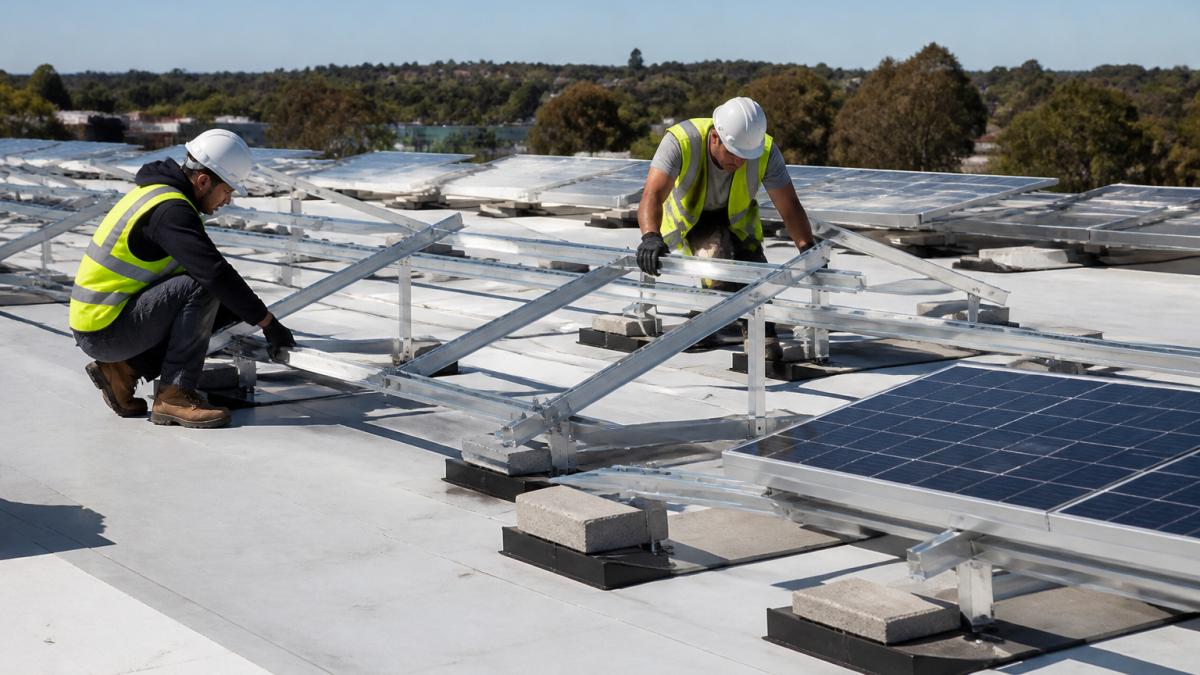
These mounting structures also necessitate a careful assessment of the underlying electrical infrastructure, as the integration of solar systems and wiring requires compatibility with existing circuits to ensure long-term safety and performance.
Ballast, Tilt Frames and Membrane Protection
Tilt frames lift panels to the correct angle, typically somewhere between 10 and 30 degrees depending on latitude and how much self-cleaning you want from rainfall.
Membrane protection matters just as much. A mounting foot that compresses insulation or traps water will shorten the roof’s life, and repairing a failed membrane under an array is far more expensive than doing it right first.
Skipping a structural check on an older flat roof is the most common expensive mistake we see. If the roof cannot carry the ballast or the fixings, the whole design changes after you have already signed.
How Flat Roofs Compare With Pitched Roofs on Cost
Flat roof solar generally costs more than pitched roof solar for the same system size, because the mounting hardware is more complex and the labour is slower.
The gap narrows on large, open, unshaded flat roofs where access is easy. It widens on small roofs with parapets, plant equipment or multiple levels.
Where a flat roof genuinely wins is layout flexibility.
Solar System Prices by Size: What to Expect
Solar system prices scale with kilowatt capacity, but not linearly. A larger system spreads the fixed costs of design, electrical work and installation across more panels, which is why cost per watt usually falls as system size rises.
As a working rule, the panel-and-inverter hardware accounts for roughly half to two-thirds of a flat-roof quote, with the balance going to mounting, roof preparation, electrical work and labour.
Indicative Flat-Roof Price Bands by System Size
| System size | Typical flat-roof price band (AUD, incl. GST) | Approx. cost per watt (AUD) | Notes |
|---|---|---|---|
| 6.6 kW | $5,500 – $8,500 | $0.83 – $1.29 | Common single-phase entry size; tilt frame and ballast add to a pitched-roof equivalent |
| 10 kW | $8,000 – $12,500 | $0.80 – $1.25 | Fixed costs spread further; often the best value per watt on a clear roof |
| 13.2 kW | $10,500 – $16,000 | $0.80 – $1.21 | Needs confirmable roof area and row spacing; three-phase may be required |
| 20 kW | $15,500 – $24,000 | $0.78 – $1.20 | Commercial-leaning; structural and drainage design becomes a larger line item |
These bands widen sharply when any of the following apply: the roof is above two storeys, access requires a hoist or crane, the membrane is at end of life, the switchboard needs upgrading, or the array must be split across multiple roof levels.
What an Itemised Flat-Roof Quote Should Separate
A transparent quote breaks the total into lines you can compare across installers. Ask for each of the following as a separate figure:
- Panels, model, wattage and quantity
- Inverter, model, capacity and whether it is single- or three-phase
- Mounting system, tilt frame type, ballast blocks or mechanical fixings, and the brand
- Roof preparation, membrane protection, sealing of penetrations, drainage planning
- Structural assessment, engineering sign-off, whether included or billed separately
- Electrical work, switchboard upgrade, cable runs, isolators, metering
- Labour and access, scaffolding, hoist or crane hire, travel
If an installer will only give you a lump sum, ask them to split it using this list. A refusal is itself information.
Request the mounting hardware specification in writing alongside the price. Two quotes at the same total can differ enormously in frame quality and fixing method, and on a flat roof, that difference is where the real cost risk sits.
Worked Example: A 10 kW Flat-Roof Quote
A representative itemisation for a 10 kW ballasted system on a single-storey flat roof might look like this (AUD, incl. GST, before certificate discount):
| Line item | Indicative amount (AUD) |
|---|---|
| Panels (approx. 24 × 415 W) | $3,200 – $4,600 |
| Inverter (10 kW) | $1,400 – $2,400 |
| Tilt frame and ballast | $1,600 – $2,800 |
| Membrane protection and sealing | $400 – $900 |
| Structural assessment | $300 – $800 |
| Electrical work and switchboard | $800 – $1,800 |
| Labour and access | $1,200 – $2,200 |
| Subtotal | $8,900 – $15,500 |
| Less certificate discount | Varies with current certificate value |
Use this structure to interrogate any quote you receive. If a line is missing, ask why, and if the mounting line is bundled into “installation”, ask for it to be separated before you compare totals.
Ask each installer for the same three figures alongside the itemisation: total upfront cost, estimated annual energy yield in kilowatt-hours, and the assumed payback period. Then compare like with like.
Solar Panel Installation Hidden Costs to Budget For
Solar panel installation hidden costs on flat roofs cluster around roof preparation, electrical upgrades and access equipment. These are the items that turn an attractive quote into a revised invoice.
- Roof repairs: resealing or replacing membrane before mounting
- Structural assessment: engineering sign-off on load capacity
- Electrical work: switchboard upgrades, cable runs, isolators
- Access equipment: scaffolding, hoists or crane hire for restricted sites
- Transportation: delivery surcharges for remote or difficult access
Roof Repairs, Removal and Reinstallation
If your roof is near the end of its life, install solar after the replacement, not before. System removal and reinstallation for a roof replacement is a separate job with its own labour and transport costs, and it is far cheaper to sequence correctly the first time.
Ask your installer directly: how old is this membrane, and would you mount on it?
Solar and Battery Installation Cost: Is Storage Worth Adding?
Solar and battery installation cost is the single biggest optional line in most quotes, and the honest answer is that it depends on why you want it.
As an indicative guide, a residential battery of around 10 kWh can be a significant investment, before any applicable battery rebate or loan scheme. Smaller units may sit lower; larger units may sit higher.
Sizing a Battery Against Real Numbers
A battery sized on a sales estimate rather than your actual consumption data is usually either oversized (wasted capital) or undersized (disappointing savings). The practical sequence is:
- Install solar first and run it for at least a few months with monitoring.
- Pull your interval data from your retailer or distributor.
- Identify the evening and overnight consumption the battery would actually shift.
- Size the battery to that figure, not to the showroom number.
On a flat roof, the battery and inverter location needs planning as well. Battery storage adds weight and cabling requirements, and the unit is often best mounted on a shaded wall or in a garage rather than on the roof itself, which affects cable runs and therefore cost.
Maintenance, Roof Replacement and System Removal Costs
Lifecycle costs are where flat-roof solar differs most from pitched, and they are the line most quotes omit entirely.
- Routine maintenance: panel cleaning and inspection every 12 – 24 months, typically $150 – $400 per visit depending on access and array size. Flat roofs collect more debris and leaf litter than pitched roofs, so budget for it.
- Roof replacement: if the membrane is near end of life, replace it before installing solar. Removing and reinstalling an array for a roof replacement is a separate job, plus transport and any membrane repair.
- Membrane repair under an array: far more expensive than repairing an exposed membrane, because panels and frame must be lifted first. This is the strongest argument for doing membrane protection properly at installation.
- Inverter replacement: expect one inverter replacement over a 25-year system life; budget accordingly.
If your roof is near the end of its life, install solar after the replacement, not before. System removal and reinstallation for a roof replacement is a separate job with its own labour and transport costs, and it is far cheaper to sequence correctly the first time.
Ask your installer directly: how old is this membrane, and would you mount on it? A straight answer, in writing, is worth more than a lower headline price.
Our view: get the solar right first, confirm your actual consumption data, then size a battery against real numbers rather than a sales estimate, and price the lifecycle items above into the decision before you sign.
Rebates, Layout and How to Compare Flat Roof Quotes
Government rebates reduce upfront cost, and the federal small-scale renewable energy scheme works through tradable certificates that installers usually discount at the point of sale. Eligibility and certificate values change, so check the current rules through the Clean Energy Regulator’s small-scale renewables guidance before you sign anything.
Layout, tilt, orientation and shading decide your energy yield. On a flat roof, row spacing must prevent one row shading the next, and nearby trees or parapets need modelling rather than guesswork. Shading losses are permanent, so fix them at design stage.
Use this checklist when comparing quotes:
- Mounting system specified by type and brand
- Tilt angle and row spacing stated
- Shading assessment included
- Roof condition and structural check addressed
- Rebate and certificate discount shown separately
- Payback period with assumptions listed
- Warranty terms for panels, inverter and workmanship
| Cost Factor | What to Ask | Why It Matters |
|---|---|---|
| Mounting system | Ballasted or fixed? Which frame? | Largest flat-roof cost variable |
| Roof condition | Age and membrane type? | Determines repair costs |
| Structural check | Included or extra? | Safety and design validity |
| Tilt and spacing | Angle and row gap? | Directly sets energy yield |
| Rebates | Shown separately? | Affects true upfront cost |
| Removal/reinstall | Priced if roof replaced? | Avoids surprise later cost |
Conclusion
Flat roof solar pricing is genuinely harder to compare than pitched roof pricing, and the installers who hide mounting detail in a lump sum are the ones to question hardest.
Solazone Australia has fitted solar power systems, battery backup and ventilation solutions for more than 40 years, with experienced installation teams and a preference for Australian-made equipment where it earns its place.
Frequently Asked Questions
Does installing solar panels on a flat roof cost more?
It can. Flat roofs often need tilt frames or ballast mounting to angle panels correctly and protect the membrane, which adds to the mounting component of a flat roof solar quote. Labour can also rise if panels must be carried up and across the roof. The gap varies with roof access, height and how much framing is needed, so ask for the mounting and labour lines to be itemised separately rather than bundled into one figure.
What mounting system is needed for solar panels on a flat roof?
Most flat roof solar panel mounting systems use either ballasted frames held down by weights or mechanically fixed rails anchored to the structure. Tilt frames angle the panels toward the sun, and non-penetrating options protect the waterproof membrane. The right choice depends on roof structure, wind loads and membrane type, so a site assessment should come before any fixed quote.
What extra costs should I allow for with flat roof solar?
Budget for tilt framing, possible structural assessment, membrane protection, and any roof repairs needed before panels go on. Also allow for cable runs, switchboard upgrades and metering. Solar panel installation hidden costs often include system removal and reinstallation if the roof is later replaced. Ask each installer to list these separately so you can compare quotes fairly.
Do flat roof solar panels need to be tilted?
Usually yes, at least slightly. A tilt of around 10 to 15 degrees helps rain wash dust off the glass and improves energy yield compared with panels lying completely flat. The exact angle depends on your latitude, shading and how panels are arranged. Installers should model tilt, orientation and shading before confirming a layout.