
Last Updated: November 1, 2026
Quick Summary
The best solar panel optimisers for shaded roofs are module-level DC devices that run maximum power point tracking on each panel, so a shaded panel no longer drags down its string. They recover the most energy when shade is partial, moving and falls during peak-generation hours, and gain nothing under full or persistent shade. Always base the purchase on a measured shade assessment, not a generic percentage.
- Optimisers recover commonly half to two-thirds of a shaded panel’s lost output during a moving chimney shadow window.
- Morning or afternoon building shade is the most overstated case, because early and late generation is a small share of the daily total.
- Microinverters handle heavy shade and many orientations very well but cost more per panel than optimisers.
- Ask for two quotes on the same array, with and without optimisers, to find your true incremental cost.
- Skip optimisers when the roof is clean and unshaded or when shade is full and permanent.
Table of Contents
- How Shade Actually Costs You Money on a Solar Roof
- What a Solar Panel Optimiser Does at the Module Level
- Solar Optimisers for Partial Shade: Measured Scenarios and Expected Energy Impact
- How to Read These Scenarios
- Scenario 1: Chimney Shadow, Two Hours Each Morning
- Scenario 2: Deciduous Tree, Seasonal Variation
- Scenario 3: Dormer or Roof Feature, Fixed Partial Shade
- Scenario 4: Morning or Afternoon Shade from a Neighbouring Building
- Scenario 5: Full or Persistent Shade
- What the Scenarios Tell You Together
- Microinverters vs Optimisers: Which Handles a Shaded Roof Better?
- Solar Panel Optimisers Cost: What Drives the Price and Payback
- When to Use Solar DC Optimisers (and When to Skip Them)
- Compatibility, Design Limits and Safety Before You Buy
- Book a Shade Assessment Before You Commit to Optimisers
- Frequently Asked Questions
How Shade Actually Costs You Money on a Solar Roof
Shade is the quiet thief of solar performance, and it rarely steals the way homeowners expect. A single shaded panel can drag down an entire string, because panels wired in series behave like a chain of hoses: crimp one and the whole line loses pressure.
Partial Shading Versus Full or Persistent Shade
Partial shading is temporary or limited: a chimney shadow at 9am, a bare branch in winter, a power pole clipping one corner for an hour. Persistent shade is structural: a neighbouring building, a mature evergreen, or a roof plane in shadow most of the afternoon.
Mismatch Losses and the Bypass Diode Problem
Mismatch loss is the energy lost when panels in a string produce different currents and the weakest panel sets the ceiling for the group. Bypass diodes let current route around a badly shaded cell, protecting the panel but cutting the contribution of whole sections. A modest shadow can therefore cost more than its physical size suggests, which is why shade diagnosis comes before equipment selection.
What a Solar Panel Optimiser Does at the Module Level
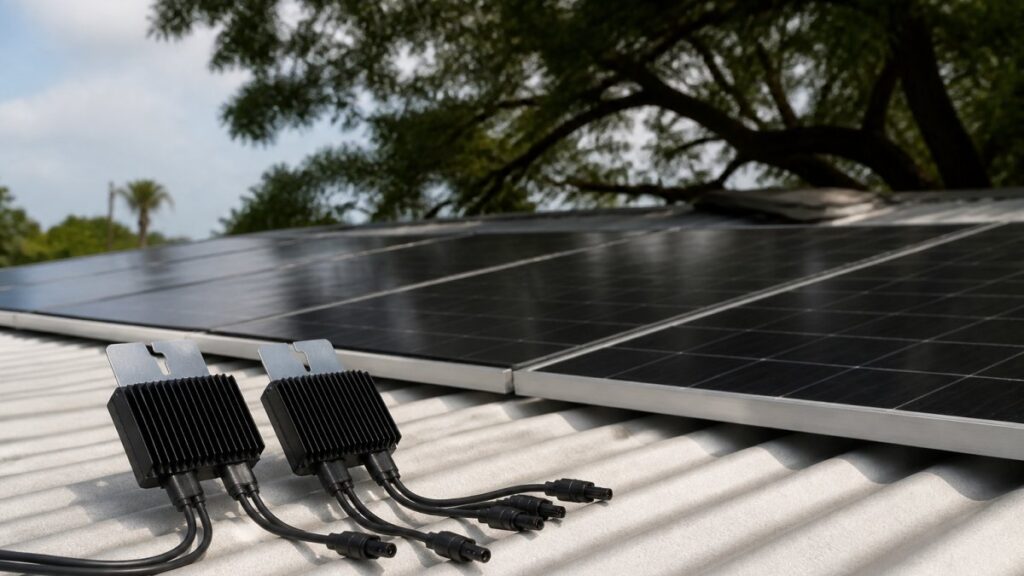
A solar panel optimiser is a module-level power electronic device that performs maximum power point tracking on each individual panel, then passes conditioned DC power to the string inverter. Ensuring these devices integrate seamlessly with your system requires a careful review of solar inverter specifications to confirm that voltage and current limits remain within the manufacturer’s recommended operating range.
DC Power Optimisers and Maximum Power Point Tracking
Each DC power optimizer runs its own MPPT routine, continuously adjusting panel voltage and current to extract the most DC power available, then converts that output to a fixed string voltage so the inverter sees a stable array. Compared with string-level MPPT, which finds one compromise operating point for the whole array, module-level tracking removes the mismatch penalty between panels.
Panel-Level Monitoring and Fault Detection
Most optimiser systems report per-panel data, turning fault detection into a dashboard: if one panel underperforms, you see it by panel rather than by string. For complex roofs with multiple orientations, this visibility is genuinely useful. But monitoring is a diagnostic convenience, not an energy-saving feature, you are paying for the tracking, and the monitoring comes along for the ride.
Solar Optimisers for Partial Shade: Measured Scenarios and Expected Energy Impact
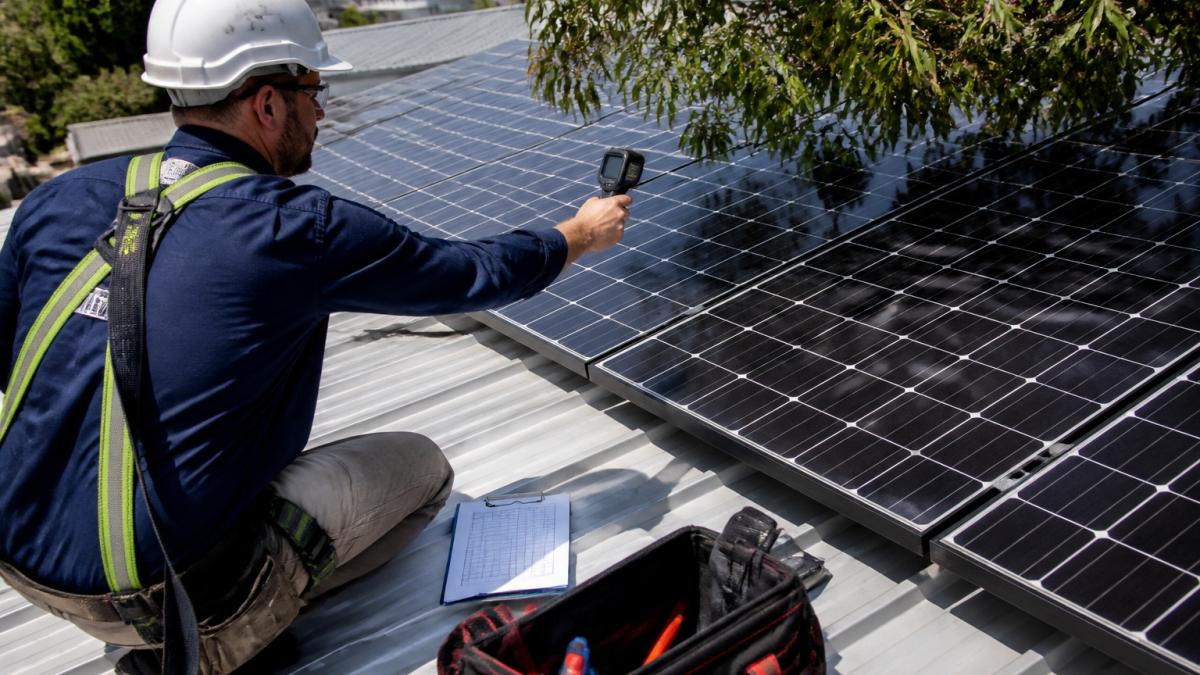
Most guides tell you optimisers “help with shade” and stop there, which is not useful when you are deciding whether to spend money on them. What follows is a scenario framework you can apply to your own roof, with assumptions stated openly.
How to Read These Scenarios
The “recoverable loss” column estimates the share of the shaded panel’s theoretical output that module-level tracking can realistically recover compared with a plain string.
Scenario 1: Chimney Shadow, Two Hours Each Morning
A chimney casts a hard-edged shadow that sweeps across one or two panels between roughly 8am and 10am. Because the shadow moves, the mismatch changes minute by minute, and a string inverter’s single MPPT is constantly chasing a compromise point.
- Shade type: partial, predictable, moving
- Panels affected: one or two
- Recoverable loss: commonly half to two-thirds of the shaded panels’ lost output during the shadow window
Scenario 2: Deciduous Tree, Seasonal Variation
A tree that loses its leaves in winter produces heavy shade in summer and light, branch-patterned shade in winter, the scenario where a single annual estimate misleads most.
- Shade type: partial, seasonal, branch-patterned
- Panels affected: two to four, varying by season
- Recoverable loss: higher in leaf-on months, lower in winter; commonly meaningful recovery for roughly half the year and little for the rest
Scenario 3: Dormer or Roof Feature, Fixed Partial Shade
A dormer, vent or satellite dish casts a fixed shadow on part of one panel for a predictable window each day. The loss is stable, which makes it easier to model but no less real.
- Shade type: partial, fixed, daily
- Panels affected: usually one
- Recoverable loss: moderate; fixed geometry means consistent bypass diode behaviour, and module-level tracking recovers a reliable share of the affected panel’s output
Scenario 4: Morning or Afternoon Shade from a Neighbouring Building
A neighbouring building shades the array for the first or last hour or two of the day, the most commonly overstated case.
- Shade type: partial, time-of-day, persistent across the year
- Panels affected: a whole row or plane
- Recoverable loss: low in energy terms, because early-morning and late-afternoon generation is a small share of the daily total
Scenario 5: Full or Persistent Shade
A panel under a permanent building shadow or a dense evergreen canopy receives little or no direct sun for most of the day.
- Shade type: full or near-full, persistent
- Panels affected: one or more
- Recoverable loss: effectively zero, no electronics can manufacture sunlight that never arrives
These scenarios are illustrative. A shadow that looks minor on a phone photo can cost more than expected because of how bypass diodes divide a panel into sections, and a shadow that looks severe can fall outside peak generation hours. Always base a purchase decision on a measured shade assessment, not on a generic percentage.
What the Scenarios Tell You Together
The pattern across all five cases is consistent: optimisers recover the most energy when shade is partial, moving and falls during peak-generation hours, and the least when shade is fixed, brief or outside peak hours, a more useful decision rule than any single headline number. For low-light conditions that compound the problem, our guide to advanced solar panel technologies for low light explains how panel design itself can help.
Microinverters vs Optimisers: Which Handles a Shaded Roof Better?
Both solve mismatch, but differently. Microinverters convert DC to AC at each panel, giving true independent panel operation with no string mismatch at all. Optimisers keep DC on the roof and hand a clean, fixed voltage to a central string inverter.
| Approach | Handles Partial Shade | Best For | Main Trade-off |
|---|---|---|---|
| String inverter only | Poorly | Unshaded, simple roofs | Whole-string mismatch losses |
| DC optimisers | Well | Some shaded panels, complex layouts | More roof-mounted components |
| Microinverters | Very well | Heavy shade, many orientations | Higher per-panel cost |
If shading or orientation is your main worry, our AP Systems microinverters page shows the module-level alternative we supply for exactly these roofs.
Solar Panel Optimisers Cost: What Drives the Price and Payback
Most articles on this topic either quote a single per-unit figure that dates within months or refuse to discuss money at all. Neither helps you decide. What follows is the cost structure and payback logic, so you can plug in your own quote and electricity price.
What You Are Actually Paying For
An optimiser system is not one product; it is a set of costs that scale with your array:
- Per-panel hardware: one optimiser unit per panel, priced per unit and varying by platform and power rating
- Communication and monitoring: a gateway or monitoring unit, often one per system, plus any app or portal subscription if the platform charges one
- Inverter compatibility: some inverters require a specific optimiser platform, which can limit your choice and affect total cost
Because each of these varies by project, a per-project quote is more honest than a published figure. Ask any installer for a line-by-line breakdown against a plain-string alternative so you can see the true incremental cost.
The Payback Question, Stated Properly
The economics rest on one comparison: the incremental upfront cost of optimisers versus the value of the energy they recover over the system’s life. That comparison has four inputs:
- Incremental cost, the optimiser quote minus the plain-string quote for the same array
- Recovered energy, the additional kilowatt-hours per year, which depends on your shade pattern (see the scenarios above)
- Value per kilowatt-hour, your retail electricity price for self-consumed energy, or your feed-in tariff for exported energy, whichever applies to the recovered generation
- System life and degradation, the number of years over which you count the benefit, allowing for panel degradation and any hardware replacement
A simple payback is the incremental cost divided by the annual value of recovered energy. If that number is longer than you are comfortable with, or longer than the optimiser warranty, the case is weak.
Worked Logic, Not Invented Numbers
- If optimisers add a modest incremental cost per panel and recover a meaningful share of a heavily shaded panel’s output during peak hours, payback can fall within a reasonable portion of the system’s life.
- If the incremental cost is high and the recovered energy is small, the morning or afternoon building-shade case, payback stretches beyond the point where it makes sense.
- If shade is full and persistent, recovered energy is effectively zero and payback never arrives.
The sensitivity is dominated by two variables: how much energy is actually recovered, and what that energy is worth to you. A household that self-consumes most of its generation values recovered energy at the retail price; one that exports most of it values it at the feed-in tariff, typically much lower. That single difference can change the verdict on the same roof.
Lifetime Costs Beyond the Upfront Price
A fair comparison includes what happens after installation:
- Replacement risk: optimisers are roof-mounted electronics and may need replacement within the system’s life; check the warranty term and what it covers
- Service access: diagnosing a faulty unit means roof access, which has a cost
- Monitoring value: per-panel data can shorten fault-finding and catch underperformance early, which has real but hard-to-quantify value
Ask for two quotes for the same array: one with optimisers and one without. The difference is your true incremental cost, and it is the only figure that matters for the payback calculation. Then ask what annual energy the installer expects the optimisers to recover, and check that assumption against your shade assessment.
When the Numbers Say Skip Them
The honest conclusion is that optimisers are an economic decision, not a default. On a heavily and partially shaded roof, the recovered energy can justify the cost. On a lightly shaded roof, or one shaded mainly outside peak hours, it often cannot. To model your own numbers, our solar payback period calculator walks through the factors step by step.
When to Use Solar DC Optimisers (and When to Skip Them)
Use solar DC optimisers when shade is partial, intermittent, or uneven across the array, and when panels face different directions or sit at different pitches. Before committing, check whether your roof type and layout make optimisers worthwhile at all; our guide to roof type and solar installation covers the structural side in detail.
Complex Roof Layouts and Multiple Orientations
Complex roof layouts are where module-level electronics earn their reputation. When panels face north, east and west across several planes, a single string-level MPPT cannot optimise them all. Module-level tracking lets each panel chase its own maximum, which is why multiple roof orientations are a classic optimiser use case.
Compatibility, Design Limits and Safety Before You Buy
Compatibility is where good intentions meet paperwork. Optimisers must match the inverter’s supported voltage range and communication protocol, and each unit has a maximum input power and current rating that must suit your panels. Safety matters too: Installation must follow the relevant Australian standards and local requirements.
Book a Shade Assessment Before You Commit to Optimisers
The most valuable step in choosing the best solar panel optimizers for shaded roofs happens before any hardware is ordered: a proper shade assessment. Our team at Solazone Australia, with more than 40 years of technical expertise, can help you assess your roof and choose the right equipment. If you want realistic expectations first, read our solar installation timeline guide.
Frequently Asked Questions
Are solar panel optimisers worth it for a shaded roof?
They can be, but only when shade is intermittent or partial and the rest of the array performs well. Optimisers let each panel operate independently, so a shaded module does not drag down the string. On a roof with heavy, persistent shade from a fixed obstruction, the returns shrink and the money may be better spent on repositioning panels or trimming trees. Ask for a shade assessment with modelled yield before committing.
Do solar optimisers improve output when panels are shaded?
Yes, in partial shade. Without panel-level optimisation, a shaded module can cut the output of every panel on its string through mismatch losses. Optimisers use maximum power point tracking at the module level so unshaded panels keep producing near their full capacity. The gain depends on how much shade falls, when it falls, and how the strings are wired. Expect the biggest benefit from chimneys, vents and moving tree shadows rather than solid all-day shade.
Are microinverters or optimisers better for a partially shaded roof?
Both solve the same mismatch problem, so the choice comes down to design. Microinverters convert DC to AC at each panel and suit complex roofs with multiple orientations, but they cost more per panel and put electronics on the roof. Optimisers keep a central string inverter and add module-level tracking and monitoring, which is often simpler to service. Compare warranty terms, inverter compatibility and fault detection before deciding.
How much do solar DC optimisers cost?
Solar panel optimisers cost varies with the number of panels, the brand, and whether monitoring hardware is included. Pricing depends on system size, roof access and delivery, so there is no single figure that fits every home. Ask your installer for a line-by-line quote showing optimiser cost separately from panels, inverter and labour, and check what the payback period looks like under your actual shade profile rather than a generic estimate.
Shade on a roof is a solvable design problem, not a reason to walk away from solar. The challenge is choosing the right fix for your specific shade pattern rather than guessing. Solazone Australia brings over 40 years of technical expertise, personalised customer service, and experienced installation teams to every assessment, so the recommendation fits your roof and your budget. Get started with Solazone Australia and turn a shaded roof into a system that still performs.
