
Table of Contents
- Why Choosing the Right Solar Installer Matters More Than the Hardware
- What a Clean Energy Council Accredited Solar Installer Actually Means for Your System
- The Benefits of Australian-Made Solar Panels and Why They Suit Local Conditions
- Your Solar Installation Checklist: What to Verify Before You Sign
- Red Flags in Solar Sales Tactics and Quotations
- Understanding System Design, Shading, and Roof Suitability
- What Happens After Installation: Monitoring, Maintenance, and Warranty Support
- Frequently Asked Questions
Last Updated: October 2, 2026
Why Choosing the Right Solar Installer Matters More Than the Hardware
Choosing the right solar installer for Australian products matters more than the brand of panel on your roof. This guide from Solazone Australia explains how to pick an installer who designs, installs and supports your system properly for years to come.
The panels are the easy part. Almost every modern panel performs well on paper.
A common mistake is treating quotes as a pure price contest. The cheapest quote often hides shortcuts in system design, cheaper mounting hardware or no real after-sales support.
Below, we break down exactly how to check credentials, read a quotation and avoid the sales traps. We also cover what happens after installation, which most guides ignore.
What a Clean Energy Council Accredited Solar Installer Actually Means for Your System
A Clean Energy Council accredited solar installer is a tradesperson who has met the national industry standard for solar design and installation.
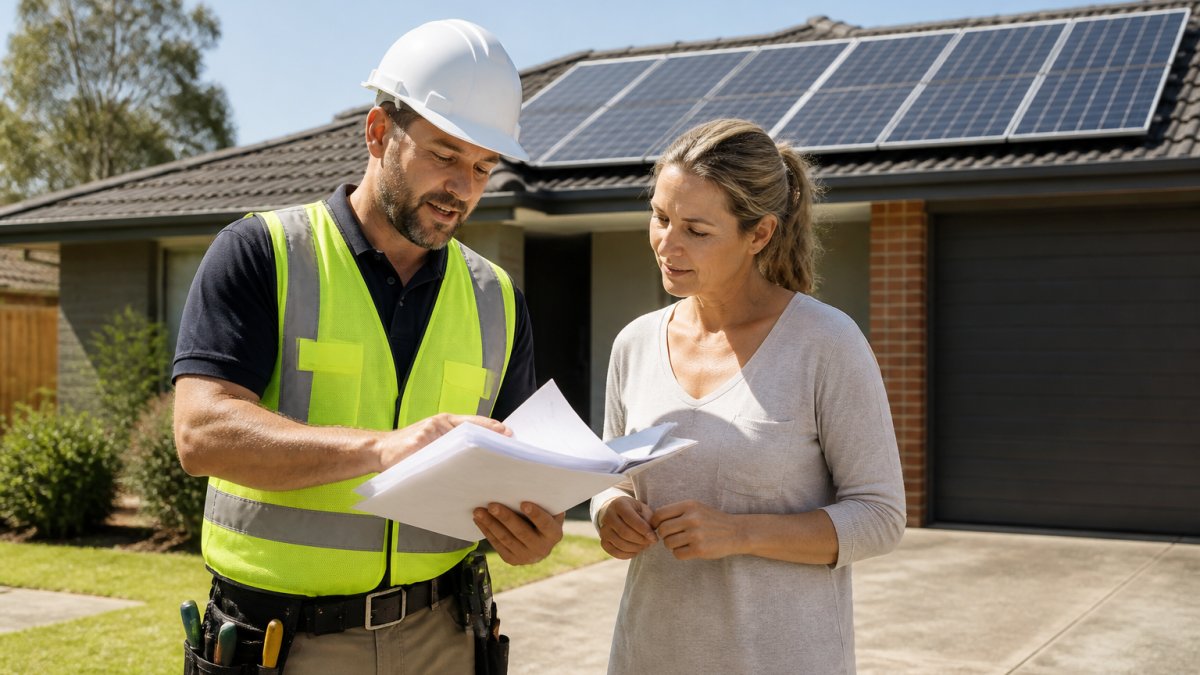
The Clean Energy Council’s approved installer program sets out the training and competency requirements installers must meet. Accreditation covers design and install work.
Why does this matter? Because grid-connected solar must comply with Australian standards, including AS/NZS 5033 for installation and electrical safety rules.
Check that the accreditation covers both design and installation, not just one. Also confirm it is current, not expired.
The Benefits of Australian-Made Solar Panels and Why They Suit Local Conditions
Australian-made solar panels are built and tested for the conditions they will actually face here: harsh UV, high summer heat and coastal salt air. That local fit is the real benefit, not just a marketing line, but it only matters if you understand why it matters and how to verify it.
Heat is the enemy of panel output. Panels lose efficiency as their temperature rises above the standard test condition of 25°C, and roof temperatures routinely climb 20-30°C above air temperature on a still summer day.
Testing and certification matter more than the flag on the box. Any panel sold and installed in a grid-connected system here must carry the relevant certification and appear on the Clean Energy Council’s approved products list to be eligible for STCs (Products). What separates a genuinely locally-suited panel is how it performs under the IEC 61215 (design qualification) and IEC 61730 (safety) test regimes, plus how the manufacturer handles salt-mist corrosion and potential-induced degradation (PID), both real risks in coastal and humid regions.
The support chain is the underrated advantage. When something fails, the question is who pays for the replacement, who climbs the roof, and how long the part takes to arrive.
The honest caveat. Australian-made is not automatically better than every imported option. Some imported panels use the same cells and pass the same tests.
Ask for the panel’s temperature coefficient, its product warranty length, and its performance guarantee (the guaranteed output at year 25). Three numbers, three datasheets, no sales pitch.
This is also where the installer-versus-brand distinction bites. A premium panel integrated poorly, wrong string sizing, mismatched inverter, poor ventilation behind the array, will underperform a mid-tier panel installed correctly. The installer’s competence is the multiplier on whatever hardware you choose. Technical precision remains just as critical when calculating the necessary solar generator sizing to ensure your backup system maintains the same level of efficiency as your primary rooftop array.
Your Solar Installation Checklist: What to Verify Before You Sign
A solar installation checklist keeps you focused on what actually matters before you commit. Use this one to compare installers on substance, not just price.
- Confirm current Clean Energy Council accreditation for design and install
- Ask for the licence number of the qualified electrician doing the work
- Request a full site assessment, not a quote from a satellite photo
- Check the shading analysis covers winter sun, not just summer
- Confirm the system sizing matches your energy consumption profile
- Ask how solar rebates and STCs are handled in the quote
- Read the workmanship warranty and performance guarantee in writing
- Confirm who handles after-sales support and system monitoring
- Check the feed-in tariff assumptions used in the payback estimate
- Ask what happens if your usage does not drop as projected
Run every quote through this list. The installer who answers all ten clearly is the one worth your money.
A quote built from a satellite image without a site visit is a red flag. Roof condition, shading and wiring routes can all change the design, and a remote quote often means surprises later.
Red Flags in Solar Sales Tactics and Quotations
Pushy sales tactics are the clearest warning sign in this industry. If a quote creates pressure to sign today, walk away and get another one. But the tactics have become more sophisticated than the obvious door-knock, so here is what to actually watch for, and what to say when you see it.
The specific tactics to recognise:
- The expiring discount. “Sign before the end of the month and we’ll take $1,500 off.” The deadline is manufactured. STC values and rebate eligibility do not vanish overnight for a residential system, and a genuine price does not need a countdown timer.
- The satellite-only quote. A proposal generated from an aerial image with no site visit. Roof condition, shading, rafter spacing and cable routes can all change the design, and the price, once someone actually looks.
- The rebate-as-discount switch. The quote shows a large “discount” that is actually the value of the federal STC incentive you are already entitled to. You are not being given anything; the incentive is being dressed up as a favour.
- The inflated payback. A payback estimate that assumes a feed-in tariff well above what your retailer currently offers, or assumes you export most of your generation. Most households self-consume a large share of what they produce, and feed-in rates have fallen sharply over the past decade.
- The subcontracted install. The salesperson is not the installer, and the installer is a crew you have never met. Ask who physically does the work and whether they are directly employed or contracted.
- The deposit pressure. A demand for a large upfront deposit before any design work is done. A reasonable deposit covers materials; it should not be most of the contract value.
- The warranty hand-wave. Verbal assurances about a “25-year warranty” with nothing in writing distinguishing the panel product warranty, the inverter warranty and the installer’s own workmanship warranty.
How to push back. You do not need to be confrontational. Three sentences do most of the work:
- “I don’t sign on the first visit. Send me the full proposal in writing and I’ll come back to you.”
- “Can you show me the STC calculation separately from your price?”
- “Who is the licensed electrician signing off the install, and what is their licence number?”
A trustworthy installer will answer all three without hesitation. An installer who gets defensive, repeats the deadline, or dodges the electrician question has told you everything you need to know.
Ask each installer the same three questions and compare the answers side by side: What is my projected payback and why? Who does the electrical work? What is covered after installation? The gaps in their answers tell you more than the quote total.
The pattern behind every red flag is the same: pressure replaces information. When a sales process is designed to stop you comparing, it is usually because comparison would not favour them.
Understanding System Design, Shading, and Roof Suitability
System design is where good installers earn their fee.
Shading is the biggest factor most homeowners underestimate.
Roof suitability matters just as much. Older roofs, complex layouts and structural quirks need real engineering, not a standard package dropped on top.
System sizing should follow your energy consumption profile. An oversized system wastes money, while an undersized one leaves savings on the table.
| Design factor | What to check | Why it matters |
|---|---|---|
| Shading | Full-day and seasonal analysis | Shade cuts output across a string |
| Roof condition | Age, structure, orientation | Affects mounting and safety |
| System sizing | Matched to usage profile | Avoids waste or shortfall |
| Inverter choice | Efficiency and warranty | Core of system performance |
What Happens After Installation: Monitoring, Maintenance, and Warranty Support
After-sales support is where most solar guides stop, and it is where the real difference shows. A system needs monitoring and occasional maintenance to keep performing.
System monitoring lets you spot problems early. If output drops, you want to know before your next bill does.
Maintenance is usually light but not zero. Panels need occasional cleaning in dusty or coastal areas, and connections should be checked over time.
Warranty support is the test of whether your installer will still be there in ten years. Ask for the workmanship warranty in writing and confirm who honours it.
The best installer is the one still answering the phone years later. Check the workmanship warranty and after-sales process before you sign, not after something goes wrong.
Frequently Asked Questions
How do I verify if a solar installer is Clean Energy Council accredited?
Check the Clean Energy Council’s online installer database. Search the company name or individual installer’s name. Accreditation must be current, not expired. Ask for the accreditation number and verify it yourself rather than trusting a logo on a quote. An accredited installer can process STCs and rebates on your behalf, which reduces your upfront cost. If they cannot provide a valid accreditation number, walk away. This single check protects your eligibility for government incentives and confirms the installer meets industry standards.
What questions should I ask a solar installer before signing a contract?
Ask for their Clean Energy Council accreditation number, proof of insurance, and a detailed written quotation that separates hardware costs from labour. Request the expected system output in kilowatt-hours per day, not just the panel wattage. Ask who handles warranty claims and how long the workmanship warranty lasts. Confirm whether they use subcontractors and if those subcontractors hold the required electrical licences. A reputable installer answers these without hesitation and provides everything in writing before you commit.
What is the 20% rule for solar and how does it affect my system size?
The 20% rule relates to inverter capacity limits on grid-connected solar. Many networks restrict inverter size to 20% above the panel array’s rated output, or cap exports to 5kW per phase. This affects how much you can export and earn through feed-in tariffs. A good installer designs your system around your energy consumption profile and your network’s specific rules, not just maximum panel count. Ask them to explain the export limit for your address before finalising the design.
What are the risks of choosing an inexperienced solar installer?
Poor workmanship causes roof leaks, electrical faults, and system underperformance. An inexperienced installer may skip shading analysis, undersize cabling, or install panels in positions that void manufacturer warranties. They may also disappear before honouring workmanship guarantees. Compliance with AS/NZS 5033 is mandatory, and non-compliant installations can fail inspection, leaving you liable for remediation costs. Choosing an installer with a proven track record and verifiable references reduces these risks significantly.
Picking a solar installer is a decision you live with for decades, and it is easy to get wrong when price is the only filter. Solazone Australia brings more than 40 years of technical expertise, a focus on Australian-made systems and personalised service to every project. Our experienced installation teams handle design, installation and ongoing support so your system keeps delivering. Get started with Solazone Australia and choose an installer who will still be there when you need them.