
Table of Contents
- Solar Panel Efficiency Comparison 2026: The Modules That Matter
- How Conversion Efficiency Is Calculated
- Why Cell Architecture (TOPCon, PERC, ABC) Decides Real-World Output
- Monocrystalline vs Bifacial Solar Panels: Which Suits Your Roof?
- Solar Panel Degradation Rates and Temperature Coefficients Compared
- Cost of High-Efficiency Solar Panels: Is the Premium Worth It?
- Efficiency vs Climate: How Heat, Humidity and Hail Change the Ranking
- Inverter Compatibility and Maintenance: The Efficiency Factors Most Buyers Miss
- Conclusion
- Frequently Asked Questions
Last Updated: September 22, 2026
Solar Panel Efficiency Comparison 2026: The Modules That Matter
Solar panel efficiency is the percentage of sunlight a module converts into usable electricity under standard test conditions. In 2026, that figure ranges from roughly 21% to 25% across the mainstream and premium end of the market, and the gap between those numbers decides how much power you get from the roof you actually have. This comparison from Solazone Australia cuts through the marketing claims and looks at what each cell architecture delivers once the panels leave the lab.
The headline numbers hide the real story. Two panels rated at 23% can behave very differently on a 38°C afternoon, or after twelve years of UV exposure. Conversion efficiency is only the starting point.
Below, we break down how efficiency is calculated, how TOPCon, PERC and ABC architectures compare, and which modules suit which roof, climate and budget.
How Conversion Efficiency Is Calculated
Conversion efficiency is calculated by dividing a module’s power output by the total solar energy hitting its surface, measured under Standard Test Conditions (STC): 1,000 W/m² irradiance, 25°C cell temperature, and a defined air mass.
A 440 W panel measuring 1.96 m² on a 1,000 W/m² test bed works out to roughly 22.4% module efficiency. That is the number on the spec sheet.
STC ratings assume a cell temperature of 25°C. Real rooftops run far hotter, so a panel rated at 440 W may deliver noticeably less on a still summer day. Always check the temperature coefficient, not just the wattage.
Why Cell Architecture (TOPCon, PERC, ABC) Decides Real-World Output
Three architectures dominate the 2026 market, and each trades off differently.
PERC (Passivated Emitter and Rear Contact) adds a passivation layer to the rear of a p-type cell to reduce electron loss. It is mature, cheap and reliable, with module efficiency typically in the low 20s.
TOPCon (Tunnel Oxide Passivated Contact) uses an ultra-thin tunnel oxide layer on an n-type silicon wafer. It handles heat better and degrades more slowly than PERC, which matters in hot climates.
ABC (All Back Contact) moves all the busbars to the rear of the cell, eliminating front-side shading and lifting conversion efficiency toward 24-25% in current models. It costs more.
Monocrystalline vs Bifacial Solar Panels: Which Suits Your Roof?
The choice between monocrystalline and bifacial modules comes down to mounting conditions. Monocrystalline panels absorb light from the front only. Bifacial panels also capture reflected irradiance on the rear face, adding energy yield when the mounting allows it.
Bifacial gain requires space and reflectivity. Ground mounts, flat commercial roofs and light-coloured surfaces deliver meaningful uplift. A pitched residential roof sitting 10 cm above dark tiles will not.
| Module Type | Typical Efficiency | Best Mounting | Bifacial Gain |
|---|---|---|---|
| Monocrystalline PERC | 21-22% | Pitched residential roofs | None |
| Monocrystalline TOPCon | 22-23.5% | Most rooftops | None |
| Bifacial TOPCon | 22-23.5% | Ground mounts, flat roofs | Moderate |
| ABC (back contact) | 24-25% | Space-constrained roofs | None |
For most homeowners with a standard pitched roof, a high-efficiency monocrystalline panel beats a bifacial one. The rear-side gain never materialises.
Solar Panel Degradation Rates and Temperature Coefficients Compared
Degradation rate describes how much power a panel loses each year. Temperature coefficient describes how much output drops as the cell heats up. Both matter more than the headline efficiency figure over a 25-year system life.
Premium n-type modules (TOPCon, ABC) typically carry lower annual degradation than older p-type PERC panels. The difference compounds: a slightly lower degradation rate on a 10 kW system adds up to meaningful kilowatt-hours over two decades.
Temperature coefficient works the same way. A panel with a stronger (less negative) coefficient holds more of its rated output on a hot day. In warmer regions, this single spec can outweigh a one-point efficiency advantage.
Ask your installer for the temperature coefficient in %/°C, not just the efficiency rating. Two panels with identical efficiency can differ by several percentage points of real output at 45°C cell temperature.
Cost of High-Efficiency Solar Panels: Is the Premium Worth It?
High-efficiency modules carry a higher price per watt, but the premium only pays off in specific situations. The useful way to judge it is not the sticker price of the panel, it is the cost per kilowatt-hour delivered over the system’s life, against the roof area you actually have.
A common pattern in the current market is a premium of roughly 10-25% per watt for a top-tier n-type module (TOPCon or back-contact) over a standard p-type PERC panel of similar physical size. That premium buys you more watts per square metre, not more watts per dollar.
The decision therefore turns on one question: is roof area your binding constraint?
If roof area is effectively unlimited, a mid-efficiency module usually wins on return on investment. You install more panels to reach your target system size, and the lower cost per watt dominates. The extra racking and labour are modest compared with the panel premium.
If roof area is tight, shaded, or partly unusable, higher efficiency is often the only way to hit your target system size at all.
| Approach | Module efficiency | Approx. panels needed | Roof area used | Relative panel cost |
|---|---|---|---|---|
| Standard PERC | ~21-22% | More panels | Larger | Lower per watt |
| High-efficiency n-type | ~23-24% | Fewer panels | Smaller | Higher per watt |
Ask for two quotes at the same target system size, one with standard modules and one with high-efficiency modules. Comparing cost per watt at the system level, not the panel level, is the only fair test of whether the premium is worth it for your roof.
Efficiency vs Climate: How Heat, Humidity and Hail Change the Ranking
Most efficiency comparisons rank panels on a lab bench at 25°C. In the field, climate reshuffles that ranking, and the effect is large enough to overturn a one-point efficiency advantage. This is the angle most guides skip, so it is worth working through properly.
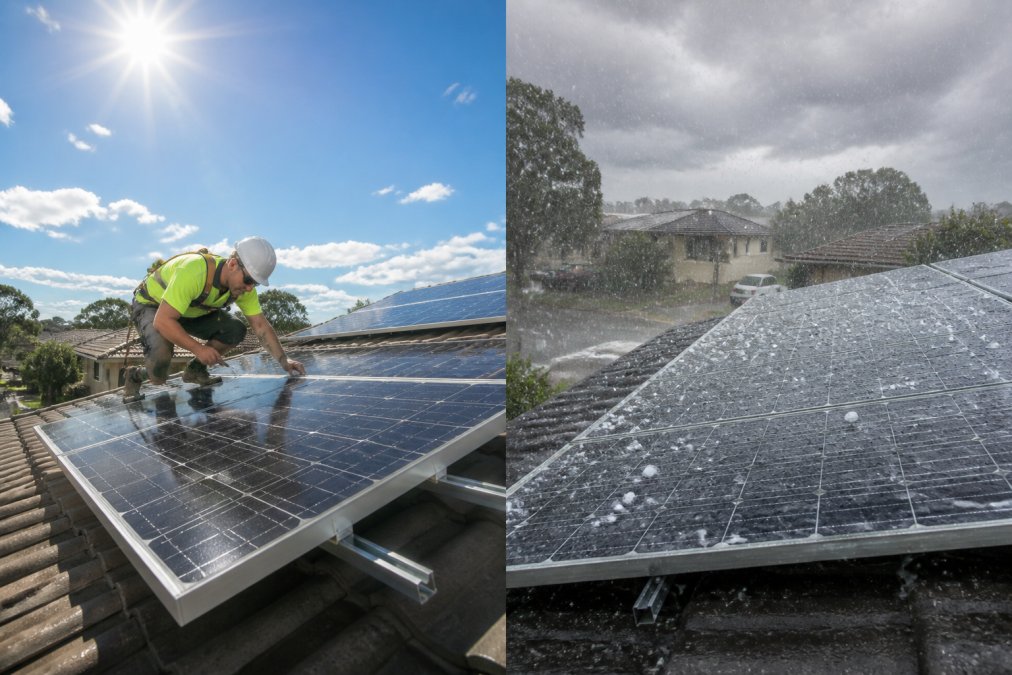
Why temperature coefficient matters more than headline efficiency
Cell temperature on a working roof routinely runs 20-35°C above ambient. On a 38°C day, cell temperatures of 60-70°C are common. Every panel loses output as it heats, but the rate of loss differs.
Climate-zone expectations
Different regions stress panels in different ways. The practical implications break down roughly as follows:
| Climate stress | What it does to output | What to prioritise |
|---|---|---|
| Sustained high heat | Lifts cell temperature well above STC; weak coefficients lose most | Strong (less negative) temperature coefficient; n-type architecture |
| Coastal humidity and salt | Corrodes frames, junction boxes and connectors over time | Certified corrosion resistance; quality mounting hardware |
| Hail exposure | Physical impact can crack cells or glass | Modules with certified impact resistance |
| Dust and dry conditions | Soiling reduces irradiance reaching the cells | Cleaning access; soiling-tolerant design |
The compounding effect over 25 years
Climate stress does not act once, it acts every day for the life of the system. A panel running hotter and degrading faster loses ground year on year. Two modules that start within half a point of each other can diverge meaningfully by year 15 once heat-driven degradation compounds.
In a hot climate, the best panel is not the one with the highest lab efficiency, it is the one that holds the most of its rated output at 65°C cell temperature and loses the least each year. Match the module to your climate, not to the leaderboard.
Inverter Compatibility and Maintenance: The Efficiency Factors Most Buyers Miss
Inverter compatibility and maintenance quietly decide whether a high-efficiency array performs to spec. A mismatched inverter clips output, and dirty or shaded panels drag down the whole string.
The best module on paper is only as good as its match to your inverter, mounting and climate. Efficiency is a system property, not a panel property.
Conclusion
Getting the most from a solar investment means looking past the efficiency badge and matching cell architecture, temperature coefficient and inverter to your actual roof and climate. Solazone Australia brings more than 40 years of technical expertise, Australian-made system options, and experienced installation teams to every project, with personalised service from quote through to commissioning. Get started with Solazone Australia and build a system sized to your roof, your climate and your energy goals.
Frequently Asked Questions
What are the most efficient solar panels in 2026?
The highest efficiency ratings in 2026 come from N-type ABC and back-contact modules, with several models reaching 24-25% conversion efficiency. TOPCon and HPBC modules sit just below that band, typically 22-23.5%. Higher efficiency means more power output from the same roof area, which matters most when space is limited. Ask your installer for the module datasheet and confirm the efficiency figure is measured under standard test conditions, not a marketing peak.
Do higher efficiency ratings always mean better value for money?
No. A 24% module can cost noticeably more per watt than a 22% module, and if you have plenty of unshaded roof space, the extra efficiency may not deliver enough additional energy yield to justify the premium. Work out the cost per watt and the projected annual output for your roof, then compare that against the payback period. For most homes, a mid-to-high efficiency module paired with good system sizing beats chasing the single highest rating.
How do Australian weather conditions affect solar panel efficiency?
Heat is the main factor. Panel output drops as cell temperature rises above 25°C, and the temperature coefficient on the datasheet tells you how much. A module rated -0.30%/°C loses less output on a 40°C day than one rated -0.35%/°C. Humidity, salt air and dust also reduce performance over time, so weather resistance and cleaning matter. Hail-prone areas need modules with certified impact resistance, and coastal installs benefit from corrosion-resistant frames and mounting.
What is the difference between monocrystalline and bifacial panel efficiency?
Monocrystalline panels generate power from the front face only, while bifacial panels also capture reflected light on the rear. That rear gain can add roughly 5-20% more energy yield depending on the surface beneath, the mounting height and how much light bounces back. On a pitched roof with little clearance, bifacial gain is minimal. On ground mounts, flat roofs or light-coloured surfaces, the extra harvest can be worthwhile, but it depends on the specific site.