
Table of Contents
- How Solar Roof Ventilation Works
- Key Benefits of Solar Roof Ventilation
- Solar Roof Vent vs Whirlybird Comparison
- How Solar Roof Fans Reduce Energy Bills
- Solar Ventilators for Damp Subfloors: Moisture Control
- Installation, Maintenance, and Climate Suitability
- ROI and Payback Period for Solar Ventilation Systems
- Conclusion
Last Updated: August 25, 2026
How Solar Roof Ventilation Works
Solar roof ventilation harnesses the sun’s energy to power a motorised fan that removes hot air and moisture from your roof cavity and subfloor spaces. As the sun heats your roof, a temperature sensor triggers the solar-powered fan to activate, drawing hot, humid air from the roof cavity and expelling it outside whilst drawing cooler air in through intake vents. This active thermal regulation reduces the temperature differential between your roof space and living areas, cutting the workload on your air conditioning system.
The system operates at zero running cost because it relies on solar power alone, with no mains electricity draw, no monthly energy bills, and no complex wiring. The photovoltaic panel generates power proportional to sunlight intensity, meaning the system works hardest during the hottest part of the day when your roof cavity needs it most.
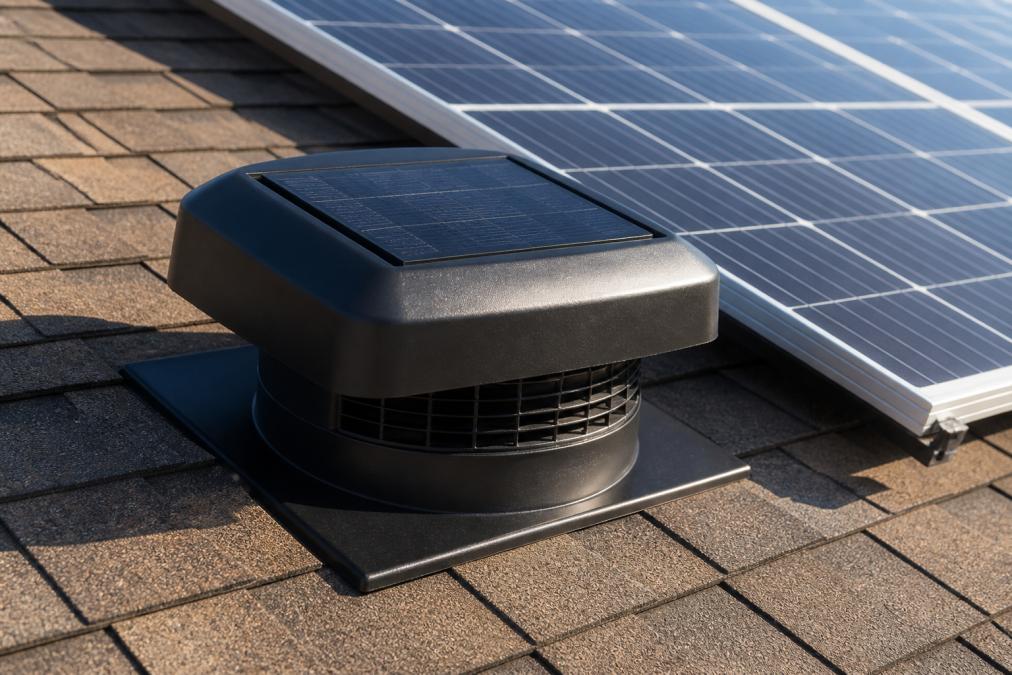
Solazone Australia has installed thousands of solar roof ventilation systems across residential and commercial properties. Active solar-powered ventilation achieves the air circulation and heat transfer rates needed to make a measurable difference in comfort and energy efficiency, whereas passive ventilation alone cannot extract moisture and heat fast enough during peak summer conditions.
Key Benefits of Solar Roof Ventilation
Solar roof ventilation benefits span energy efficiency, indoor air quality, structural protection, and long-term cost savings. The primary advantage is reduced roof cavity temperature: during summer, roof cavities can reach 60-70°C without active ventilation; solar roof vents typically reduce this to 40-45°C, meaning your air conditioning doesn’t have to work as hard to maintain comfortable indoor temperatures (peer-reviewed research).
The second major benefit is moisture extraction and mould prevention. Active ventilation removes moisture before it accumulates, maintaining humidity levels that inhibit mould colonisation (the CDC). This is particularly valuable in coastal and high-rainfall regions where ambient humidity is naturally elevated.
A third benefit is extended roof lifespan and structural integrity. Lower cavity temperatures reduce thermal stress on roof materials, and dry conditions prevent timber rot and insect damage. Energy efficiency improvements are real but context-dependent: homes with poor insulation see more dramatic cooling cost reductions, whilst homes with excellent insulation see modest improvements because insulation already limits heat transfer.
Solar Roof Vent vs Whirlybird Comparison
The comparison between solar roof vents and traditional whirlybirds reveals fundamental differences in airflow capacity, reliability, and suitability for different climates. A whirlybird is a passive ventilation device that spins when wind passes over it; a solar roof vent is an active system with a motorised fan powered by a photovoltaic panel (ashrae.org).
| Feature | Solar Roof Vent | Whirlybird |
|---|---|---|
| Power source | Solar panel (zero running cost) | Wind energy (passive) |
| Airflow capacity | 300-600 m³/hour (adjustable) | 100-200 m³/hour (wind-dependent) |
| Effectiveness on calm days | Excellent (sun still provides power) | Poor (no wind = minimal extraction) |
| Noise level | Minimal (quiet motor) | Moderate to high (spinning noise) |
| Maintenance | Annual cleaning of panel | Bearing lubrication, seasonal checks |
| Installation cost | Higher upfront | Lower upfront |
| Lifespan | 15-20 years | 10-15 years |
| Best for | Humid climates, high heat buildup | Breezy locations, supplementary ventilation |
Whirlybirds work reasonably well in naturally windy areas, but they’re unreliable during calm weather, precisely when you need ventilation most. Solar roof vents perform consistently regardless of wind conditions because they depend on solar radiation, not air movement. In calm, hot, humid conditions (common inland during summer), a solar roof vent will outperform a whirlybird significantly. Whirlybirds can produce noticeable spinning sounds, whilst solar roof vents operate quietly because the motor speed is controlled and the fan design minimises vibration.
How Solar Roof Fans Reduce Energy Bills
Solar roof ventilation benefits directly translate to lower energy bills by reducing the cooling load on your air conditioning system. When roof cavity temperature drops from 70°C to 45°C, your air conditioner doesn’t have to work as hard to maintain a comfortable 22°C indoors. The magnitude of savings depends on your current insulation quality, roof cavity size, local climate, and air conditioning usage. Homes in hot climates with poor insulation see reductions of 15-25% during summer months; homes with excellent insulation see 5-10% savings.
Active solar ventilation moves air at high velocity, continuously extracting heat and moisture, and operates in proportion to solar intensity, meaning it’s most active during the hottest part of the day. Another benefit is that solar roof fans reduce peak demand on your air conditioning system, extending equipment lifespan and reducing the risk of system failure during extreme heat events.
Solar Ventilators for Damp Subfloors: Moisture Control
Damp subfloors are common in coastal and high-rainfall regions. Moisture accumulates when warm, humid air enters the subfloor space and condenses on cooler surfaces, creating ideal conditions for mould, timber rot, and structural deterioration. Solar ventilators address this by establishing continuous air circulation that prevents moisture accumulation, maintaining relative humidity levels below the threshold where mould thrives (typically below 60%).
The advantage of solar-powered ventilation for subfloors is that it operates independently of external wind conditions. Installation typically involves ducting warm, humid air from the subfloor to roof-mounted solar vents, or installing dedicated solar ventilation units directly in subfloor access points. Professional assessment is essential because improper installation can create unintended air leaks or fail to address the moisture source.
In cool climates, condensation is a primary concern. If subfloor air is drawn directly outside during winter, the temperature drop can cause condensation inside the ducting. Solutions include insulating ducts, installing check valves to prevent reverse flow, or using thermostatic controls to stop the system during cold periods. ventilation upgrade services.
Installation, Maintenance, and Climate Suitability
Solar roof ventilation installation requires professional assessment of your roof structure, cavity dimensions, insulation type, and local climate conditions. Installation typically takes one to two days for a standard residential property and involves cutting vent openings, securing the solar vent assembly, installing ducting if required, and testing airflow capacity. Roof penetrations must be properly sealed to prevent water ingress.
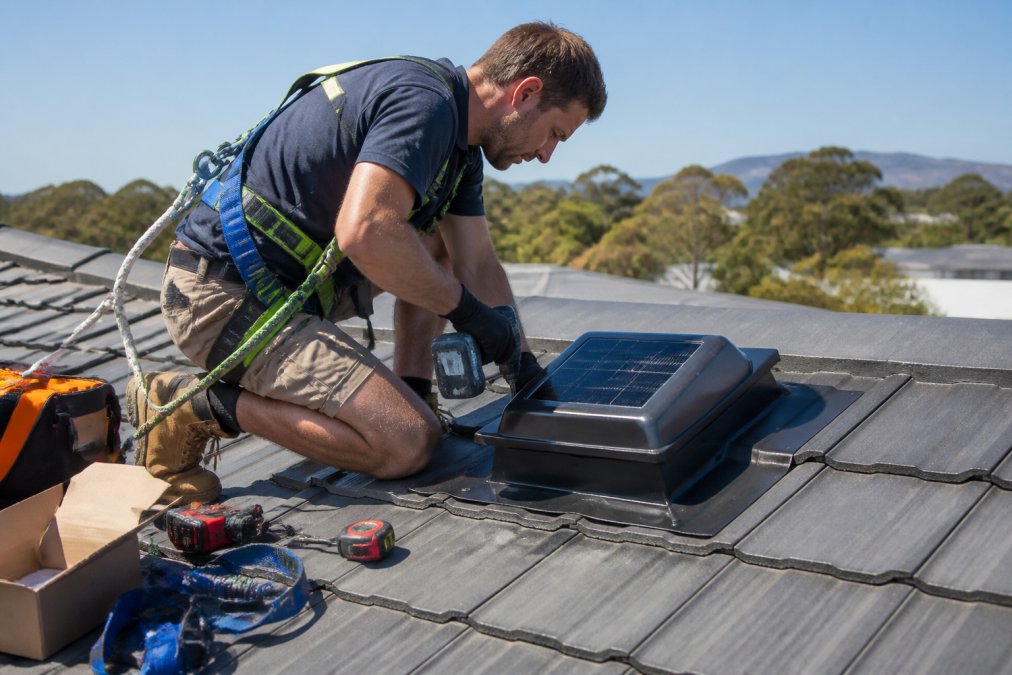
Maintenance is minimal but important. Annual cleaning of the photovoltaic panel ensures maximum solar absorption; dust and debris can reduce output by 10-20%. Motor bearings should be inspected annually, and ducting should be checked for blockages.
Solar roof ventilation works well in hot, humid climates where roof cavity temperatures are high and moisture problems are common. In cooler climates, it’s less critical for cooling but still valuable for moisture management. Sarking compatibility is important: solar roof ventilation works effectively with sarking because the vent draws air from the cavity above the sarking, where heat accumulates. Insulation type matters too; bulk insulation allows air circulation, whilst spray foam or closed-cell insulation restricts airflow.
ROI and Payback Period for Solar Ventilation Systems
Calculating return on investment requires understanding both direct energy savings and indirect cost avoidance. Direct savings come from reduced air conditioning consumption; indirect savings come from preventing mould remediation, structural repairs, and premature equipment replacement. A typical household in a hot climate might save 500-1,500 kWh annually, translating to a payback period of 8-15 years based on energy savings alone.
However, indirect savings often exceed direct energy savings. Preventing mould remediation (which costs $5,000-$20,000+ for serious infestations) and avoiding structural timber repairs (which can cost $10,000-$50,000+ for significant rot) justify the system investment many times over. The financial case strengthens for properties with existing moisture problems or high cooling costs. Homes already experiencing mould growth see payback in 3-5 years; homes in hot climates using air conditioning 8+ hours daily see payback in 6-10 years.
Solazone Australia recommends treating solar roof ventilation as a preventative investment rather than a pure energy-saving device. The energy savings are real and measurable, but the true value lies in protecting your home’s structure and avoiding expensive problems down the line.
Conclusion
Solar roof ventilation benefits extend far beyond simple energy savings. By actively managing roof cavity temperature, extracting moisture, and preventing mould growth, these systems protect your home’s structural integrity whilst reducing cooling costs and improving indoor air quality. The technology is proven, maintenance is minimal, and the long-term return on investment is strong, especially when you account for the cost of avoiding moisture-related damage.
If you’re experiencing roof heat buildup, damp subfloors, or rising air conditioning bills, solar roof ventilation is worth investigating. At Solazone Australia, our team has over 40 years of experience designing and installing solar ventilation systems tailored to your specific climate and property conditions. We’ll assess your home’s needs, calculate realistic energy savings, and ensure professional installation that protects your investment. Get started with a consultation today and discover how solar roof ventilation can improve your home’s comfort and durability.
Frequently Asked Questions
Q: Are solar roof ventilators worth the investment?
A: Yes, for most homes. Solar roof ventilation systems reduce roof cavity temperatures by 10-15°C during peak heat, lowering air conditioning strain and energy consumption. They prevent mould and moisture buildup without running costs, making them cost-effective over 10+ years. Payback depends on your climate, roof size, and current energy usage. Homes in warmer regions may see faster returns. Request a personalised quote to calculate your specific ROI based on your property and local electricity rates.
Q: How do solar roof vents compare to traditional whirlybirds?
A: Solar roof vents use photovoltaic panels to power active ventilation fans, extracting hot air and moisture continuously regardless of wind. Whirlybirds rely on wind and temperature differences (passive ventilation), so they're less effective on calm days or in enclosed roof cavities. Solar vents handle higher airflow capacity, reduce humidity more reliably, and work in various weather conditions. Whirlybirds are cheaper upfront but offer less consistent thermal regulation and moisture extraction. For damp subfloors or extreme heat, solar vents can deliver superior performance.
Q: Can solar roof ventilation prevent mould and moisture buildup?
A: Yes. Mould thrives in humid, stagnant environments. Solar roof vents extract moisture-laden air from roof cavities and subfloors, reducing humidity levels and preventing condensation. This active moisture extraction is especially effective in homes with poor air circulation or high ambient moisture. Combined with proper insulation and sarking, solar ventilation creates an environment hostile to mould growth. Regular maintenance, cleaning intake vents and checking airflow, keeps the system working at peak efficiency.
Q: How many solar roof vents do I need for my home?
A: The number depends on roof cavity volume, insulation type, climate, and existing ventilation. Larger homes, heavily insulated roofs, or humid climates typically need multiple units for adequate airflow capacity. A professional assessment evaluates your roof pitch, cavity dimensions, and thermal load to recommend the right configuration. Undersizing reduces effectiveness; oversizing wastes money. Solazone Australia provides personalised site surveys to determine your exact requirements and ensure optimal heat transfer and air circulation.
Q: Do solar roof vents help reduce air conditioning costs?
A: Absolutely. By reducing roof cavity temperature by 10-15°C, solar vents lower the thermal load on your home's cooling system. Your air conditioner runs less frequently and for shorter periods, cutting electricity consumption and operating costs. The savings are most dramatic in hot climates or during summer months when HVAC strain is highest. Combined with proper insulation, solar ventilation can reduce cooling costs, depending on your current system efficiency and usage patterns.
Q: What are the disadvantages of solar roof fans?
A: Initial installation costs are higher than passive vents, though zero running costs offset this over time. Some solar roof fans produce minor noise during operation, typically 30-40 decibels, comparable to a quiet refrigerator. They require occasional maintenance: clearing dust from panels and checking airflow. In very cold climates with minimal heat buildup, the ROI may be slower. Shading from trees or structures reduces photovoltaic panel efficiency. A professional site assessment identifies whether your property is suitable and what limitations apply to your specific situation.
Q: How do I calculate the payback period for solar roof ventilation?
A: Payback = system cost divided by annual energy savings. To estimate savings, calculate your current cooling costs during peak months, then project a reduction based on your climate and roof cavity size. Factor in zero running costs and minimal maintenance. Homes in warmer regions may see faster payback; cooler climates may take longer. Your electricity rate, roof size, existing insulation, and seasonal heat patterns all influence the calculation. Contact Solazone Australia for a detailed ROI analysis tailored to your property and local energy pricing.
Q: Are solar roof ventilation systems suitable for all climates?
A: Solar vents work best in warm, humid climates where heat buildup and moisture are significant concerns. Homes in tropical or subtropical regions may see the fastest ROI and greatest comfort improvements. In cooler climates, benefits are reduced but still valuable for moisture control and occasional summer cooling. Extreme cold can slow photovoltaic efficiency, though modern panels perform well even in overcast conditions. Climate-specific suitability depends on your roof pitch, insulation type, and local weather patterns. A professional assessment determines whether solar ventilation is right for your location and building characteristics.
This article was written using GrandRanker