
Table of Contents
- How Solar Roof Ventilation Works
- Benefits of Roof Ventilation for Australian Homes
- Solar Roof Vent vs Whirlybird: Which Performs Better
- Installation Process and Requirements for Solar Roof Ventilation
- Solar Roof Vent Installation Cost and ROI Analysis
- Smart Home Integration and Modern Features
- Is Solar Roof Ventilation Worth the Investment
- Conclusion
Solar Roof Ventilation for Homes: ROI & Installation Guide
Last Updated: August 3, 2026
Solar roof ventilation for homes represents one of the most underutilised energy efficiency improvements available to Australian homeowners. At Solazone Australia, we’ve worked with thousands of customers across Melbourne and the Sunshine Coast who’ve installed these systems to manage roof cavity temperatures, reduce energy consumption, and prevent moisture-related structural damage. This guide covers everything you need to know about solar roof ventilation systems, how they work, whether they’re worth the investment, and what to expect during installation.
How Solar Roof Ventilation Works
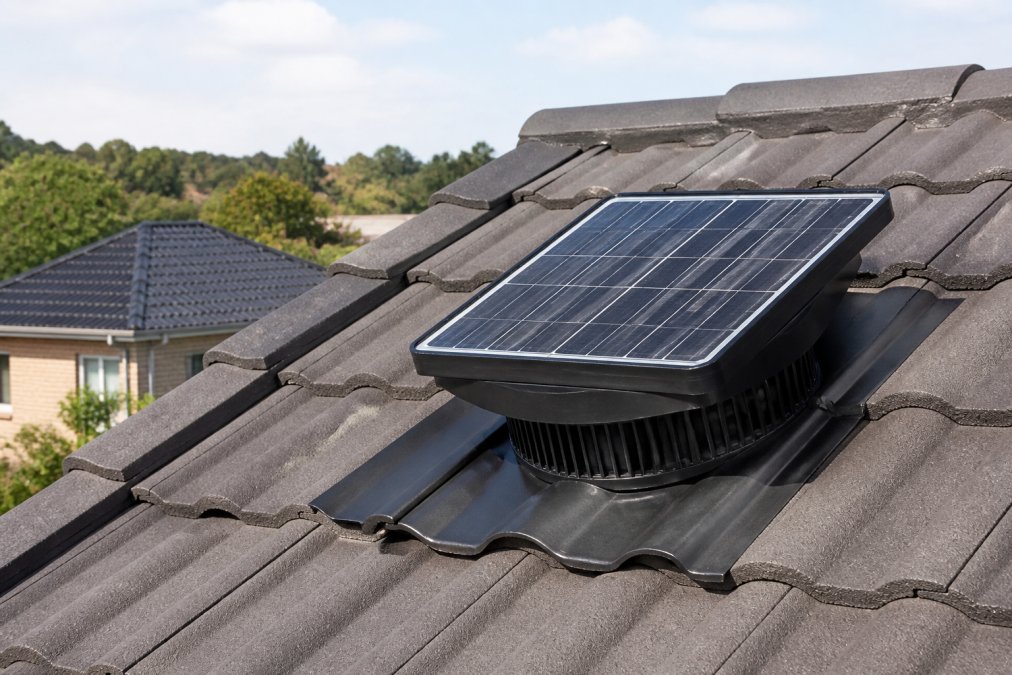
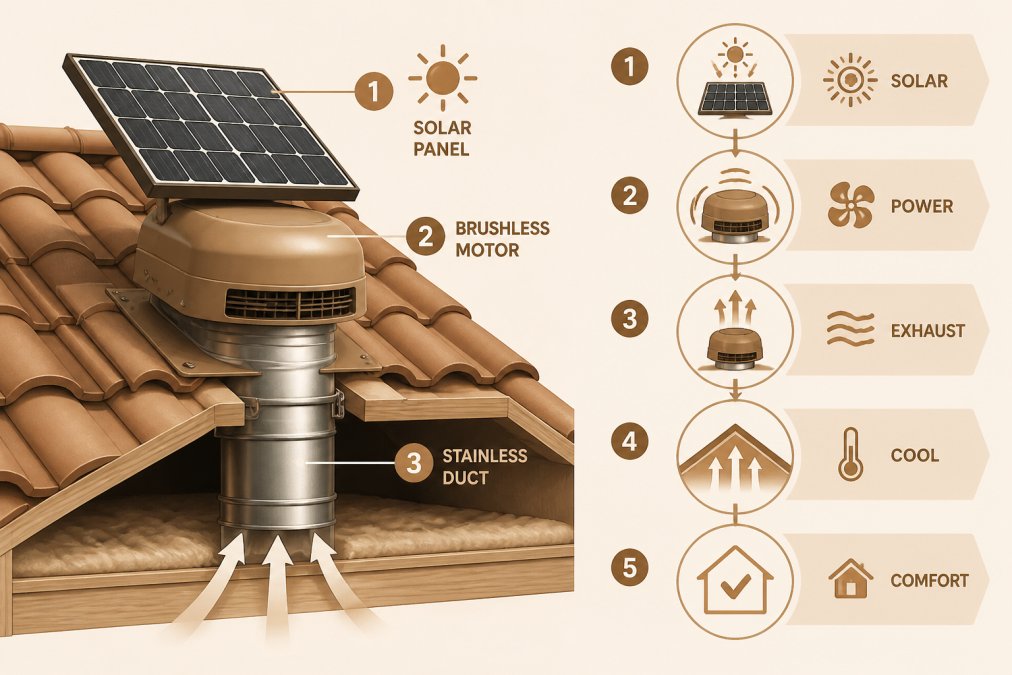
Solar roof ventilation systems extract hot air from your roof cavity using energy from the sun rather than grid electricity. The system consists of a solar panel mounted on the roof that powers a brushless motor, which drives an exhaust fan. As sunlight hits the solar panel, it generates electricity that activates the motor, spinning an impeller inside the ductwork to create suction that draws air from the roof cavity. Replacement air enters through existing eave vents, establishing continuous airflow through the roof space.
The system works hardest during the hottest part of the day, exactly when you need it most, because solar output peaks alongside ambient temperature. A well-sized system can move 400-600 cubic feet per minute (CFM) of air, significantly more than traditional wind-powered alternatives.
Active vs Passive Ventilation Systems
Active ventilation systems use powered fans to extract air, while passive systems rely on natural convection and wind pressure. Solar-powered fans fall into the active category because they provide motorised extraction. The key advantage is consistency, active systems deliver predictable CFM rates regardless of external conditions.
Passive systems like traditional whirlybirds depend on wind and temperature differences to create airflow. On calm, cool days, passive ventilation becomes nearly ineffective. Many modern solar units include thermostatic controls that activate the fan only when roof cavity temperature exceeds 30-35°C, preventing unnecessary operation while maintaining optimal roof space conditions.
Benefits of Roof Ventilation for Australian Homes
Proper roof ventilation reduces roof cavity temperatures, which decreases the heat load on your home’s ceiling and upper floors. It also prevents moisture buildup that leads to mold, rot, and structural deterioration, particularly important in humid climates like the Sunshine Coast.
Australian homes face unique ventilation challenges. Metal roofing conducts heat aggressively, while tiled roofs often have poor eave ventilation due to modern construction practices. Both scenarios create sealed roof cavities where heat accumulates and moisture becomes trapped, accelerating degradation of timber framing and insulation.
Energy Efficiency and Cost Savings
Reducing roof cavity temperature directly decreases the thermal load entering your home. When your roof space sits at 50°C instead of 65°C, less radiant heat penetrates the ceiling into living areas, translating to lower air-conditioning runtime and reduced electricity consumption during peak cooling months.
Energy savings vary by climate, roof colour, insulation depth, and air-conditioning usage. Homes in hot climates with dark roofing and minimal insulation can see significant reductions in cooling costs during summer. More conservatively, many Australian homeowners report reductions in total energy consumption when solar roof ventilation is combined with other efficiency measures. If your annual cooling costs are $2,000 and ventilation reduces that by 10%, you’re saving $200 annually, $4,000 over a 20-year system lifespan before accounting for rising electricity rates.
Moisture Control and Structural Protection
Roof cavities trap moisture from humidity rising from living spaces, humid weather, and condensation on metal roofing during temperature swings. Without adequate exhaust, moisture accumulates, creating conditions for mold growth and timber rot.
Timber framing in Australian homes is particularly vulnerable. Structural beams, rafters, and roof trusses deteriorate rapidly once moisture exceeds 20% of wood weight. Mold spores damage insulation performance and create health risks. Solar roof ventilation prevents these problems by continuously exchanging moist roof air with drier ambient air. The cost of repairing rot in roof framing can exceed $10,000-$20,000, making prevention through proper ventilation far more economical.
Solar Roof Vent vs Whirlybird: Which Performs Better
Both solar roof ventilation and traditional whirlybirds extract hot air from roof cavities, but they achieve it through fundamentally different mechanisms.
Airflow Capacity and Thermal Regulation
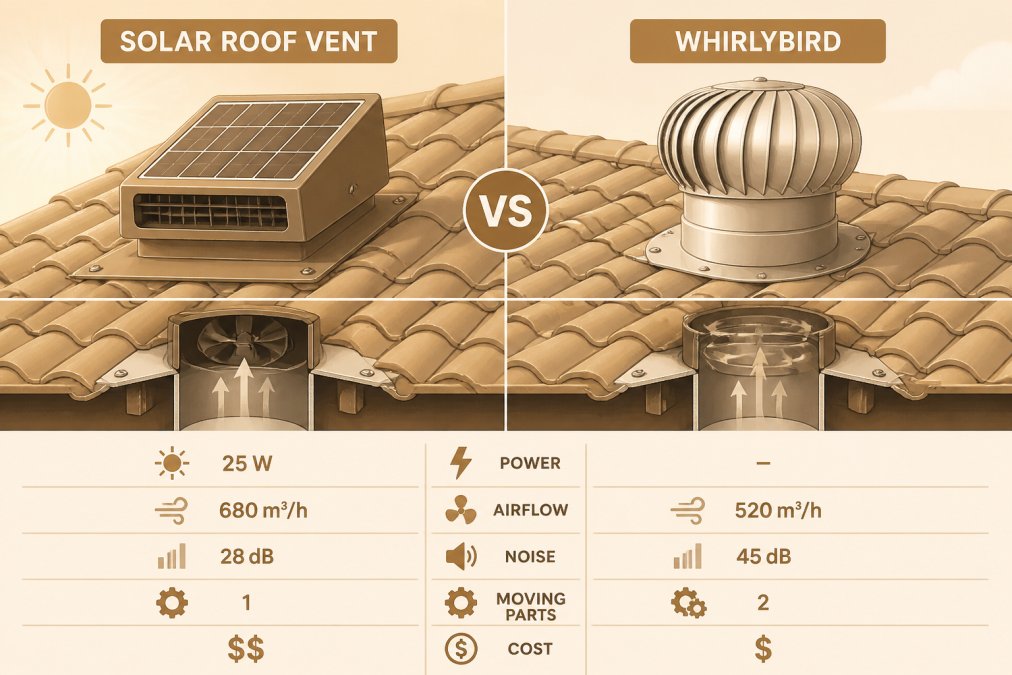
A typical solar roof ventilation system delivers 400-600 CFM, depending on motor size and ductwork design. Traditional whirlybirds deliver 150-300 CFM under ideal wind conditions, but performance drops to near zero on calm days since wind is the primary driver of rotation.
A 500 CFM solar system exchanges the entire air volume in a large roof cavity every 3-4 minutes, while a 200 CFM whirlybird might take 10-15 minutes under good conditions. Solar systems can maintain roof cavity temperatures within a narrower, cooler range throughout the day. For homes in areas prone to still, hot days, common across inland Australia, solar ventilation can provide superior thermal control.
Noise Levels and Operating Costs
Solar roof ventilation systems operate quietly at 30-40 decibels, roughly equivalent to a whisper. Whirlybirds can reach 45-50 decibels during windy conditions, and some residents report whistling noise.
Operating costs favour solar systems decisively. Once installed, solar ventilation has zero electricity costs. Whirlybirds have no operating costs either, but they also have no operating performance on calm days. Solar systems have brushless motors with no lubrication requirements and typically last 20+ years, compared to 10-15 years for whirlybirds. The solar panel itself is designed for 25-30 year lifespan.
Installation Process and Requirements for Solar Roof Ventilation
Installing a solar roof ventilation system involves structural assessment, roof penetration, ductwork routing, electrical connection, and testing. The process typically takes 1-2 days for a standard residential installation.
Roof Type Compatibility and Structural Assessment
The system requires a south-facing roof section (in the Southern Hemisphere) with adequate sunlight exposure. Shading from trees, neighbouring buildings, or other obstructions significantly reduces solar panel output and system performance.
Tile roofs are ideal for installation, with the system mounting between tiles or replacing a tile entirely. Metal roofing is also suitable, though installation requires careful waterproofing. Slate roofs and heritage-listed properties may present challenges.
Structural assessment evaluates roof pitch, rafter spacing, and cavity accessibility. Steep roofs (45°+ pitch) are easier to work on and provide better solar panel angle. The installation team checks that ductwork can route from the roof cavity to exterior without obstruction. Existing eave vents must be cleared or installed before the solar system can function effectively.
Professional Installation and Warranty
Professional installation is strongly recommended due to working at height, roof penetrations, and waterproofing requirements. Reputable installers provide warranties covering both equipment and installation workmanship. Equipment warranties typically span 5-10 years for the motor and 10-15 years for the solar panel. Installation warranties usually cover 2-5 years against defects in workmanship.
Solar Roof Vent Installation Cost and ROI Analysis
Understanding the financial investment and payback timeline helps you make an informed decision about whether solar roof ventilation suits your situation.
Calculated Payback Period and Long-Term Savings
The payback period depends on your current energy costs, climate, and cooling usage. For a Melbourne home with $1,500 annual cooling costs, a 10% reduction saves $150 annually. At this rate, payback can occur over 10-15 years. However, electricity rates in Australia have risen. If rates continue to rise, your savings in year 5 might be higher, and by year 10, even more. Over 20 years, cumulative savings can exceed the initial investment.
Beyond financial ROI, consider non-financial benefits: improved summer comfort, reduced moisture damage risk, and the satisfaction of using renewable energy.
Climate-Specific Suitability for Melbourne and Sunshine Coast
Melbourne’s cool winters, moderate summers, and high humidity make solar roof ventilation particularly valuable for moisture control. Summer temperatures rarely exceed 30°C, so cooling savings are modest, but humidity creates significant mold risk. Melbourne homeowners can benefit more from structural protection than energy savings alone.
The Sunshine Coast’s warm, humid subtropical climate with summer temperatures regularly exceeding 35°C makes air-conditioning usage higher and cooling costs substantial. Solar roof ventilation can deliver meaningful energy savings here. The payback period can be shorter on the Sunshine Coast, compared to Melbourne.
| Region | Average Summer Temps | Primary Benefit | Estimated Annual Savings | Payback Period |
|---|---|---|---|---|
| Melbourne | 25-28°C | Moisture control, mold prevention | Varies | Varies |
| Sunshine Coast | 30-35°C | Energy savings, cooling reduction | Varies | Varies |
Smart Home Integration and Modern Features
Contemporary solar roof ventilation systems increasingly incorporate smart controls that optimise performance and provide homeowner visibility into system operation. Thermostat-controlled systems activate the fan only when roof cavity temperature exceeds a set point, typically 30-35°C, preventing unnecessary operation during cool months and extending motor lifespan.
Some systems integrate with broader smart home platforms, allowing remote monitoring through smartphone apps. You can check real-time roof cavity temperature, view historical data, and receive alerts if performance drops. Smart integration also enables scheduling, allowing you to program operation during specific hours or peak electricity rate periods.
Is Solar Roof Ventilation Worth the Investment
Solar roof ventilation is worth the investment if you live in a warm climate where cooling costs are significant, experience humidity issues or mold in roof spaces, have good roof sun exposure without major shading, plan to remain in your home for 10+ years, and are comfortable with a typical payback period for such systems.
The investment makes sense as part of a broader energy efficiency strategy. Combined with ceiling insulation upgrades, window treatments, and air-conditioning servicing, solar ventilation amplifies overall comfort and cost savings.
At Solazone Australia, we help homeowners evaluate their specific situation. Our team assesses roof suitability, calculates realistic savings based on your energy usage patterns, and discusses warranty and support options. With over 40 years of technical expertise and thousands of satisfied customers across Australia, we’ve guided homeowners through this decision across diverse climates and home types.
Solar roof ventilation for homes is a proven efficiency upgrade that addresses both energy costs and structural protection. Whether you’re managing summer heat on the Sunshine Coast or preventing moisture damage in humid Melbourne, a properly sized and installed system delivers measurable benefits over its 20-25 year lifespan. Contact Solazone Australia to discuss your roof’s suitability, receive a performance estimate tailored to your climate and usage, and explore our range of Australian-made solar ventilation solutions.
Frequently Asked Questions
Does solar roof ventilation actually work in Australian climates?
Yes. Solar roof ventilation systems extract heat from roof cavities using active airflow powered by solar panels or thermostat controls. In Australian climates, particularly Melbourne and the Sunshine Coast, they reduce roof cavity temperatures by 10-15°C on average, directly lowering home cooling energy consumption. They also prevent moisture buildup and condensation, which is critical in humid coastal regions. Performance depends on roof pitch, cavity size, and ductwork design.
What is the typical payback period for solar roof vent installation?
Payback periods vary by home size, climate zone, and current energy usage. Homes in hot climates with high cooling demands typically see payback within 5-8 years through reduced air conditioning costs. Melbourne properties may see longer payback periods (8-12 years) due to milder summers. Actual returns depend on your specific energy consumption, roof cavity temperature, and local electricity rates. Request a personalised ROI analysis based on your property's measurements and usage patterns.
How does a solar roof vent compare to a traditional whirlybird?
Solar roof vents use active ventilation powered by solar panels or thermostats, delivering consistent airflow regardless of wind conditions. Whirlybirds rely on wind and stack effect (passive ventilation), so performance drops on calm days. Solar vents typically move 300-600 CFM (cubic feet per minute), while whirlybirds manage 150-300 CFM in moderate wind. Solar systems are quieter, more reliable in variable weather, and offer thermostat control. Whirlybirds cost less upfront but provide inconsistent thermal regulation.
Are solar roof vents suitable for older homes with complex roof layouts?
Solar roof ventilation can work on most roof types, but older homes with complex layouts, low pitch angles, or structural quirks may require custom ductwork and reinforcement. Professional assessment is essential to evaluate roof cavity space, structural integrity, and optimal vent placement. Some older homes may need additional eave vents or ceiling vents to support adequate air circulation. Solazone Australia's installation teams assess each property individually to determine suitability and recommend tailored solutions rather than standard packages.
This article was written using GrandRanker