
Table of Contents
- What Determines Solar Battery Storage Cost
- Best Solar Batteries for Home Use
- Solar Battery Rebates and Incentives
- Solar Battery Payback Period Calculation
- Is Solar Battery Storage Worth the Investment?
- Conclusion
What Determines Solar Battery Storage Cost
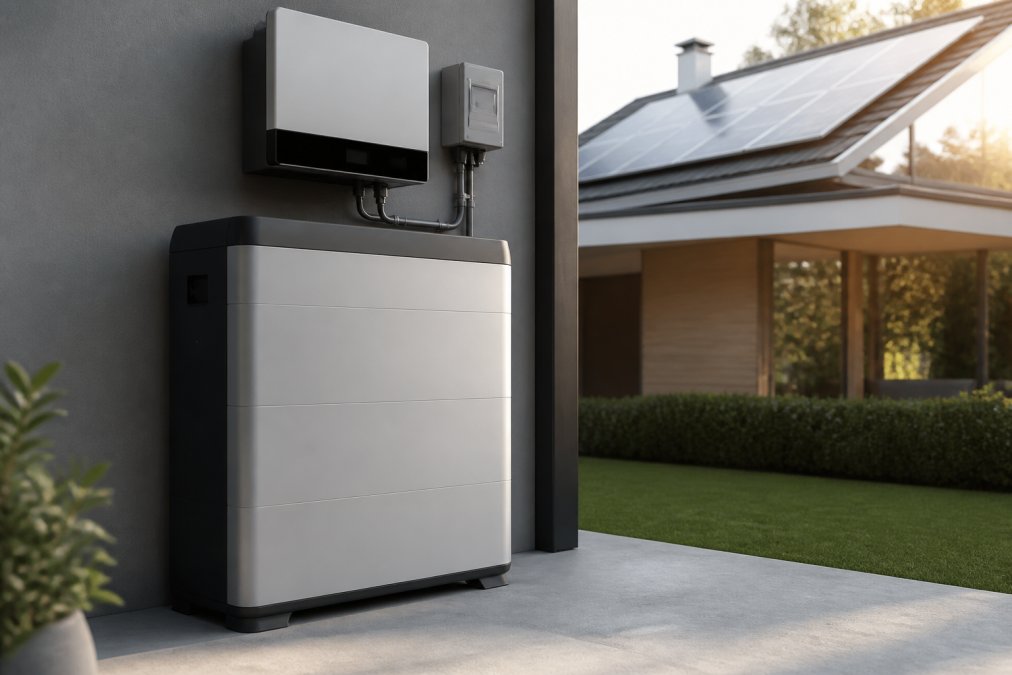
The price you’ll pay for solar battery storage depends on system capacity, chemistry, installation approach, and integration method. Unlike commoditised solar panels, battery systems remain highly variable in cost. Understanding these drivers helps you avoid overpaying for features you don’t need or undershooting on capacity.
System capacity and usable energy
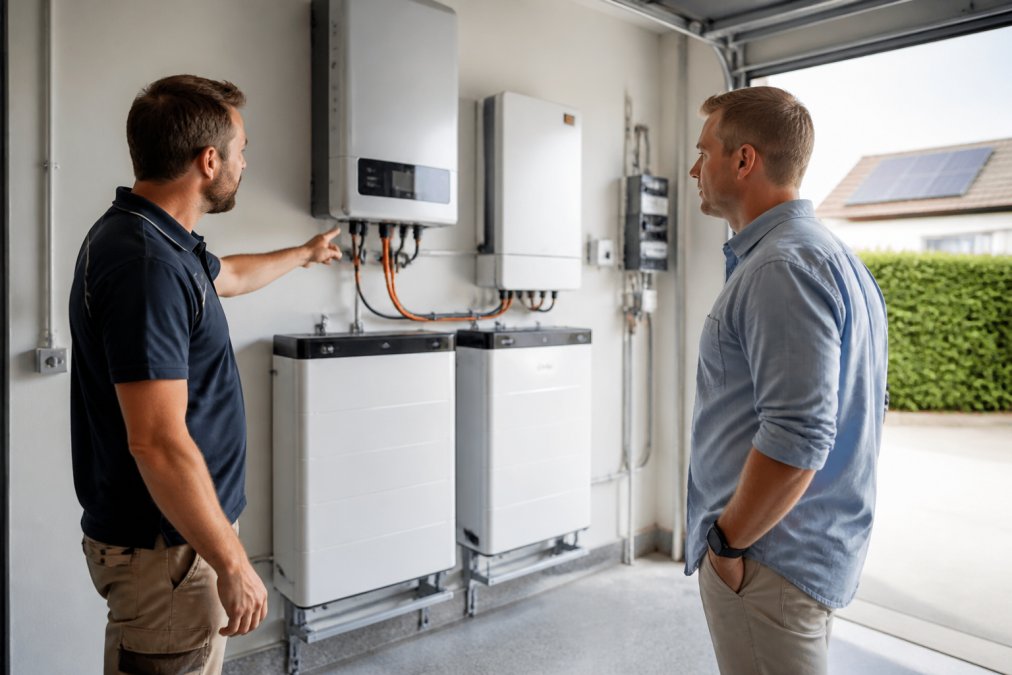
The single biggest cost driver is how much energy your battery can store and deliver, measured in kilowatt-hours (kWh). However, usable capacity, the practical amount available to your home, often differs significantly from the total capacity listed on spec sheets. A battery rated at 13 kWh total capacity might only offer 10 kWh usable energy if the manufacturer limits depth of discharge to protect longevity. Always check usable capacity; it determines whether the battery meets your needs.
Cost per kWh of usable capacity varies widely across battery types and brands. Smaller systems (under 10 kWh) tend to cost more per unit than larger systems because installation labour gets spread across less capacity.
Check whether the system lists total capacity or usable capacity. If the spec sheet doesn’t clearly state usable capacity, ask the installer directly. This single figure often explains 15-20% price variation between seemingly identical systems.
Battery chemistry and chemistry differences
Not all battery chemistries cost the same or behave identically under Australian conditions. The two dominant types in residential systems are lithium iron phosphate (LFP) and lithium nickel manganese cobalt (Li-NMC).
Lithium iron phosphate (LFP) is the safer, more durable option. It tolerates deeper discharge cycles, handles temperature extremes better, and lasts longer, often rated for 6,000+ cycles versus 3,000-4,000 for older chemistries. LFP batteries cost slightly more upfront but deliver better value over their lifespan. Brands like Sungrow SBR Series and Alpha-ESS SMILE5 use LFP chemistry.
Lithium nickel manganese cobalt (Li-NMC) chemistry, used in systems like the LG Chem RESU, offers higher energy density in a compact form, attractive for retrofits where space is tight. However, it typically has shorter cycle life and performs less reliably in high-temperature environments, a real consideration in Queensland and northern New South Wales.
The chemistry you choose affects not just upfront cost but also how many years you’ll benefit from the system.
Installation labour and complexity
Installation costs diverge dramatically between homes. A straightforward retrofit on a modern home might cost A$2,000-A$4,000 in labour, while a complex installation retrofitting an older home can easily double or triple labour costs.
Several factors compound installation complexity: roof structure and access (pitched roofs are cheaper than flat roofs requiring scaffolding), existing electrical infrastructure (older switchboards may require upgrades costing A$1,000-A$3,000), grid connection type (on-grid systems are cheaper than off-grid), and integration with existing solar (incompatible inverters require replacement, adding A$2,000-A$4,000).
Solazone Australia emphasises understanding your specific site conditions before quoting, since a generic "average installation cost" is nearly useless, your actual cost depends entirely on what your home requires.
Best Solar Batteries for Home Use
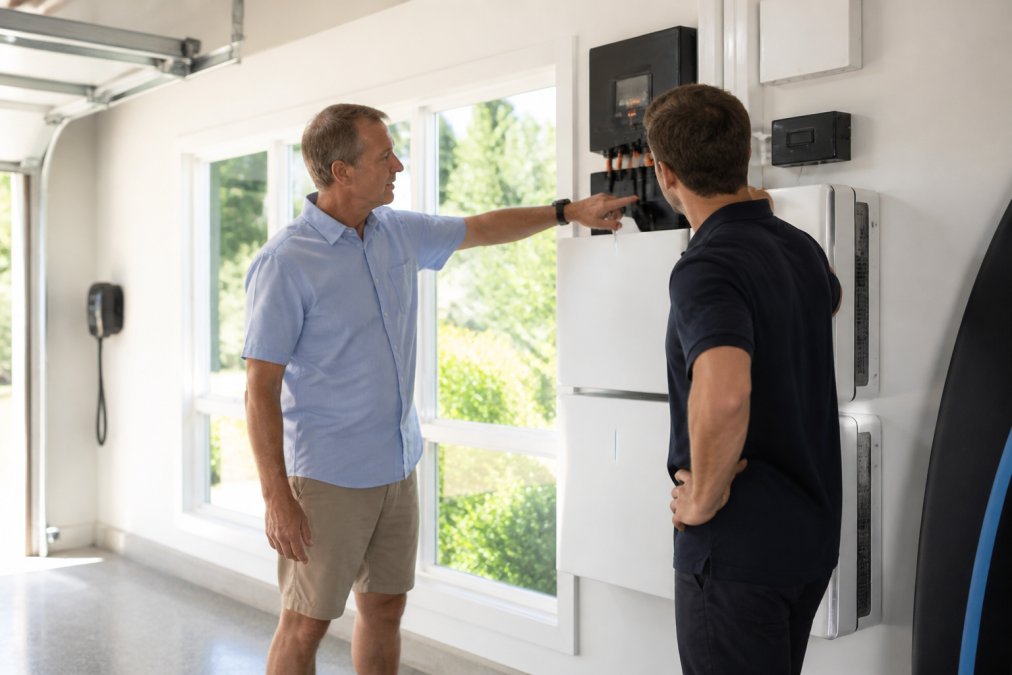
The best battery for your home depends on whether you prioritise integrated simplicity, modularity for future expansion, or Australian-made reliability.
All-in-one integrated systems
An all-in-one system combines the battery, inverter, and energy management controls into a single unit, simplifying installation and often reducing cost compared to buying separate pieces.
Alpha-ESS SMILE5 is one of the most installed home battery brands in Australia. It integrates a 5 kW hybrid inverter with modular LFP battery storage (commonly configured at 13.3 kWh usable capacity). The modular design lets you expand capacity later if your energy use grows.
Tesla Powerwall 3 bundles inverter, battery, and smart controls with 13.5 kWh capacity. The integrated design is elegant, and the Tesla app provides sophisticated energy management.
Varta Pulse Neo is a compact AC-coupled all-in-one system designed for easy retrofitting into existing solar setups. However, the Varta Pulse Neo has been discontinued and is being replaced by the VARTA.hybrid.wall, so stock is limited.
Homes installing solar and battery together, or those wanting the simplest possible setup with minimal component integration.
Modular and expandable options
Modular systems separate the battery from the inverter, giving you flexibility to expand capacity later and choose inverter brands independently.
Sungrow SBR Series uses modular LFP batteries scaling from 6.4 kWh to 25.6 kWh in 6.4 kWh increments.
LG Chem RESU offers proven reliability with compact, lightweight modules available in 6.5 kWh, 9.8 kWh, and 13.1 kWh capacities.
BYD Battery-Box Premium HVM is a high-voltage modular LFP system designed for residential and commercial applications. The modular design means precise sizing and easy future expansion.
Modular systems suit homes that want to start smaller and expand later, or those replacing an existing inverter anyway.
Australian-made alternatives
RedEarth DropBear is engineered and assembled in Brisbane, specifically built for harsh Australian conditions. It’s an all-in-one system combining inverters, batteries, and smart controls, supporting up to 36 kW of solar panels. The DropBear excels for homes needing high energy output or off-grid capability, particularly in rural areas where reliability and local support matter.
Choosing an Australian-made system like DropBear means you’re supporting local manufacturing and getting equipment designed for local conditions, often translating to better long-term reliability and faster service support.
All-in-one systems are simpler to install but less flexible. Modular systems cost more upfront but let you expand later. Australian-made options prioritise durability in local climate conditions.
Solar Battery Rebates and Incentives
Government support for solar battery storage varies by state, and rebate programs change frequently. Queensland, Victoria, and New South Wales have historically offered programs, though eligibility criteria are strict, usually requiring that your home meets energy efficiency standards or that you’re installing solar and battery together.
The most reliable way to find current rebates is to check your state’s official energy or environment department website, or ask your installer. Solazone Australia can advise on rebates available in your area and help you understand eligibility before you commit.
Virtual Power Plants are increasingly common. A VPP aggregates multiple home batteries and allows the network operator to draw power during peak demand periods. In return, you receive a payment (typically A$200-A$400 annually, though this varies). For homes in areas with VPP schemes, this can offset battery costs meaningfully over time.
Rebate programs have strict eligibility requirements and change regularly. Don’t assume you qualify until you’ve checked your specific state’s current rules. Some rebates require the installation to be completed by an accredited installer.
Solar Battery Payback Period Calculation
Working out your real savings
Payback period is the number of years it takes for your battery’s energy savings to equal its upfront cost. The basic formula is: Payback Period = System Cost ÷ Annual Savings. But "annual savings" requires honest assumptions about your actual energy use and electricity rate increases.
Your actual savings depend on your current electricity consumption, self-consumption rate (the percentage of your solar generation you use on-site), the gap between your feed-in tariff and consumption rate, and expected electricity rate increases.
A realistic worked example: A household with 15 kWh daily consumption, a 10 kWh usable battery, 70% self-consumption rate, and a 15 cents per kWh feed-in tariff versus 32 cents consumption rate generates daily savings of 10 kWh × (0.32 − 0.15) = A$1.70, or approximately A$620 annually. If the installed system costs A$15,000, payback period = 24 years. But if electricity rates rise to 45 cents per kWh, annual savings reach approximately A$1,825, pushing payback to 8 years. The point: payback depends entirely on your specific consumption pattern, tariff structure, and rate assumptions.
Accounting for degradation and cycle life
Battery capacity degrades over time. A battery rated at 100% capacity when new might deliver 95% capacity after 5 years and 85% after 10 years. This degradation is predictable and slow with modern LFP chemistries, but it’s real.
Cycle life is how many charge-discharge cycles a battery can complete before capacity drops below a usable threshold (usually 80% of original capacity). Most modern residential batteries are rated for 5,000-6,000 cycles. If you cycle your battery once daily, that’s roughly 15-16 years of service before capacity degrades noticeably. However, if you cycle your battery twice daily, you’ll reach end-of-life in 7-8 years.
When calculating payback, factor in annual capacity degradation (typically 1-2% per year for LFP) and expected cycle frequency. A more realistic payback calculation accounts for degradation by reducing expected annual savings in years 8-10 as capacity declines, typically extending payback by 2-3 years.
Is Solar Battery Storage Worth the Investment?
When battery storage makes financial sense
Battery storage isn’t universally worthwhile; it depends on your specific circumstances.
Battery storage makes sense when: your electricity consumption rate is significantly higher than your feed-in tariff (25+ cents difference), you have high daytime energy consumption (working from home, running air conditioning, EV charging), you live in an area with frequent or long grid outages, you have access to rebates or incentive schemes, you’re installing solar and battery together, or your roof has excellent solar exposure and you can generate substantial daily surplus.
Battery storage doesn’t make financial sense when: your feed-in tariff is competitive (12+ cents per kWh) and consumption rate is low (under 25 cents per kWh), your home is empty during peak solar hours, you have limited roof space, your electricity usage is already low (under 10 kWh daily), or you’re retrofitting into an older home with complex installation requirements.
For many Australian homes, battery payback extends beyond 10 years, meaning the battery degrades before it pays for itself. This doesn’t mean it’s a bad investment, backup power and energy independence have non-financial value, but you shouldn’t expect pure financial returns.
Do the maths for your specific situation before committing. Generic payback claims ignore your actual tariffs, consumption patterns, and [installation complexity](/solar-installation-timeline-and-process-a-complete-australian-guide/). Work with an installer like Solazone Australia who can model your specific scenario.
Off-grid and backup power considerations
Off-grid systems require larger battery banks (typically 20-40 kWh usable capacity) because they must store enough energy to carry you through multiple cloudy days. Off-grid makes sense only if grid connection is unavailable or prohibitively expensive, or if energy independence is a genuine priority.
Backup power is different from off-grid operation. A grid-connected system with battery storage provides backup during blackouts, typically 4-8 hours of essential loads. This has real value in areas with unreliable supply, particularly during extreme weather events.
Conclusion
Solar battery storage cost depends on system capacity, chemistry, installation complexity, and your specific home requirements. There’s no single "right" price; you’re paying for the specific combination of features, reliability, and integration that your situation demands.
The best approach is to get quotes from multiple installers, understand what you’re actually paying for (usable capacity, chemistry type, warranty terms, installation complexity), and model payback based on your real tariffs and consumption patterns rather than industry averages.
Solazone Australia brings over 40 years of technical expertise to help you navigate these decisions. With their commitment to Australian-made systems, personalised customer service, and experienced installation teams, they can assess your specific site conditions, explain what drives costs in your situation, and help you choose a system that actually delivers value for your home. Get a personalised solar battery quote from Solazone Australia to understand your real costs and savings potential.
Frequently Asked Questions
How much does a solar battery storage system cost to install?
Installation costs for solar battery storage depend on system capacity, battery chemistry, inverter type, and your home's electrical setup. Pricing varies significantly based on whether you're retrofitting an existing solar system or installing a new integrated setup. For accurate pricing tailored to your situation, contact Solazone Australia for a detailed quote that accounts for your specific requirements and installation complexity.
What government rebates and incentives are available for solar batteries?
Several schemes support solar battery storage costs. Check the Small-scale Technology Certificates (STCs) scheme, which may apply to eligible systems. State-based incentives vary, some states offer rebates or grants for battery installation. The Capacity Investment Scheme and Virtual Power Plant (VPP) programs in certain regions can reduce out-of-pocket expenses. Eligibility depends on your location, system size, and battery chemistry. Verify current schemes with your local authority or installer.
What is the typical payback period for a solar battery storage system?
Payback periods typically range from 7 to 15 years, depending on your energy consumption, feed-in tariff rates, electricity costs, and system size. Households with high daytime solar production and high evening peak demand see faster returns. Real-world degradation (typically 0.5-1% annually) and round-trip efficiency losses affect long-term savings. Calculate your specific payback by comparing annual energy arbitrage gains and self-consumption benefits against your total installed cost, accounting for warranty coverage and maintenance.
Is adding solar battery storage worth it if I already have solar panels?
Battery storage is worth considering if you have high evening electricity consumption, experience frequent power cuts, want energy independence, or live in an area with attractive feed-in tariffs and VPP incentives. If your current feed-in tariff is generous and you consume most solar energy during the day, batteries may take longer to pay back. Off-grid or backup power needs often justify the investment regardless of payback period. Request a personalised analysis from Solazone Australia to assess whether storage suits your situation.
This article was written using GrandRanker