
Table of Contents
- Why Commercial Solar Installation Matters for Melbourne Businesses
- How Commercial Solar Installation Works
- Commercial Solar Panel Costs in Melbourne
- Victorian Energy Upgrades Program and Government Rebates
- Commercial Solar Maintenance Melbourne: Keeping Systems Running
- Regulatory Compliance and Grid Connection Permits
- Battery Storage and Energy Independence
- Conclusion
Last Updated: August 9, 2026
Why Commercial Solar Installation Matters for Melbourne Businesses
Commercial solar installation Melbourne has become essential for businesses reducing operational costs and meeting sustainability targets. Rising electricity prices across Victoria push organisations toward renewable energy solutions, making solar increasingly strategic rather than optional.
Businesses switching to solar typically see substantial power bill reductions within the first year. Beyond immediate savings, commercial solar installations create long-term value through energy independence, protection against future rate increases, and improved corporate environmental credentials.
At Solazone Australia, we’ve worked with thousands of Melbourne businesses to design and install systems tailored to their energy consumption patterns. Our 40+ years of technical expertise means we understand the unique challenges commercial properties face, from complex roof structures to demanding energy loads requiring precise system design.
Many organisations now view renewable energy as a competitive advantage. Customers and investors increasingly expect businesses to demonstrate environmental responsibility, and a visible solar installation signals genuine commitment to sustainability. For facility managers and business owners in Melbourne and the Sunshine Coast, commercial solar installation represents both operational efficiency and strategic positioning.
How Commercial Solar Installation Works
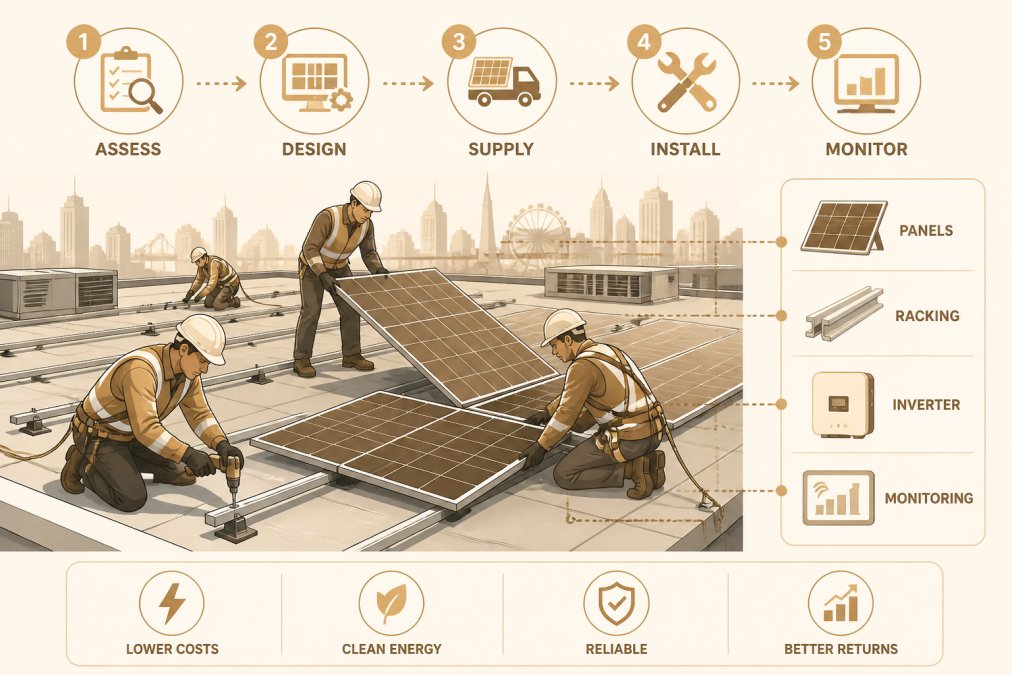
Commercial solar installation Melbourne involves several interconnected stages, each critical to system performance and longevity. Understanding the process helps you anticipate timelines and communicate effectively with your installation team.
System Design and Site Assessment
The foundation of any successful commercial solar installation Melbourne begins with a thorough site assessment and system design phase. Your installation team will evaluate your roof structure, orientation, shading patterns, electrical infrastructure, and current energy consumption to determine the optimal system configuration.
Technicians examine roof integrity and load-bearing capacity, sun exposure throughout the day, shading from trees or adjacent buildings, and your electrical infrastructure to ensure it can accommodate the new system safely. The design phase produces detailed specifications calculating the ideal number of panels, inverter capacity, and battery storage requirements based on your actual energy consumption patterns.
Rushed assessments lead to undersized systems that never deliver projected savings or oversized systems that waste capital. Solazone Australia invests significant time in this stage because it determines whether your installation will perform as expected for the next 25+ years.
Installation and Connection to the Grid
Once design approval is complete, physical installation typically takes 2-5 days depending on system size and roof complexity. Installation teams mount photovoltaic panels, install the inverter (which converts DC power to usable AC power), and run electrical connections throughout the building.
The inverter is the system’s intelligence hub, managing power flow, monitoring performance, and ensuring safe and efficient operation. Modern inverters include advanced monitoring capabilities that track energy generation in real time.
After physical installation, your system connects to the electricity grid through a formal process managed by your local distribution network operator. In Victoria, this requires compliance with the National Electricity Rules and Australian Standards. Your installer coordinates with the network operator to ensure your commercial solar installation Melbourne meets all technical requirements before grid connection is approved.
Commercial Solar Panel Costs in Melbourne
The investment required for commercial solar installation Melbourne varies significantly based on system size, panel quality, and additional components like battery storage. Understanding the factors that drive costs helps you evaluate value.
System size is the primary cost driver. A small commercial installation (5-10 kW) serves businesses with modest energy consumption, while larger systems (50+ kW) suit manufacturing facilities or data centres. Larger systems benefit from economies of scale, with cost per kilowatt typically decreasing as system size increases.
Panel quality and efficiency affect both upfront cost and long-term returns. Higher-efficiency panels generate more power in the same space, reducing the number of panels required. Solazone Australia prioritises Australian-made systems where possible, supporting local manufacturing while ensuring panels withstand Australia’s harsh climate conditions.
Installation complexity influences final costs. A straightforward rooftop installation on a modern commercial building costs less than retrofitting an older structure with structural limitations. For accurate pricing on your specific commercial solar installation Melbourne, contact Solazone Australia for a personalised quote.
Financing Options: Power Purchase Agreements vs Outright Purchase
Two primary financing models exist for commercial solar installation Melbourne. An outright purchase means your business owns the system entirely, retaining all energy savings and qualifying for available government rebates. This approach maximises long-term financial returns and provides complete control over system maintenance.
A Power Purchase Agreement (PPA) is an alternative where a third party owns and maintains the system. Your business agrees to purchase the solar energy generated at a fixed rate, typically lower than your current grid electricity rate. PPAs require no upfront capital investment and transfer maintenance responsibility to the system owner.
The right choice depends on your financial position, risk tolerance, and long-term strategy. Outright purchase delivers higher returns but requires capital investment and ongoing maintenance oversight. PPAs provide immediate cost savings with minimal upfront expense but typically deliver lower total financial benefit over time.
Victorian Energy Upgrades Program and Government Rebates
Victoria’s approach to renewable energy support includes the Victorian Energy Upgrades program, which provides financial incentives for businesses implementing energy efficiency measures, including solar installations. The program operates through a tradeable credit system where eligible solar installations generate credits based on energy savings projected over the system’s lifetime. These credits can be sold to finance companies, reducing your upfront costs.
Beyond Victorian programs, the Australian Government’s Small-scale Renewable Energy Scheme provides additional support for certain commercial installations. Eligibility criteria and incentive levels change periodically, so current details should be verified with your installer or through official government sources.
Solazone Australia stays current with all available rebate programs and can advise which incentives apply to your specific commercial solar installation Melbourne.
Commercial Solar Maintenance Melbourne: Keeping Systems Running
Once your commercial solar installation Melbourne is operational, ongoing maintenance ensures consistent performance and longevity. Well-maintained systems continue generating full power for 25+ years, while neglected installations experience gradual performance decline.
Photovoltaic panels require periodic cleaning to remove dust, pollen, and debris that reduce light penetration. In Melbourne’s climate, rainfall typically provides natural cleaning, but dry periods may require manual washing. Most commercial systems benefit from cleaning 1-2 times annually. Electrical components require less frequent attention but regular inspection, with inverters, wiring, and safety equipment checked annually by a qualified technician.
Monitoring and Performance Tracking
Modern commercial solar installation Melbourne systems include real-time monitoring that tracks energy generation, system health, and performance metrics. Monitoring systems display how much power your installation generates each day, how much energy your business consumed, and how much excess power was exported to the grid.
A sudden drop in energy generation often indicates a technical issue requiring professional attention. Catching these problems early minimises lost energy production and prevents small issues from becoming major repairs. Solazone Australia’s monitoring support helps commercial customers track their system’s performance and alerts them to any anomalies requiring attention.
Regulatory Compliance and Grid Connection Permits
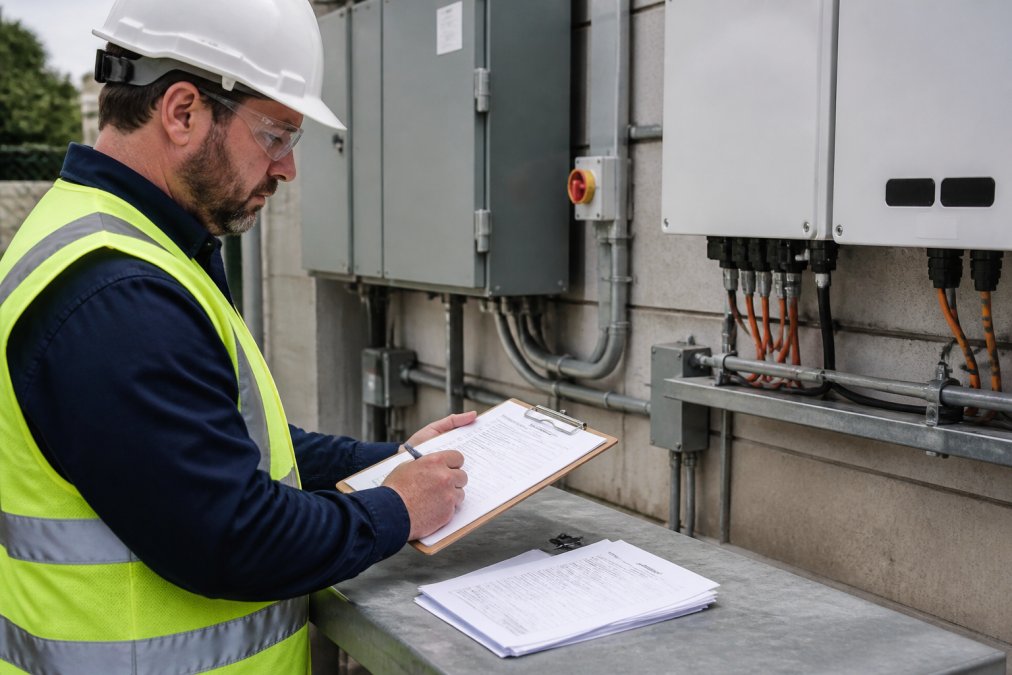
Commercial solar installation Melbourne must comply with multiple regulatory frameworks protecting electrical safety, grid stability, and worker safety. The key regulatory framework is the National Electricity Rules, which governs how solar installations connect to the electricity grid. Your system must meet technical standards ensuring it won’t destabilise the local network or create safety hazards.
Australian Standards AS/NZS 4777 specifies how grid-connected photovoltaic systems must be designed, installed, and tested. Electrical installation work must be performed by licensed electricians in Victoria, and your installation will be inspected to verify compliance.
Building permits are required in most cases, with your installer coordinating with your local council to obtain necessary approvals before work begins. Safety standards for work at height apply to rooftop installations, with installation teams following WorkSafe Victoria guidelines for fall protection and safe work practices.
Compliance ensures your commercial solar installation Melbourne meets all obligations and operates safely for decades.
Battery Storage and Energy Independence
Battery storage systems paired with commercial solar installation Melbourne create energy independence and protect against grid outages. Battery systems store excess solar energy generated during the day for use during evening hours or cloudy periods. Without storage, excess solar power is exported to the grid at the feed-in tariff rate, typically lower than the cost of grid electricity.
For businesses experiencing occasional power outages, battery backup provides continuity during grid failures, protecting operations and preventing costly downtime. Lithium-ion battery technology has become the standard for commercial installations, offering greater efficiency, compact size, and reliability compared to older alternatives.
The financial case for battery storage depends on your electricity usage pattern, feed-in tariff rates, and power reliability concerns. Businesses with high evening energy consumption benefit most from storage. Solazone Australia can model your specific situation to determine whether battery storage delivers financial returns or serves primarily as backup insurance.
Conclusion
Commercial solar installation Melbourne has matured from a niche investment into a standard business decision. Falling technology costs, reliable equipment, and strong financial incentives make solar increasingly attractive for organisations seeking to reduce energy expenses and improve sustainability credentials.
The process requires careful planning, from initial site assessment through system design, installation, regulatory compliance, and ongoing maintenance. Each stage matters, as rushing through assessment or skimping on design creates systems that underperform.
Solazone Australia brings 40+ years of technical expertise to every commercial solar installation Melbourne we undertake. Our commitment to personalised customer service, Australian-made systems, and experienced installation teams ensures your system performs reliably for decades. Get started with Solazone Australia and transform your energy costs while building genuine sustainability into your operations.
Frequently Asked Questions
What government rebates are available for commercial solar installation in Melbourne?
Victoria's Victorian Energy Upgrades program provides rebates and financial support for businesses installing commercial solar systems. Eligibility depends on your business size, energy consumption, and property location. The scheme helps offset upfront costs and improves return on investment. Contact your local government or a registered provider to confirm your business qualifies and understand the specific rebate amount available for your commercial solar installation in Melbourne.
How long does commercial solar installation take in Melbourne?
Timeline varies based on system size, roof complexity, and permit approvals. Initial site assessment and design typically takes 2-4 weeks. Permit applications and grid connection approvals can add 4-8 weeks depending on your local council and the electricity distributor. Actual installation usually takes 1-3 weeks. Full project completion from quote to grid connection often spans 3-4 months. Clear communication and experienced teams help keep projects on schedule.
Is commercial solar worth it for small businesses in Victoria?
Commercial solar delivers strong returns for most small businesses in Victoria. Energy savings depend on your current electricity consumption, roof space, and local feed-in tariff rates. Many businesses see payback periods of 5-8 years, with systems lasting 25+ years. The Victorian Energy Upgrades program and renewable energy certificates improve financial viability. To assess whether it suits your specific situation, obtain a detailed cost-benefit analysis that models your actual energy usage and local electricity rates.
Do I need a permit for commercial solar panels in Melbourne?
Yes, commercial solar installations require building permits from your local Melbourne council and electrical compliance approval. Grid-connected systems need connection approval from your electricity distributor. Roof structural assessments may be required to confirm the building can safely support the photovoltaic system. Your installation provider should handle permit applications, but you're responsible for ensuring all regulatory compliance is met before work begins. This protects your business and ensures the system meets Australian standards.
This article was written using GrandRanker